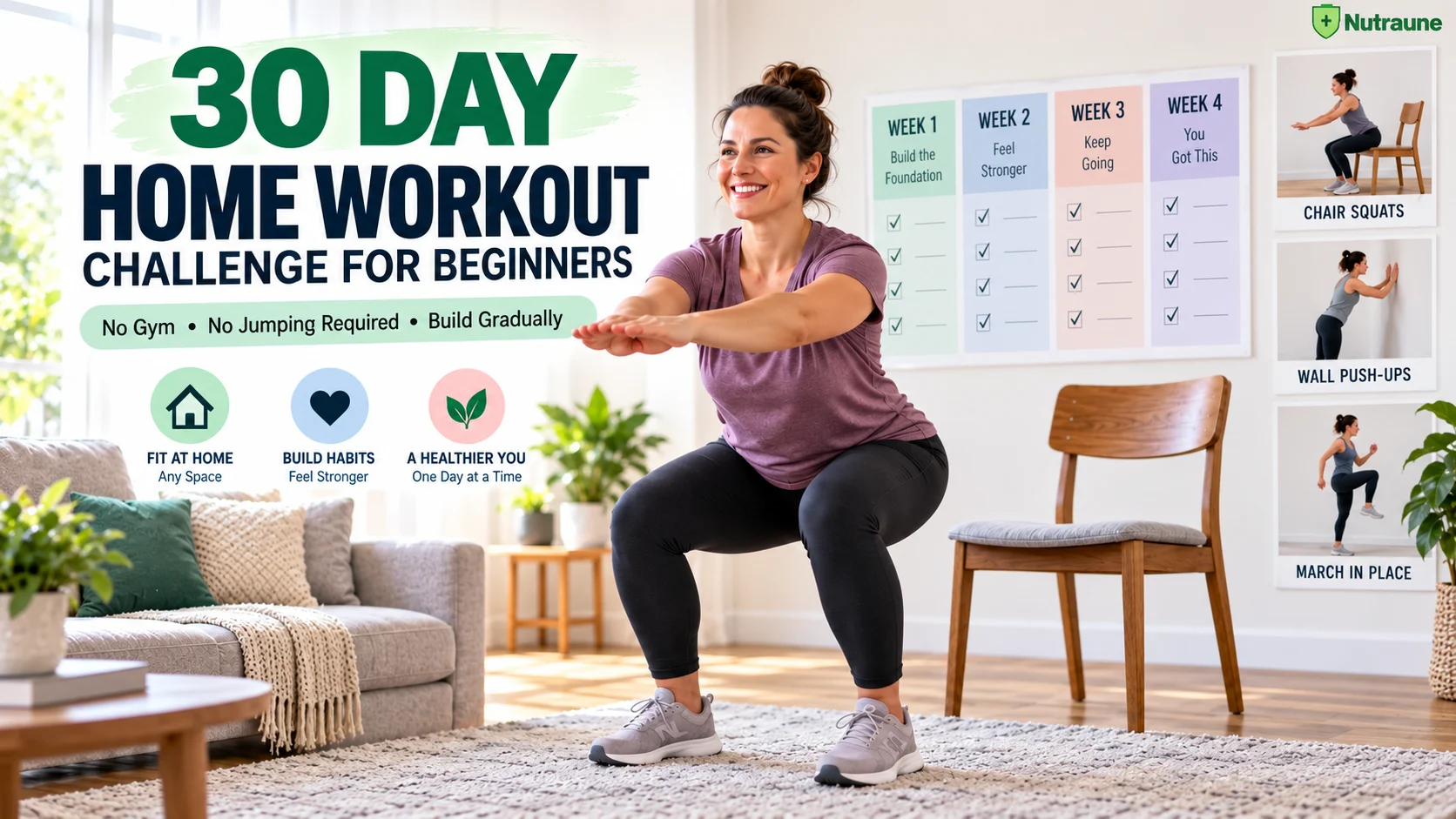

Starting exercise is often harder than exercise itself. You have to decide what movements to do, how long to train, how hard to work and whether the soreness you feel tomorrow means you should exercise again or rest.
This 30 day workout challenge for beginners removes most of those decisions. You will alternate short full-body strength sessions, walking or low-impact cardio, recovery days and real rest days. You don’t need a gym, you don’t need to jump, and most structured sessions take roughly 10–25 minutes.
More importantly, the plan doesn’t automatically become harder just because another day has passed. You progress when your current level feels controlled and manageable.
Thirty days won’t guarantee a dramatic body transformation or make exercise an automatic lifelong habit. It can give you something more useful: a month of structured practice and a clear starting point for what comes next.
Quick Answer: What Will You Do for 30 Days?
This challenge uses three types of activity:
- Strength: simple full-body bodyweight movements
- Cardio: walking, marching or other low-impact movement
- Recovery: easy movement, mobility or complete rest
You’ll begin with manageable sessions and gradually increase only one thing at a time—repetitions, rounds, duration or exercise difficulty.
The goal is not to finish every workout exhausted. The goal is to reach Day 30 feeling more capable of exercising consistently than you did on Day 1.

Before You Start
You need very little equipment.
A stable chair, a wall or sturdy counter, comfortable clothing and enough floor space to lie down are sufficient. A mat is optional.
If even a full month feels intimidating, you can first use Nutraure’s 7-day beginner no-equipment workout as a shorter practice week.
Who should get individualized guidance first?
This article provides general exercise education rather than individualized medical advice.
If you have an injury, recently had surgery, have been told to restrict physical activity, are pregnant or recently postpartum, or have a medical condition that could affect exercise, an appropriate healthcare or exercise professional can help you choose suitable movements.
Stop exercising and seek appropriate medical attention for warning signs such as chest pain or pressure, fainting or severe dizziness, or unusual and severe shortness of breath. These are not symptoms to “push through.”
How This 30-Day Beginner Challenge Works
The month has four phases.
Week 1: Learn. You practice the movements and discover what versions suit you.
Week 2: Build. You add a small amount of work if Week 1 felt manageable.
Week 3: Progress. You may add another round, a few repetitions, slightly longer cardio or one more challenging exercise variation.
Week 4: Consolidate. Instead of endlessly increasing difficulty, you practice doing the work with better control and confidence.
That last phase matters. Progress isn’t only doing more. Better technique, greater comfort, shorter recovery between normal daily activities and feeling less intimidated by exercise are also meaningful improvements.
The World Health Organization recommends that adults eventually work toward 150–300 minutes of moderate-intensity aerobic activity each week, or an equivalent amount of vigorous activity, plus muscle-strengthening activities on two or more days. It also emphasizes that some activity is better than none and that inactive adults can start with smaller amounts and increase gradually.
This beginner challenge is deliberately a ramp toward those long-term targets. A complete beginner may not reach the full aerobic recommendation during the first few weeks, and that is fine.
Read the WHO Guidelines on Physical Activity and Sedentary Behaviour
How hard should the workouts feel?
You do not need a smartwatch.
Use your breathing and the talk test.
During moderate-intensity activity, CDC guidance says you should generally be able to talk but not sing. On a 0–10 relative-effort scale, moderate activity is roughly 5–6.
For this plan:
| Effort | What it feels like | Use it for |
|---|---|---|
| Easy | Comfortable breathing; full conversation | Warm-up and recovery |
| Moderate | Breathing faster; can talk but not sing comfortably | Most cardio sessions |
| Hard | Talking becomes difficult | Usually unnecessary for this beginner challenge |
Your strength exercises may feel challenging near the end of a set, but your movement should remain controlled.
Use the CDC exercise-intensity and talk-test guide

Use the five-minute fallback on difficult days
Busy day? Low motivation? Poor schedule?
If you otherwise feel well, do five minutes of easy walking or marching, or perform one gentle round of your strength circuit.
This is not physiologically identical to the full workout. Its purpose is simply to keep the routine easier to resume.
If you’re actually sick or need recovery, rest instead.
And if you miss an entire day, do not perform two workouts the next day. Resume the plan where you left off or move on to the next appropriate session.
Nutraure’s 10-minute home workout for beginners is another useful short-session option.
Your Beginner Movement Library
You should never need to “earn” the right to use an easier exercise.
Start with the version you can control.
| Movement | Start here | Progression when ready |
|---|---|---|
| Squat pattern | Sit down to and stand up from a stable chair | Bodyweight squat without the chair |
| Push | Wall push-up | Push-up against a sturdy counter |
| Hip movement | Glute bridge | Slower bridge or controlled hip hinge |
| Single-leg pattern | Supported backward toe tap | Supported reverse lunge |
| Core | Bird dog moving one limb at a time | Opposite arm + leg bird dog |
| Plank | Wall plank | Counter/elevated plank |
| Cardio | Easy march or walk | Brisker walk, larger steps or faster march |
A harder variation is not automatically better. It is useful only when you can perform it without losing control.

Strength Workout A
Perform:
- Chair squat or bodyweight squat — 8–12 reps
- Wall or counter push-up — 6–10 reps
- Glute bridge — 8–12 reps
- Bird dog — 5–8 per side
- Wall or elevated plank — 15–30 seconds
- Easy march — 60 seconds
Rest 30–60 seconds between exercises when needed and roughly 60–90 seconds between rounds.
Strength Workout B
Perform:
- Chair sit-to-stand or squat — 8–12 reps
- Supported backward toe tap or reverse lunge — 6–8 per side
- Standing hip hinge — 8–12 reps
- Wall or counter push-up — 6–10 reps
- Dead bug — 5–8 per side
- March or side step — 60 seconds
The American College of Sports Medicine’s 2026 resistance-training update emphasizes that meaningful benefits don’t require unnecessarily complicated programming. Consistency, progressive training and regular work for the major muscle groups matter more. Home-based resistance methods can also be useful.
See the ACSM 2026 resistance-training guidance
Your 30 Day Workout Challenge Calendar
Before Day 1, remember one rule:
The calendar tells you what is planned. Your body tells you what version is appropriate.

Week 1: Learn the Movements
Day 1 – Baseline + Strength A
Do two easy rounds of Strength A.
Record a few non-maximal starting points:
- how comfortable 8–10 chair squats feel
- how comfortable 6–10 wall push-ups feel
- your comfortable plank time, capped at 30 seconds
- how a 10-minute easy walk or march feels on a 0–10 effort scale
This isn’t a test you have to “win.”
Day 2 – Easy cardio
Walk or march for 10–15 minutes at an easy-to-moderate pace.
Day 3 – Strength B
Complete two rounds.
Use the easiest movement variations that let you maintain control.
Day 4 – Recovery
Take a relaxed 10-minute walk or perform gentle mobility.
If you’re tired, complete rest is acceptable.
Day 5 – Strength A
Complete two rounds again.
Do not add repetitions just because it is Day 5. Notice whether the movements already feel smoother.
Day 6 – Low-impact cardio
Walk, march or alternate marching and side steps for 10–15 minutes.
Day 7 – Rest
No workout is required.
Week 2: Build Consistency
Day 8 – Strength A
Complete two rounds. Add a third only if two rounds now feel comfortably manageable.
Day 9 – Moderate cardio
Walk or perform low-impact cardio for 15–18 minutes.
Use the talk test: you should still be able to speak.
Day 10 – Strength B
Complete two or three rounds.
If you’re ready to progress, change only one variable. For example, add two repetitions to one exercise rather than adding reps, another round and a harder variation simultaneously.
Day 11 – Recovery
Easy movement for 10–15 minutes or rest.
Day 12 – Strength A
Repeat your current level.
If wall push-ups have become easy and controlled, try a sturdy counter for a few repetitions. Return to the wall if your technique changes.
Day 13 – Cardio + optional core
Perform 10–15 minutes of moderate walking or marching.
If you feel good afterward, add one easy set of bird dogs or dead bugs.
Day 14 – Rest
Use the day for recovery rather than “making up” missed workouts.
Week 3: Progress One Thing at a Time
Day 15 – Strength A
Aim for up to three controlled rounds if appropriate for you.
Day 16 – Low-impact intervals
Perform approximately 15–18 minutes.
After warming up, alternate:
- 40 seconds purposeful walking/marching
- 20 seconds easier movement
No jumping is necessary.
Day 17 – Strength B
Complete up to three rounds with your current movement versions.
Day 18 – Recovery
Take an easy walk and perform comfortable mobility, or rest completely.
Day 19 – Strength A
Choose one progression:
- 1–2 additional repetitions
- slightly greater comfortable range of motion
- a more challenging variation
- slower lowering phase
- one additional round
Do not choose all five.
Day 20 – Cardio
Complete 18–20 minutes of walking, marching or another comfortable low-impact activity.
Day 21 – Rest
Take the day off.
Week 4: Consolidate Your Progress
Day 22 – Strength A
Complete your current version for up to three rounds.
Think about consistency of technique rather than setting a record.
Day 23 – Moderate cardio
Aim for approximately 20–22 minutes.
Day 24 – Strength B
Perform up to three controlled rounds.
Day 25 – Recovery
Walk easily for 10–15 minutes, perform gentle mobility or rest.
Day 26 – Strength A
Repeat your established level.
If appropriate, progress one variable.
Day 27 – Cardio + mobility
Perform approximately 20–25 minutes of moderate low-impact cardio, followed by a few minutes of easy movement.
Day 28 – Rest
Recover before your final two days.
Day 29 – Retest
Repeat the simple observations from Day 1.
You might find that the same number of squats feels easier, your push-ups feel more controlled, your comfortable plank lasts longer or your 10-minute walk requires less perceived effort.
You do not need to test to failure.
Day 30 – Finish and Plan Forward
Choose either:
- one or two comfortable rounds of your preferred strength circuit, or
- a relaxed 20–30 minute walk
Then write down what you will do next week.
That final step is more important than squeezing in one spectacular workout.
Progress, Repeat, Scale Down or Stop?
Beginners often assume progression always means “more.”
Use this decision instead.
Progress slightly
Progress when:
- your movement remains controlled
- you complete the planned work without struggling to preserve form
- your normal recovery feels reasonable
- the exercise is becoming comfortably manageable
Change one variable.
Repeat the same level
Repeat when:
- the session remains challenging
- you can complete it with acceptable control
- you need the current level to feel more familiar
Repeating is training, not failure.
Scale down
Make the next session easier when:
- your technique consistently breaks down early
- you’re carrying unusual fatigue into daily life
- your current exercise variation is too difficult to control
- soreness makes normal movement substantially uncomfortable
Use fewer repetitions, fewer rounds, an easier variation or a longer recovery period.
Stop
Stop the workout when you develop concerning symptoms such as sharp or severe pain, chest pressure, faintness or severe/unusual shortness of breath. Seek appropriate medical care instead of using a fitness challenge as a reason to continue.

What Results Can a Beginner Expect in 30 Days?
A month is long enough to practice consistently, but short enough that expectations matter.
Reasonable things you may notice include:
- exercises becoming more familiar
- better movement confidence
- improved tolerance for walking or low-impact activity
- additional controlled repetitions
- a longer comfortable plank
- less hesitation about starting a workout
- better understanding of what exercise intensity feels like
You should not expect the same result as somebody else.
Body-weight changes depend on many factors beyond this workout schedule, including overall activity, food intake, body size and individual physiology. A 30-day workout plan therefore cannot promise a specific amount of weight loss.
It also cannot guarantee that exercise will become an automatic habit in exactly 30 days.
A 2024 systematic review of health-habit formation found substantial variation between people. Among studies reporting median habit-formation time, estimates were around 59–66 days, while individual ranges were much wider.
Think of Day 30 as a launch point, not a finish line.
Review the systematic research on health-habit formation
Six Mistakes That Make Beginner Challenges Harder Than Necessary
1. Making all 30 days hard
Recovery is part of training. Rest days aren’t holes in the program.
2. Increasing everything simultaneously
More reps + more rounds + harder exercises + faster tempo produces a large jump in workload.
Progress one thing at a time.
3. Treating soreness as a score
A workout does not have to leave you very sore to be worthwhile.
4. Sacrificing technique to hit a number
If a calendar says 12 repetitions but your movement starts falling apart at eight, eight controlled repetitions are more useful than four messy ones.
5. Doubling workouts after a missed day
One missed session does not erase the previous week.
Resume rather than punish yourself.
6. Measuring progress only with body weight
Your scale cannot tell you that a wall push-up became easier, a walk feels less demanding or you finally know how to exercise without feeling lost.
Those changes count.
What Should You Do After Day 30?
Choose the path that matches what you enjoyed and what you want to improve.
If you liked bodyweight training: repeat the program with one modest progression.
If you want to become stronger: gradually add external resistance. Nutraure’s 20-minute dumbbell workout for beginners is a logical next step.
If you enjoyed walking/cardio: gradually build your weekly activity toward established physical-activity recommendations rather than suddenly doubling your minutes.
If the month still felt difficult: repeat the final manageable week instead of jumping to an “intermediate challenge.”
The best result of a 30-day workout challenge isn’t surviving 30 difficult workouts. It’s reaching the end with a routine you understand well enough to continue.
Final Takeaway
Start Day 1 easier than you think you need to.
Learn the movements. Keep most cardio at a conversational intensity. Use real recovery days. Progress one variable at a time. If you miss a workout, resume rather than restart.
At the end of the month, don’t ask only, “Did I finish the challenge?”
Ask a better question:
“What can I comfortably keep doing next month?”
That’s the question that turns a 30-day challenge into the beginning of a sustainable exercise routine.
FAQ
Should a beginner work out every day for 30 days?
Not with hard workouts every day. A sensible beginner challenge can include daily engagement while alternating strength, cardio, easy recovery and complete rest. Recovery is part of the program.
How long should each beginner workout last?
For this challenge, most sessions take approximately 10–25 minutes. The appropriate duration depends on your current fitness and how well you recover; longer is not automatically better.
Can I complete this 30-day workout challenge without equipment?
Yes. The plan primarily uses bodyweight movements, walking or marching, plus a sturdy chair and wall or counter for support.
What should I do if I miss a day?
Resume the program. Don’t perform two challenging workouts the next day and don’t automatically restart at Day 1. Consistency over time matters more than a perfect streak.
Is 30 days enough to form an exercise habit?
Not necessarily. A 2024 systematic review found large person-to-person variation, with habit automaticity often taking longer than one month. Thirty days is better viewed as a useful period for establishing repetition and momentum.
Can this challenge help me lose weight?
It can increase physical activity, but it cannot promise a specific weight-loss result. Body-weight change is influenced by total energy intake, total activity, body size, physiology and other factors.
How do I know when to make an exercise harder?
Progress when you can complete your current version with controlled technique and reasonable recovery. Change one variable—such as reps, rounds, range of motion or exercise variation—rather than increasing everything simultaneously.