
If you have not exercised regularly for months or even years, the hardest question usually isn’t which workout burns the most calories?
It is much simpler:
Where should I start without doing too much?
A beginner exercise plan after inactivity should not try to make up for lost time. Your first goal is to rebuild your tolerance for regular movement, learn what your current body can comfortably handle and create a routine you can repeat.
This four-week plan combines walking or similar low-impact aerobic activity with basic strength training and recovery. The sessions intentionally begin short and manageable. As they become easier, you increase the challenge gradually.
This plan is for generally healthy adults returning after lifestyle-related inactivity. It is not a rehabilitation program for an injury, surgery or medical condition.
Quick Answer: How Should You Start Exercising After Inactivity?
Start with short, comfortable sessions based on what you can do now—not what you could do months or years ago. Walking or another easy aerobic activity plus simple strength exercises is enough initially.
Do not worry about reaching the full public-health exercise target during Week 1. WHO guidance specifically advises inactive adults to begin with small amounts of activity and gradually increase frequency, intensity and duration.
WHO physical activity guidance

Before You Start: Know When a General Plan Is Not Enough
Being inactive by itself does not automatically mean every adult needs medical testing before taking a walk.
Moderate physical activity is considered appropriate for most people. However, CDC guidance recommends discussing appropriate activity with a healthcare professional when a chronic health condition affects what you can safely do. It also advises inactive adults in certain circumstances to seek advice before beginning vigorous exercise.
A general internet workout also should not replace individualized guidance if your inactivity resulted from a significant illness, injury or surgery.
Most importantly, pay attention to symptoms rather than trying to “push through” everything.
The American Heart Association identifies warning signs such as chest pressure or tightness, dizziness or confusion, unusual or extreme shortness of breath, an unusually fast or irregular heartbeat, and extreme fatigue associated with activity. Stop exercising and seek appropriate medical help if concerning symptoms occur.
American Heart Association exercise warning signs
Don’t Start Where You Stopped
Suppose you ran 5 kilometres comfortably two years ago.
That does not mean your first workout back should be a 5K.
Likewise, previously squatting a certain weight does not make that weight today’s starting point.
Time away can change conditioning, movement tolerance, routines and confidence. One of the most common themes across current return-to-exercise guidance is therefore to use your present capacity as your baseline rather than attempting to recreate your former routine immediately.
Your first few workouts are partly training sessions and partly information gathering.
You’re discovering:
- how long you can move comfortably;
- which exercises feel controlled;
- how your breathing responds;
- how much recovery you need;
- how you feel later that day and the following morning.
That information is more useful than proving how hard you can exercise once.
How Hard Should Exercise Feel When You’re Starting Again?
For your first week, most exercise should feel easy to comfortable.
As your fitness builds, some aerobic activity can gradually enter the moderate range.
You do not need a smartwatch to estimate intensity.
The CDC’s talk test is simple:
- During easier activity, normal conversation should feel comfortable.
- During moderate activity, you can generally talk but not sing.
- During vigorous activity, saying more than a few words without stopping for breath becomes difficult.
CDC guide to measuring exercise intensity
You do not need vigorous activity during this four-week restart plan.

Beginner Exercise Plan After Inactivity: Your 4-Week Schedule
This is a conservative starting template, not a personalized medical or athletic prescription.
The goal is to move progressively toward a sustainable routine.
Week 1: Reintroduce Regular Movement
Your objective this week is simply to prove that exercise can fit back into your life.
| Day | Activity |
|---|---|
| Day 1 | 10–15 min easy walk |
| Day 2 | Rest or normal light activity |
| Day 3 | 10–15 min easy walk |
| Day 4 | Beginner strength routine, 1 set |
| Day 5 | Rest |
| Day 6 | 10–15 min easy walk |
| Day 7 | 10–15 min relaxed walk or recovery |
If ten minutes already feels like plenty, stop at ten.
If you need five minutes, start there.
The federal Physical Activity Guidelines emphasize that people who are inactive can benefit from replacing sedentary time with even light-intensity physical activity and then gradually increasing moderate activity.
Week 2: Build Repeatability
Keep the same general structure but make the aerobic sessions slightly longer if Week 1 felt manageable.
| Day | Activity |
|---|---|
| Day 1 | 15–20 min walk |
| Day 2 | Beginner strength |
| Day 3 | Recovery |
| Day 4 | 15–20 min walk |
| Day 5 | Beginner strength |
| Day 6 | 15–20 min walk |
| Day 7 | Easy walk or rest |
You are now introducing two strength sessions, but they do not need to be difficult.
One controlled set of each movement may still be appropriate.
Week 3: Add Modest Volume
If the first two weeks went well:
- make several walks 20–25 minutes;
- allow portions of the walk to reach moderate intensity;
- continue two strength sessions;
- use one or two sets depending on your response.
Example:
| Day | Activity |
|---|---|
| Monday | 20–25 min walk |
| Tuesday | Strength |
| Wednesday | 15–20 min easy walk |
| Thursday | Rest |
| Friday | 20–25 min walk |
| Saturday | Strength |
| Sunday | 20 min comfortable walk |
Remember that “moderate” does not mean exhausting.
You should still generally be capable of talking.
Week 4: Build a Normal Weekly Rhythm
By Week 4, your schedule might look like:
- four or five aerobic sessions of approximately 20–30 minutes;
- two simple strength sessions;
- at least one easier recovery period;
- additional everyday movement when convenient.
You do not need to hit exactly 150 minutes simply because four weeks have passed.
For long-term health, WHO recommends that adults accumulate approximately 150–300 minutes of moderate-intensity aerobic physical activity each week, or the vigorous equivalent, plus muscle-strengthening activity. The CDC similarly uses 150 minutes plus two muscle-strengthening days as its general adult benchmark.
Treat those numbers as a direction to build toward, not a test you fail if you need longer.

Your Beginner Strength Routine
Strength training does not have to mean a barbell, complicated machines or training until your muscles fail.
The American College of Sports Medicine’s updated 2026 position stand reviewed 137 systematic reviews involving more than 30,000 participants and found that resistance training improves multiple measures of strength, muscle function and physical performance. ACSM also emphasizes that effective resistance training can include bodyweight, bands and home-based exercise rather than requiring traditional gym equipment.
ACSM 2026 resistance-training guidance
For this restart routine, perform each exercise slowly and comfortably.
1. Chair Squat
Sit toward a sturdy chair and stand again.
Start with 5–10 controlled repetitions.
Make it easier by sitting fully before standing.
Progress toward a free bodyweight squat only when control improves.
2. Wall Push-Up
Place your hands on a wall around chest level. Bend your elbows and bring your chest toward the wall while keeping your body aligned.
Aim for 5–10 controlled repetitions.
A kitchen counter can provide a harder progression later.
3. Glute Bridge
Lie on your back with your knees bent. Press through your feet and gently raise your hips.
Perform 6–10 comfortable repetitions.
If getting onto the floor is unsuitable, use a standing hip-hinge movement instead.
4. Supported Calf Raise
Hold a wall or chair and slowly rise onto the balls of your feet before lowering.
Perform 8–12 repetitions.
5. Bird-Dog
From hands and knees, extend one arm or one leg at a time initially.
When that feels stable, progress toward extending the opposite arm and leg simultaneously.
Complete several slow repetitions on each side.
Rest whenever you need to. Technique matters more than finishing a predetermined number.

Nutraure already has a short no-equipment routine if you want a follow-along option once these basic movements feel familiar:
10-Minute Home Workout for Beginners
When Should You Increase Your Exercise?
Do not progress simply because the calendar says Monday.
Instead, use the 3-Check Restart Method.
Check 1: During the workout
Was your breathing manageable?
Could you control the exercises without rushing or losing technique?
Check 2: Immediately afterward
Did you finish feeling as though you had exercised without completely draining yourself?
Check 3: The following day
Can you perform normal daily movement comfortably?
A little tiredness or mild unfamiliar muscle soreness does not automatically mean something went wrong. The more important question is whether your response is manageable and improving.
Then choose one of four options.
Progress slightly
Choose this when the workout felt comfortable, technique remained controlled and recovery was straightforward.
For example:
- add five minutes to one walk; or
- add one or two repetitions; or
- progress one exercise variation.
Repeat
If the workout was challenging but manageable, repeat it.
You do not need to make every workout harder than the previous one.
Repeating the same workload can itself build familiarity and capacity.
Scale down
Reduce the next session if technique deteriorated, fatigue was much greater than expected, or the workload clearly exceeded your current ability.
Possible changes:
- shorten the workout;
- slow the pace;
- return to an easier exercise variation;
- reduce repetitions;
- take longer rests.
Stop
Stop exercising for potentially concerning symptoms such as chest pressure, feeling faint or dizzy, or unusual/extreme breathlessness and seek appropriate medical evaluation.

What Should You Increase First?
One of the easiest ways to turn a manageable plan into an exhausting one is to increase everything simultaneously.
You add another training day, extend every walk, perform harder exercises and try to move faster.
Instead, use this progression ladder:
Consistency → Time → Frequency → Effort or Resistance
For example, first become comfortable walking 15 minutes.
Then make one or two walks 20 minutes.
Later add another walking opportunity.
Only after that feels routine do you need to worry about faster walking, hills, jogging intervals or more demanding resistance exercise.
There is no universal mathematical progression rate that suits every returning exerciser.
Your response to the workload is more useful than chasing an arbitrary percentage.
Recovery Is Part of the Plan
A successful first month should not feel like four weeks of constant exhaustion.
Easy activity can occur frequently, but demanding strength sessions for the same muscles do not have to happen every day.
Sleep, nutrition and ordinary daily activity also affect how your workouts feel.
More importantly, do not use soreness as a score.
A workout was not better merely because stairs became miserable the next morning.
For the returning beginner, a much better measure is:
Can I recover from this and repeat it?
If yes, you are probably building something sustainable.
What Should You Do After Week 4?
You do not need a completely different program on Day 29.
Keep the movements that are working and gradually build toward a balanced weekly routine containing aerobic activity and strength training.
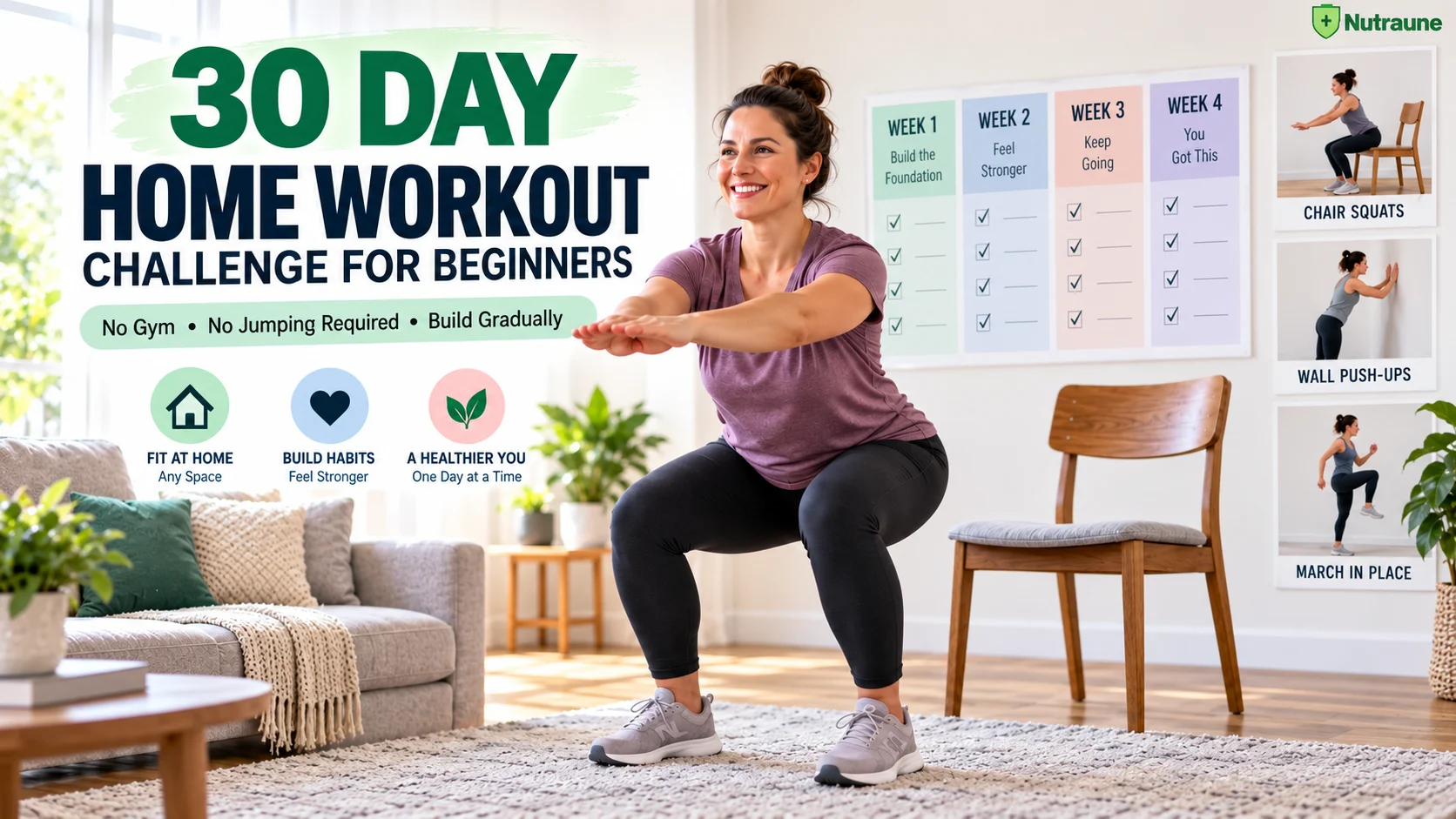
If you are ready for a more structured beginner program, Nutraure’s existing 30-day beginner fitness challenge can become a logical next step.
30 Day Fitness Challenge for Beginners
If strength training becomes your main interest, you can instead progress to a simple beginner dumbbell workout.
Final Takeaway
After a long period of inactivity, your first objective is not to prove that you can still exercise hard.
It is to find an amount of movement you can control, recover from and repeat.
Start with a short walk. Add simple strength work. Let the same workout become familiar before making it harder.
The long-term goal may eventually be hundreds of active minutes across each month.
But today’s job can be much smaller:
Choose when your first 10-minute walk will happen.
FAQ
How long should a beginner exercise after being inactive?
There is no minimum session length you must reach on Day 1. If you have been very inactive, even 5–10 minutes can be a reasonable place to begin. Add time gradually when the current session feels manageable. Public-health guidance specifically recognizes that inactive adults benefit from starting small rather than immediately attempting the full weekly target.
How many days a week should I exercise after a long break?
Several short activity days may be easier to tolerate than a few exhausting workouts. The sample plan begins with three to four easy aerobic opportunities and gradually introduces two strength sessions. Your schedule should still be adjusted to your current ability and recovery.
Is walking enough when I first start exercising again?
Walking can be an excellent starting aerobic activity. Over time, adding muscle-strengthening exercise creates a more balanced routine because adult activity guidelines include both aerobic and strengthening components.
Can I start exercising with only 10 minutes a day?
Yes. A short session can be useful when the alternative is remaining inactive. Current guidelines no longer require activity to occur only in 10-minute bouts to count toward health benefits.
Should I exercise every day after being inactive?
You do not need a challenging workout every day. Easy everyday movement may be fine for many adults, but early strength sessions and harder workouts should allow enough recovery for your response and ability.
When should I increase my workouts?
Progress when the current session feels controlled during exercise, recovery afterward is reasonable and your next-day response is manageable. Change one important variable at a time instead of increasing duration, difficulty and frequency simultaneously.
How quickly will my fitness return?
There is no reliable universal deadline. Your previous training history, length of inactivity, age, current health, exercise type and consistency all matter. Measure progress against your recent workouts rather than an arbitrary “back in shape” date.
Should I talk to a doctor before exercising after years of inactivity?
Not every inactive adult needs medical clearance before ordinary moderate activity. However, chronic medical conditions, concerning symptoms, or plans to begin vigorous exercise may change what is appropriate. CDC recommends discussing suitable activity with a healthcare professional when chronic conditions affect exercise choices.