Starting strength training should not feel like studying for an exam. You do not need a long list of complicated exercises, a crowded gym, or an hour of free time. You need a few movements you can learn, a weight you can control, and a routine simple enough to repeat.
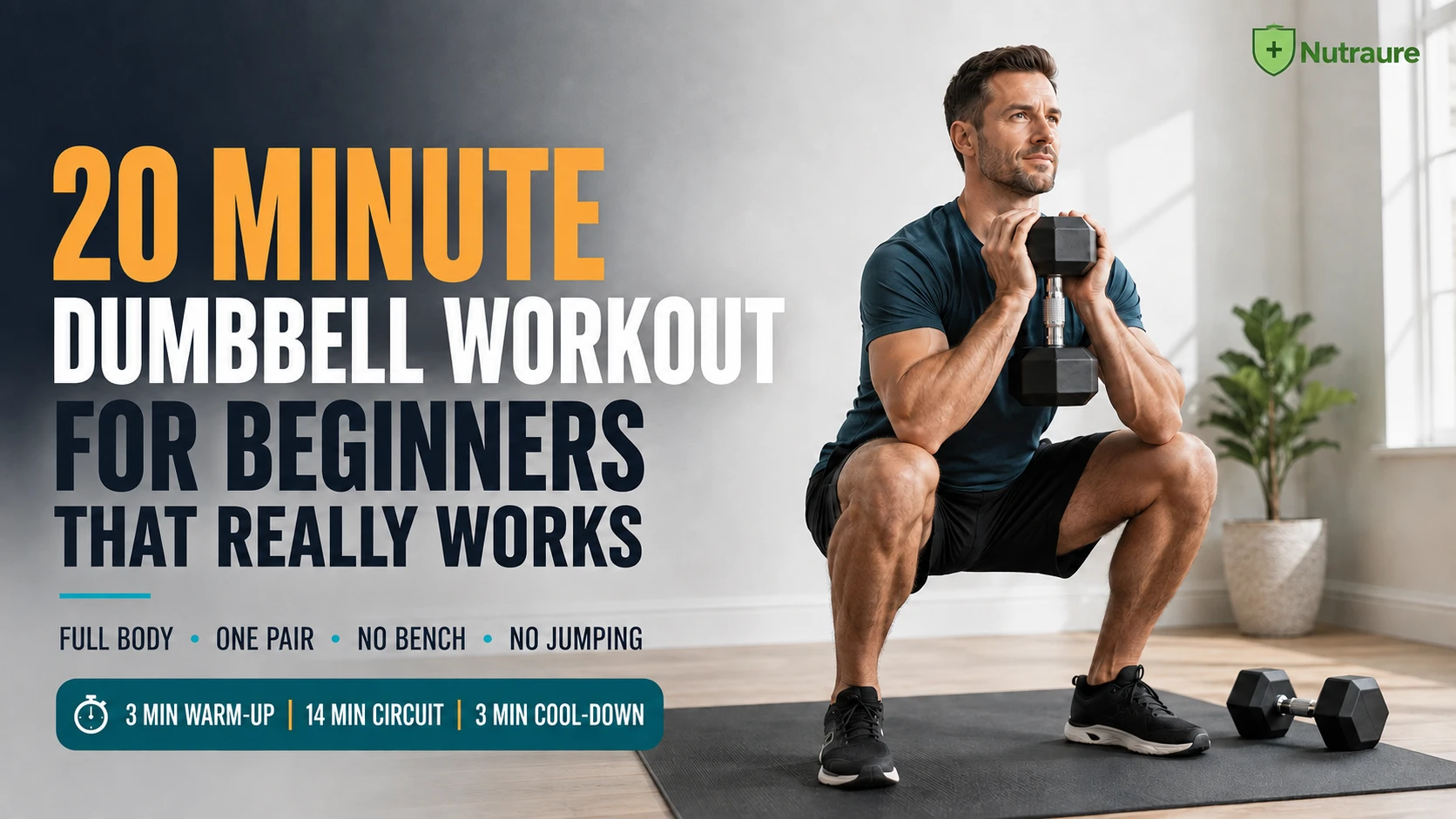
This 20 minute dumbbell workout for beginners gives you exactly that. It trains your legs, hips, back, chest, shoulders, arms, grip, and core using seven straightforward exercises. You only need one pair of dumbbells, a small amount of floor space, and an optional chair or exercise mat.
The entire session lasts 20 minutes from start to finish. There is no jumping, no exercise bench, and no rushed combination movements.
Safety note: This routine is written for generally healthy adults. Stop if you experience sharp or worsening pain, dizziness, chest discomfort, unusual shortness of breath, or loss of balance. Speak with a qualified healthcare or exercise professional before starting if you are injured, pregnant, returning after surgery, or managing a medical condition.
Your 20-Minute Beginner Dumbbell Workout at a Glance
A 20 minute dumbbell workout for beginners can train the major movement patterns with one pair of weights. Warm up for three minutes, complete seven exercises for 40 seconds each with 20 seconds of rest, repeat the circuit once, and finish with a three-minute cool-down.
| Workout phase | Time | What will you do |
|---|---|---|
| Dynamic warm-up | 3 minutes | Four bodyweight movements |
| Circuit round one | 7 minutes | Seven dumbbell exercises |
| Circuit round two | 7 minutes | Repeat the seven exercises |
| Cool-down | 3 minutes | Gentle mobility and breathing |
| Total | 20 minutes | Complete full-body session |
Each strength exercise lasts one minute:
- Work with control for 40 seconds.
- Rest and prepare for 20 seconds.
- Complete seven exercises to finish one round.
- Repeat the circuit for a second round.
During your first week, you can work for 30 seconds and rest for 30 seconds. This keeps the session at 20 minutes while giving you more time to reset your position.

What Is a 20-Minute Dumbbell Workout?
A 20-minute dumbbell workout is a short resistance-training session that uses handheld weights to challenge several muscle groups. Instead of isolating one muscle at a time, this routine uses practical movement patterns that involve multiple areas of the body.
The seven patterns in this workout are:
- Squat
- Hip hinge
- Lunge
- Pull
- Horizontal push
- Vertical push
- Loaded carry or march
Together, these movements create a balanced full-body dumbbell circuit without requiring advanced exercises.
Why a Short Workout Can Still Be Useful
A short session is not automatically an easy or ineffective session. What matters is how well you perform the movements, whether the dumbbells provide an appropriate challenge, and whether you repeat the workout consistently.
This routine gives beginners time to practice important strength-training skills:
- Controlling weight within a comfortable range
- Keeping a stable posture as the body moves
- Coordinating the upper and lower body
- Recognizing when form begins to break down
- Gradually increasing the challenge
Physical activity does not need to happen in one long session to be valuable. The current Physical Activity Guidelines for Americans also emphasize moving more and explain that adults should include muscle-strengthening activity on at least two days each week.
What “Really Works” Means
“Works” does not mean that one workout will transform your body or produce instant fat loss.
For a beginner, a workout is working when you can:
- Perform the exercises with better control
- Complete more good-quality repetitions
- Use a slightly greater range of motion
- Increase the dumbbell weight gradually
- Recover well enough to train again
- Follow the routine consistently for several weeks
Those are realistic signs of progress. They are more useful than making every session exhausting.
What You Need Before Starting
This beginner dumbbell workout is designed for a home, bedroom, office, or small training area.
You will need:
- One pair of light-to-moderate dumbbells
- A timer or interval app
- Enough space to step backward safely
- Water nearby
- An optional exercise mat
- An optional stable chair or wall for support
Adjustable dumbbells are convenient because you can change the load between exercises, but they are not essential. A single fixed-weight pair will work.
You do not need a bench. The chest exercise is performed on the floor, which also prevents the upper arms from traveling too far behind the body.
How Heavy Should Your Dumbbells Be?
There is no single correct beginner dumbbell weight. A suitable weight depends on your current strength, movement experience, injury history, and the exercise being performed.
Your legs may be able to handle more weight than your shoulders. That is normal.
Use this simple test before beginning:
- Choose a weight you believe you can press overhead.
- Perform eight to ten slow, controlled repetitions.
- Keep your ribs down and avoid leaning backward.
- Stop if your posture, breathing, or range of motion changes.
- At the end, ask how many more clean repetitions you could have completed.
A useful starting weight should leave you feeling as though you could perform approximately two or three more good repetitions.
The weight may be too light when:
- You could continue for many more repetitions.
- Your movement speed never slows.
- The exercise requires very little concentration.
The weight is probably appropriate when:
- The final few repetitions require focus.
- You can maintain the same range of motion.
- You can breathe without holding your breath.
- Your posture remains steady.
The weight is likely too heavy when:
- You swing the dumbbells.
- You rush the movement.
- You lean or twist to finish a repetition.
- Your range becomes noticeably shorter.
- You cannot lower the weight under control.
When in doubt, begin lighter. Your first goal is to learn the movement, not to prove how much you can lift.
If your only pair feels too heavy for shoulder presses or lunges, hold one dumbbell instead of two. For single-sided exercises, switch sides halfway through the interval.

Set Up a Safe Workout Area
Before starting the timer:
- Move loose rugs, bags, cables, and furniture out of the way.
- Check that the floor is dry and stable.
- Keep a chair nearby if you are uncertain about your balance.
- Practice the squat, hinge, lunge, and press without weight.
- Place your dumbbells where you can reach them without rushing.
Stable athletic shoes can be useful, especially on slippery or uneven floors. Training barefoot may also be comfortable for some people, but only on a clean, secure surface.
3-Minute Beginner Warm-Up
You do not need dumbbells for the warm-up. Move at a comfortable pace and use a smaller range whenever necessary.
0:00–0:45: March in Place With Arm Swings
Stand tall and begin marching gently. Let your arms swing naturally beside your body.
Gradually lift your feet a little higher, but keep the movement comfortable. This prepares your body for the farmer’s march at the end of the circuit.
Easier option: Hold the back of a chair and perform alternating toe taps.
0:45–1:30: Bodyweight Squat to Reach
Stand with your feet shoulder-width apart. Sit your hips down and back as far as you can control. Stand up and reach your arms forward or slightly overhead.
Keep your heels on the floor and allow your knees to move in the same direction as your toes.
Easier option: Lower toward a chair and stand before fully sitting.
1:30–2:15: Bodyweight Hip Hinge
Place your hands on the front of your hips. Soften your knees and push your hips backward as though you were closing a door behind you.
Keep your back long and stop when you feel gentle tension in the backs of your thighs.
This movement prepares you for the Romanian deadlift and bent-over row.
2:15–3:00: Alternating Reverse Step and Reach
Step one foot backward and touch the toes lightly to the floor. Return to the starting position and repeat on the other side.
Reach your arms forward as you step to help with balance.
Easier option: Hold a chair and make each backward step shorter.
The 14-Minute Full-Body Dumbbell Circuit
Perform each exercise for 40 seconds. Use the next 20 seconds to safely put the dumbbells down, rest, and prepare for the next movement.
Complete all seven exercises, then repeat the circuit once.
Move slowly enough to stay in control. More repetitions are not automatically better. Eight steady repetitions with good form are more useful than 15 rushed repetitions with a shortened range.
Pause the timer or take additional rest if your form starts to change. Finishing in exactly 20 minutes is less important than moving safely.

| Exercise | Movement pattern | Main areas trained | Beginner option |
| Goblet squat | Squat | Thighs, glutes, core | Chair squat |
| Romanian deadlift | Hip hinge | Glutes, hamstrings, back | Shorter range |
| Reverse lunge | Lunge | Legs, glutes, balance | Backward toe tap |
| Bent-over row | Pull | Upper back and arms | Supported one-arm row |
| Dumbbell floor press | Horizontal push | Chest, shoulders, triceps | One arm at a time |
| Shoulder press | Vertical push | Shoulders, triceps, core | Seated one-arm press |
| Farmer march | Loaded carry | Core, grip, hips | Stationary hold |
1. Goblet Squat
Hold one dumbbell vertically against the center of your chest. Support the upper end of the weight with both hands.
Stand with your feet approximately shoulder-width apart. Gently brace your midsection, then bend your hips and knees together. Lower only as far as you can while keeping your heels down and your chest comfortably lifted.
Press through your whole foot to stand.
Simple cue: Sit between your hips, then stand tall.
Common mistake: Allowing the knees to collapse inward or lifting the heels.
Easier option: Squat toward a chair or perform the movement without a dumbbell.
More challenging option: Lower for three seconds before standing.
2. Dumbbell Romanian Deadlift
Hold the dumbbells in front of your thighs with your arms long. Stand tall with your feet about hip-width apart.
Soften your knees and push your hips backward. Let the dumbbells travel close to your legs. Your torso will tip forward as your hips move back.
Stop when you feel tension in your hamstrings or when you can no longer maintain a comfortable, neutral back position. Press your feet into the floor and squeeze your glutes to stand.
Simple cue: Close a car door with your hips.
Common mistake: Bending the knees so much that the movement becomes a squat.
Easier option: Use a smaller range or practice without weights.
3. Alternating Reverse Lunge
Hold one dumbbell at your chest or one dumbbell in each hand.
Step your right foot backward and place the ball of the foot on the floor. Bend both knees slightly, lowering only as far as your balance and comfort allow. Push through the front foot and return to standing.
Repeat on the left side and continue alternating.
Simple cue: Step back quietly and keep the front foot planted.
Common mistake: Taking a step that is too short, which can make the position feel cramped.
Easier option: Perform alternating backward toe taps without lowering into a lunge.
You can also hold a chair or a wall with one hand.
4. Bent-Over Dumbbell Row
Begin in the same hip-hinge position used for the Romanian deadlift. Keep your knees soft and your back long.
Let the dumbbells hang below your shoulders. Pull your elbows toward your lower ribs or back pockets. Pause briefly, then lower the weights slowly until your arms are straight.
Try to keep your torso in one position as your arms move.
Simple cue: Pull your elbows toward your back pockets.
Common mistake: Shrugging the shoulders or repeatedly lifting and dropping the torso.
Easier option: Place one hand on a chair and row one dumbbell at a time.
5. Dumbbell Floor Press
Sit on the floor with a dumbbell beside each thigh. Bring the weights toward your chest and carefully lie on your back.
Bend your knees and place your feet on the floor. Hold the dumbbells above your elbows with your palms facing forward or slightly inward.
Press the weights upward until your arms are straight without forcefully locking the elbows. Lower slowly until the backs of your upper arms gently touch the floor.
Simple cue: Press up while keeping your ribs relaxed.
Common mistake: Letting the wrists bend backward or dropping the arms quickly.
Easier option: Press one dumbbell at a time.
If getting down to the floor is uncomfortable, use a wall push-up instead.
6. Standing or Seated Shoulder Press
Hold the dumbbells near shoulder height. Stand with your knees soft and brace your middle.
Press the weights upward within a comfortable range. Finish with the dumbbells above your shoulders rather than far in front of your body. Lower slowly to the starting position.
Avoid leaning backward to move the weight.
Simple cue: Stay tall and press without lifting your ribs.
Common mistake: Using the lower back to finish the repetition.
Easier option: Sit on a stable chair and press one dumbbell at a time.
If overhead movement causes pain, stop and use another comfortable pushing exercise, such as a light floor press or wall push-up.
7. Farmer March
Stand with one dumbbell in each hand. Let your arms hang naturally and keep your shoulders level.
Brace your middle, lift one foot a few centimeters from the floor, and place it down quietly. Repeat on the other side.
Continue marching slowly without leaning from side to side.
Simple cue: Imagine balancing a glass of water on your head.
Common mistake: Marching too quickly or allowing the dumbbells to swing.
Easier option: Hold the dumbbells at your sides without marching.
You can also hold one dumbbell and use a chair for balance with your free hand.
Key takeaway: The goal of the circuit is not to complete the greatest possible number of repetitions. Aim for controlled movement, steady breathing, and a consistent range from the first repetition to the last.
3-Minute Cool-Down
The cool-down should feel calm and comfortable. Do not force a stretch or hold your breath.
17:00–17:45: Shoulder Rolls and Chest Opener
Stand tall and slowly roll your shoulders backward. Let your arms rest beside you.
If comfortable, gently move your hands behind your body and open your chest without aggressively pulling your shoulders back.
17:45–18:30: Standing Hip-Flexor or Quad Stretch
Use a chair for balance.
Step one foot backward and gently tuck the hips until you feel a mild stretch near the front of the hip. Switch sides halfway through.
You may bend the back knee and hold the ankle for a quadriceps stretch if that position feels stable.
18:30–19:15: Standing Hamstring Hinge
Place one heel slightly forward with the toes lifted. Soften the supporting knee and hinge forward with a long spine.
Switch legs halfway through.
19:15–20:00: Slow Breathing With a Comfortable Reach
Stand or sit tall. Breathe in gently as you raise your arms. Exhale slowly as you lower them.
Allow your breathing to settle before continuing with your day.
Beginner Modifications and Mistakes to Avoid
A beginner-friendly workout should be adjustable. You do not have to copy the deepest squat, longest lunge, or heaviest dumbbell used by someone else.
| If this feels difficult | Try this modification |
| Balance is uncertain | Hold a chair or a wall |
| Lunges are uncomfortable | Perform backward toe taps |
| Squats feel unstable | Squat toward a chair |
| Floor work is difficult | Replace the floor press with a wall push-up |
| Overhead weights feel heavy | Press one dumbbell at a time |
| Grip becomes tired | Put the weights down and continue without them |
| Forty seconds feels too long | Work for 30 seconds and rest for 30 seconds |
| Your range is limited | Use a smaller pain-free range |
Mistake 1: Choosing Speed Over Control
The timer is a guide, not a race. Moving too quickly can make it harder to notice changes in balance, posture, and range of motion.
Slow down enough to control both the lifting and lowering parts of each repetition.
Mistake 2: Starting Too Heavy
A weight that is difficult to lift once is not necessarily suitable for a 40-second interval.
Begin with a load you can control. You can increase it later once the movement becomes more familiar.
Mistake 3: Holding Your Breath
Try to exhale during the more demanding part of the exercise and inhale as you return.
If you notice that you are repeatedly holding your breath, reduce the weight, shorten the interval, or take a longer rest.
Mistake 4: Forcing Someone Else’s Range
Bodies move differently. Your squat depth, overhead position, and lunge length do not need to look identical to another person’s.
Use the largest range you can control without pain or loss of balance.
Mistake 5: Treating Every Round as a Maximum-Effort Test
Beginners do not need to reach complete muscular failure during every set. Leave enough energy to maintain your form and finish the second round with control.
Muscular effort, warmth, and fatigue can be normal. Sharp, sudden, electrical, or progressively worsening pain is not something to push through.
How Often Should Beginners Do This Workout?
Start with two nonconsecutive sessions each week. For example, train on Monday and Thursday rather than on two consecutive days.
This schedule gives you time to practice the movements regularly while also allowing for recovery. Both the federal guidelines and ACSM physical activity recommendations support including muscle-strengthening activity at least twice weekly.
A simple week could look like this:
| Day | Activity |
| Monday | 20-minute dumbbell workout |
| Tuesday | Walking or gentle mobility |
| Wednesday | Rest or light activity |
| Thursday | 20-minute dumbbell workout |
| Friday | Walking or gentle mobility |
| Saturday | Optional third session after adapting |
| Sunday | Recovery |
A third session may be appropriate after several weeks if you are recovering well and maintaining good technique. It is optional, not compulsory.
Four-Week Beginner Progression
| Week | Work and rest | Main focus |
| Week 1 | 30 seconds work, 30 seconds rest | Learn each movement |
| Week 2 | 35 seconds work, 25 seconds rest | Improve control and confidence |
| Week 3 | 40 seconds work, 20 seconds rest | Complete the standard timing |
| Week 4 | 40 seconds work, 20 seconds rest | Add a small challenge where appropriate |

When Should You Increase the Weight?
Consider moving to the next available weight when you can:
- Complete both rounds with consistent form
- Control the lowering phase of every exercise
- Maintain your normal range of motion
- Finish the interval without leaning, swinging, or rushing
- Repeat that performance in at least two workouts
Change only one variable at a time. For example, increase the weight without also increasing the work interval and exercise range during the same session.
You can also make progress without heavier dumbbells. Try:
- Lowering the weight more slowly
- Pausing briefly in a stable position
- Using a slightly larger controlled range
- Improving balance during lunges and marches
- Completing more clean repetitions in the same interval
Frequently Asked Questions
Is a 20 Minute Dumbbell Workout for Beginners Effective?
Yes. A well-planned 20-minute session can help beginners practice foundational movements and gradually improve muscular strength and control.
Its effectiveness depends on consistency, appropriate resistance, good technique, and gradual progression—not duration alone. A single short workout should be treated as one part of a wider active lifestyle.
What Weight Dumbbells Should a Beginner Use?
Use a weight that feels challenging while allowing you to complete every repetition with controlled form.
At the end of a short test set, you should feel as though you could perform approximately two or three more good repetitions. Reduce the weight if you need to swing, lean, rush, or shorten the movement.
Can Beginners Do Dumbbell Workouts Every Day?
Most beginners do not need to repeat the same full-body strength workout every day.
Start with two nonconsecutive sessions per week. Use the days between them for walking, mobility, daily activities, or recovery. Add another strength day only after your body has adapted and you are recovering comfortably.
Can I Complete This Workout With One Dumbbell?
Yes. Hold one dumbbell at your chest for squats and lunges. Perform rows, floor presses, and shoulder presses one side at a time.
For the farmer’s march, hold the dumbbell on one side for 20 seconds and then switch hands.
Is This Dumbbell Workout Good for Weight Loss?
Resistance training can support a broader weight-management plan, but one 20-minute workout cannot guarantee fat loss.
Body-weight change is influenced by food intake, overall activity, sleep, consistency, and individual factors. The CDC’s physical activity and weight guidance explains that regular activity can support weight management, while dietary intake also plays a major role.
How Many Calories Does a 20 Minute Dumbbell Workout Burn?
There is no accurate universal number.
Energy use varies according to body size, dumbbell weight, exercise selection, pace, rest time, conditioning, and effort. Fitness trackers can provide estimates, but those figures should not be treated as precise measurements.
What Should I Do if Lunges Hurt My Knees?
Stop the painful version rather than forcing it.
Try a shorter backward step, a smaller range, a supported lunge, or a backward toe tap. A chair squat can also replace the lunge. Seek qualified guidance if the discomfort persists, worsens, or affects normal daily movement.
What Should I Do if Shoulder Presses Hurt?
Stop pressing overhead and use a comfortable alternative such as a light floor press or wall push-up.
Do not force the dumbbells through a painful range. Persistent or worsening shoulder pain should be assessed by an appropriately qualified professional.
When Should I Use Heavier Dumbbells?
Increase the weight when both rounds feel controlled and the final repetitions no longer require much effort.
Your posture, breathing, movement speed, and range should remain consistent. Use the smallest available increase and reassess your form.
Start With 20 Minutes and Build From There
You do not need a perfect home gym or a complicated program to begin strength training. One pair of dumbbells and a repeatable routine can be enough to take the first step.
Focus on learning the movements before increasing the weight. Give yourself permission to use the easier options. Track what you lift, how the exercises feel, and whether your control is improving.
The best 20 minute dumbbell workout for beginners is not the hardest one. It is the workout you can perform safely, repeat consistently, and gradually improve.