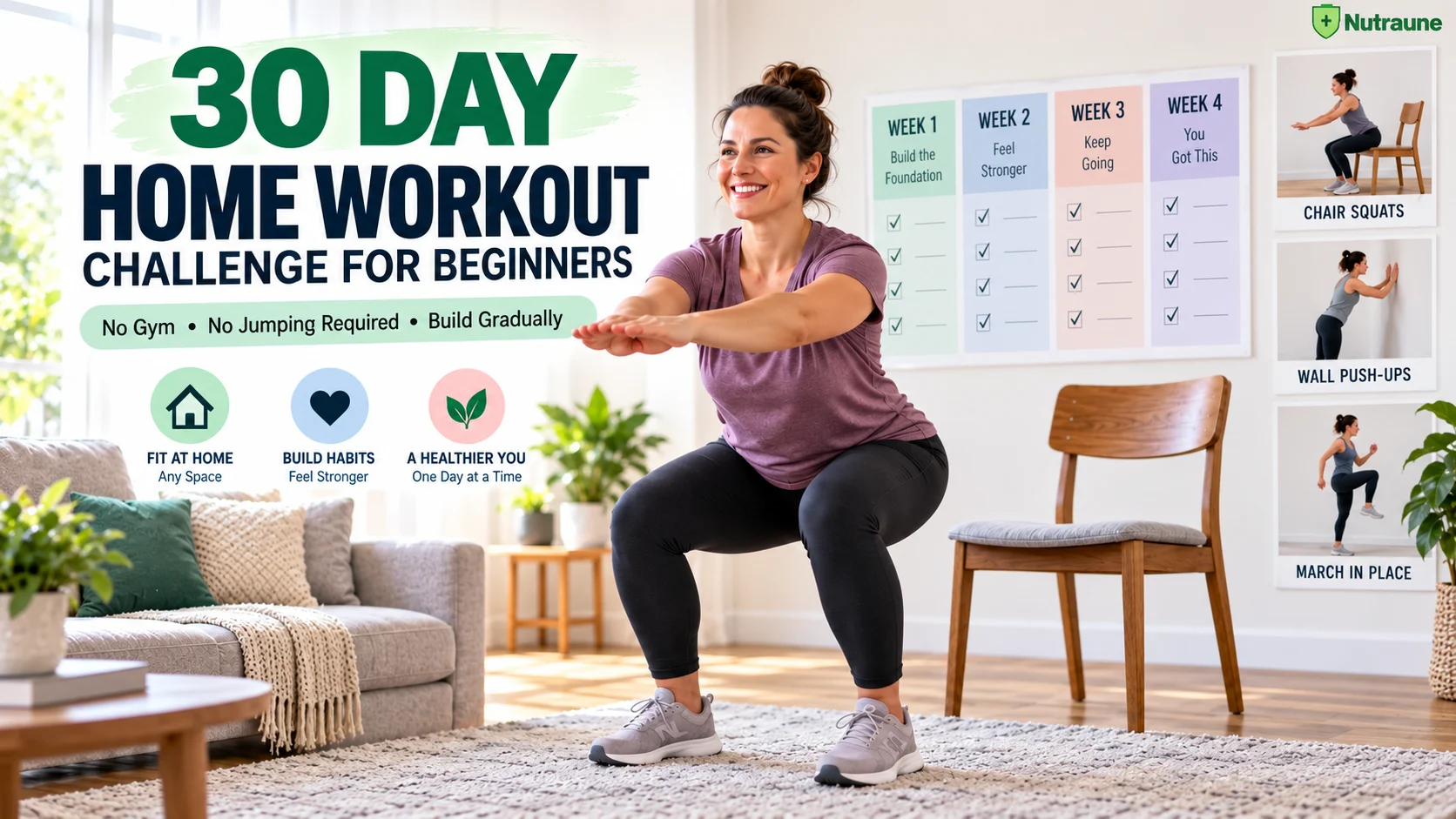

You do not need burpees, jumping jacks, or jump squats to start exercising effectively.
A beginner workout with no jumping can still train your legs, upper body, and core while raising your heart rate and breathing rate. The important distinction is that low impact does not automatically mean low effort. You can make controlled movements more demanding without adding hard landings.
The routine below takes 20 minutes, requires no gym equipment, and can be done in a relatively small space. It uses a five-minute gradual warm-up, a ten-minute full-body circuit, and a five-minute cool-down.
Every exercise has an easier option, so you do not have to keep up with somebody else’s pace to complete the workout.
Quick answer: Start with five low-impact exercises performed for 45 seconds followed by 15 seconds of rest. Complete two rounds. Use smaller movements, a wall or chair, or 30-second work intervals if necessary. You should feel like you are exercising, but beginners do not need to finish exhausted for the session to be worthwhile.
Important: This is general fitness information, not treatment for an injury or medical condition. No jumping does not automatically make every exercise appropriate for painful knees, hips, or backs. If you have an injury, unexplained pain, significant balance limitations, a medical condition affecting exercise, are pregnant/postpartum and unsure what is appropriate, or have been told to restrict activity, get individualized guidance before starting.

What Does “No Jumping” Actually Mean?
A no-jumping workout removes movements that require you to repeatedly leave the floor and land again. Instead of a jumping jack, for example, you can step one leg out at a time. Instead of running high knees, you can perform controlled knee drives or marching.
That makes the session low-impact, but it does not determine how intense the workout must be.
Low impact and low intensity are not the same thing
Impact describes the type of loading created by the movement. Intensity describes how hard your body is working.

Walking uphill is an easy example: there is no jumping, yet a steep enough hill can make you breathe hard. The same principle applies indoors. Bigger arm movements, faster controlled stepping, deeper ranges that you can comfortably manage, and longer work intervals can all increase the challenge without adding jumps.
You therefore do not need to replace every high-impact exercise with an extremely easy movement. You need an exercise you can control.
How hard should a beginner work?
Do not worry about reaching a precise heart-rate number for this routine.
A practical option is the talk test. According to the CDC, moderate-intensity activity generally allows you to talk but not comfortably sing. CDC guide to measuring exercise intensity
For your first few workouts, even that may be more effort than necessary. Aim to finish thinking, “I could do this again in a day or two,” rather than, “I never want to exercise again.”
Before You Start: Make the Workout Fit You
Clear enough floor space to take a comfortable step in any direction without hitting furniture. Keep a sturdy wall, kitchen counter, or chair nearby if you want support for balance.
Wear clothing that lets you move comfortably. Shoes may help on slippery or hard surfaces, while some people prefer to go barefoot on suitable non-slip surfaces. The important part is stable footing.
Warm up rather than beginning at full speed
A gradual warm-up lets your heart rate, breathing, and range of movement increase before the harder portion of the session. The American Heart Association recommends gradually increasing activity rather than going directly from rest into harder exercise. American Heart Association warm-up and cool-down guidance
You will spend five minutes warming up in this plan.
Know what discomfort you should not “push through”
Muscle effort is expected. Sharp or escalating pain is not a target.
Stop exercising if you develop concerning pain, dizziness, faintness, chest pain, or unusual/severe shortness of breath. MedlinePlus specifically advises stopping exercise if you feel pain, while cardiovascular safety guidance also identifies symptoms such as dizziness, chest discomfort, and unusual shortness of breath as warning signs.
Your 20-Minute Beginner Workout With No Jumping
Here is the complete structure:
| Part | Time | What you’ll do |
|---|---|---|
| Gradual warm-up | 5 minutes | Marching, side steps, shoulder movement and easy squats |
| Main circuit — Round 1 | 5 minutes | Five exercises, 45 sec work + 15 sec changeover |
| Main circuit — Round 2 | 5 minutes | Repeat the same five exercises |
| Gradual cool-down | 5 minutes | Slow walking/marching and comfortable mobility |
| Total | 20 minutes | No jumping and no equipment required |
If 45 seconds feels too long, use 30 seconds of movement and 30 seconds of rest. You will still preserve the workout’s structure.
5-Minute Warm-Up
Minute 1: Easy march
March gently in place. Let your arms swing naturally. Keep the knee lift small.
Minute 2: Step touches
Step to your right and bring the left foot toward it. Then move left. Keep the steps smooth rather than stomping.
Minute 3: Shoulder rolls and arm reaches
Continue an easy march while rolling your shoulders, then gradually add comfortable forward and overhead reaches.
Minute 4: Alternating knee lifts
Lift one knee, replace the foot, and change sides. The goal is mobility and gradual effort, not speed.
Minute 5: Easy chair squats or sit-to-stands
Stand in front of a stable chair. Push your hips back and lower toward the seat. Either lightly touch it and stand, or sit fully, then stand again.
You should now feel warmer and slightly more ready to move, not fatigued.
The 10-Minute Main Circuit
Perform each exercise for 45 seconds, followed by 15 seconds to rest or change position. Complete all five exercises, then repeat them once.

1. Step Jacks
Instead of jumping both feet apart like a traditional jumping jack, step your right foot sideways while lifting your arms. Return to the middle, then repeat with your left foot.
Keep a slight bend in the knees and land softly.
Make it easier: Keep the hands below shoulder height and use a smaller step.
Make it harder without jumping: Increase the width and pace of the steps, and swing the arms through a larger, comfortable range of motion.
2. Chair Squat or Sit-to-Stand
Stand in front of a sturdy chair with your feet in a comfortable position.
Push your hips back and bend your knees as though sitting. Touch the chair lightly and stand again, or sit fully before standing if that gives you better control.
Do not worry about reaching a particular squat depth. Use the range you can control comfortably.
Make it easier: Use a higher chair or use your hands lightly for assistance.
Make it harder: Stand before fully resting your weight on the chair and slow the lowering portion of each repetition.
3. Wall or Counter Push-Up
Place your hands against a stable wall or countertop slightly wider than shoulder width.
Step your feet back so your body forms a straight line from head to heels. Bend your elbows and bring your chest toward the surface, then press away.
The wall variation is usually easier because your body is more upright.
Make it easier: Stand closer to the wall.
Make it harder: Move to a sturdy counter or similarly stable lower surface.
Do not use lightweight furniture that can slide or tip.
4. Standing Hip Hinge
Stand with soft knees and your feet roughly hip-width apart.
Push your hips backward as your torso inclines forward, keeping the movement controlled. Stop before your back rounds noticeably, then squeeze your glutes as you return to standing.
Think “hips back, then stand tall” rather than turning the movement into a squat.
Make it easier: Reduce the range.
Optional floor alternative: If getting down to the floor is comfortable, use controlled glute bridges instead.

5. Standing Cross-Body Knee Drives
Stand tall and bring one knee toward the opposite hand or elbow. Replace the foot before changing sides.
Do not yank the knee upward. Keep the supporting leg slightly soft and move at a pace that lets you maintain balance.
Make it easier: Touch one hand to a wall or chair and perform several repetitions on one side before changing.
Make it harder: Increase the arm swing and rhythm without hopping.
After Exercise 5, you have completed one five-minute round.
Take extra rest if you need it, then repeat the circuit.
There is no prize for starting Round 2 while your form is deteriorating.
5-Minute Cool-Down
After the second round, gradually reduce the effort rather than stopping abruptly.
Spend about two minutes walking or marching slowly. Let your breathing settle.
Then use the remaining time for comfortable movements such as calf stretches, gentle chest opening, easy hamstring mobility, and slow shoulder rolls.
A stretch can feel like tension, but it should not be painful. Avoid bouncing.
How to Know Whether the Workout Is the Right Difficulty
A beginner workout should be challenging enough to create adaptation but manageable enough to repeat.
You probably chose an appropriate starting level if your breathing increases during the main circuit, you can still control the exercises, and your form does not collapse in the final minute.
If you cannot finish an interval without rushing, losing balance, or holding your breath, reduce the difficulty.
That might mean using the wall instead of the counter for push-ups, performing a shallower squat, taking smaller side steps, or switching from 45 seconds of work to 30.
Those are legitimate exercise modifications, not failures.
How to Make the Workout Easier
The simplest beginner version is:
30 seconds moving + 30 seconds resting, for only one round of the five exercises.
That gives you a five-minute main circuit between the warm-up and cool-down.
Once that feels comfortable, repeat the circuit twice.
Do not increase every variable at the same time. A common beginner mistake is making the workout longer, faster, and harder all at once.
Change one thing, then see how your body responds.
How to Make It Harder Without Adding Jumps
Progression does not require transforming the workout into HIIT.
Try this order:
- Complete both rounds comfortably.
- Increase the range of motion where appropriate.
- Use stronger arm movements during step jacks and knee drives.
- Move slightly faster while keeping your feet controlled.
- Progress wall push-ups to a stable counter.
- Reduce unnecessary pauses between repetitions.
- Eventually add another round or introduce resistance training on separate days.
This keeps progression measurable while preserving the reason you chose a no-jumping workout in the first place.
What Can You Use Instead of Common Jumping Exercises?
| High-impact exercise | Beginner no-jump alternative |
|---|---|
| Jumping jacks | Step jacks |
| High knees / running in place | Controlled marching or knee drives |
| Jump squats | Chair squats or squat-to-reach |
| Jumping lunges | Reverse step-backs |
| Burpees with a jump | Supported squat + elevated walkout |
| Skater jumps | Side steps |
| Plank jacks | Alternating plank step-outs if floor work is appropriate |

Remember that a substitution still needs to suit your movement ability. Replacing a jump does not guarantee that the replacement will be comfortable for every injury or joint condition.
How Often Should a Beginner Do This Workout?
A practical starting point is two or three non-consecutive sessions per week, then adjust according to recovery and the rest of your activity.
That is a starting structure, not a universal prescription.
Your broader goal is to build a mix of cardiovascular exercise and strength training throughout the week. WHO currently recommends that adults accumulate 150–300 minutes of moderate-intensity aerobic activity per week or the vigorous equivalent, plus muscle-strengthening activity involving major muscle groups on at least two days. WHO physical activity recommendations
Do not interpret that as meaning you must immediately jump from zero exercise to 150 minutes.
Official guidance specifically recognizes the value of starting with smaller amounts and increasing gradually.
A beginner week might look like this:
| Day | Activity |
|---|---|
| Monday | 20-minute no-jumping workout |
| Tuesday | Comfortable walk or normal daily movement |
| Wednesday | Rest or light mobility |
| Thursday | 20-minute no-jumping workout |
| Friday | Walking or another activity you enjoy |
| Saturday | Optional third workout or longer walk |
| Sunday | Recovery |
As your fitness improves, you can add more walking, cycling, swimming, strength training, or other activities that suit you.
The U.S. Physical Activity Guidelines also recognize bodyweight movements, such as push-ups, as forms of muscle-strengthening activity and recommend strengthening major muscle groups on at least two days per week. Physical Activity Guidelines for Americans
Five Mistakes That Make a Beginner No-Jump Workout Harder Than Necessary
1. Assuming faster is always better
Once your movements become uncontrolled, additional speed is not useful progression. Increase the pace only as long as you can still manage the exercise.
2. Treating pain as proof the workout is working
Muscular effort and unfamiliarity are different from sharp or concerning pain. Do not use “no pain, no gain” as your training rule.
3. Trying to match somebody else’s range of motion
Your squat does not need to be as deep as the instructor’s. Your step jack does not need to be as wide.
Start where you have control.
4. Obsessing over calories
The number of calories burned in a 20-minute workout varies substantially depending on body size, intensity, fitness level, and the specific exercises performed.
A webpage cannot accurately promise that every reader will burn a certain number.
Measure progress using things you can observe more reliably: completing another round, needing less rest, performing a stronger variation, or simply exercising consistently.
5. Never progressing
“Beginner” describes your starting point, not where you must remain.
If you can comfortably repeat the same workout week after week, gradually make an exercise more demanding or expand your overall activity.
Can a No-Jumping Workout Help With Weight Loss?
It can support a weight-management plan by increasing physical activity, but it cannot guarantee weight loss on its own.
Body-weight changes depend on multiple factors, including energy intake, overall daily movement, exercise, sleep,p and individual circumstances.
A better reason to start this workout is that regular physical activity provides health benefits even when body weight does not change substantially. The broader evidence behind current physical-activity guidance includes benefits for cardiovascular health, muscular fitness, function, and wellbeing.
What Should You Do After This Routine Becomes Easy?
Do not abandon low-impact exercise just because you improve.
You have several options.
You can extend the session, add resistance bands or dumbbells, progress your push-up angle, increase your walking duration, or start a structured week-long or month-long beginner program.
One limitation of an equipment-free routine is that it is harder to provide substantial pulling resistance for your back muscles. When you are ready, resistance bands or dumbbells can help you build a more balanced strength program.
Final Takeaway
A beginner workout does not need jumping, complicated equipment,nt or an exhausting finish to be useful.
Start with the easiest version of these five movements, move with control, and choose intervals that let you maintain good form.
Your first goal is not to make the workout spectacular.
It is to make it repeatable.
FAQ
Can beginners get a good workout without jumping?
Yes. Jumping is only one way to increase exercise demand. Controlled squats, step jacks, incline push-ups, marching,g and knee drives can train several major muscle groups and raise your breathing rate without jumping.
Is a no-jumping workout the same as a low-intensity workout?
No. Impact and intensity are different. You can make a no-jumping workout more demanding by increasing controlled movement speed, range of motion, arm involvement, resistance,ce or workout duration.
What can a beginner do instead of jumping jacks?
Use step jacks. Step one foot sideways while raising your arms, return to the middle, then repeat on the other side. It keeps the basic movement pattern without the jump.
Is a no-jumping workout good if my knees hurt?
Not automatically. Removing jumping avoids repeated jump landings, but squats, step movements, and other exercises can still aggravate some conditions. Persistent, sharp, or worsening knee pain warrants professional assessment rather than assuming that every “low-impact” exercise is safe.
How many times a week should a beginner do this workout?
Two or three sessions per week is a reasonable starting structure for many beginners, with recovery or other comfortable activity between sessions. Your total weekly activity can gradually increase as your fitness and recovery improve.
Can a no-jumping workout help with weight loss?
It can contribute to overall physical activity and energy expenditure, but a single workout does not guarantee weight loss. Body-weight changes depend on overall energy intake, activity patterns, and individual factors.
Is 20 minutes enough for a beginner workout?
Twenty minutes can be a very practical starting session. It does not need to represent your entire weekly activity target. What matters initially is developing a repeatable routine and gradually increasing activity over time.