
Starting a walking workout does not require a certain step count, treadmill speed, or fitness level.
If you are new to exercise, a better goal is to find a walking distance you can complete comfortably, repeat consistently, and build from there.
A useful walking workout for beginners can start with only 10–20 minutes. As your stamina improves, you gradually add time, then brisk walking, and eventually hills or intervals for a bigger challenge.
The four-week plan below takes that approach. You will also learn how fast to walk, how to judge your effort without complicated gadgets, how to progress safely, and what to do when 30 minutes of walking starts to feel easy.
This is general fitness information for adults, not individualized medical or rehabilitation advice.
Your Beginner Walking Workout at a Glance
A simple first workout is:
| Time | Activity | Effort |
|---|---|---|
| 0–5 min | Easy walking | Comfortable |
| 5–15 min | Purposeful walking | Easy to moderate |
| 15–20 min | Easy walking | Gradually slow down |
You do not need to hit a certain speed.
During the middle portion, gradually move quickly enough that your breathing increases while you still feel in control.
If 20 minutes is currently too much, use the same structure with 10 minutes:
The workout should fit your current capacity, not somebody else’s pace.

What Makes Walking a Workout?
Walking becomes a structured workout when you deliberately use time, pace, or terrain to challenge your cardiovascular system beyond an ordinary stroll.
That does not mean casual walking is useless. All movement contributes to your overall activity.
The difference is purpose.
For example:
- Walking around a shop is daily movement.
- Taking a planned 20-minute walk at a purposeful pace is a walking workout.
- Alternating brisk and easier walking creates an interval workout.
- Walking uphill or increasing the treadmill incline further increases the challenge.
Brisk walking is recognized as a moderate-intensity aerobic activity in current public health guidance. Adults are ultimately encouraged to work toward at least 150 minutes of moderate-intensity activity per week, along with muscle-strengthening activity on at least 2 days. You do not need to reach that total during your first week.
See the CDC’s current adult activity guidance for the broader recommendation. CDC physical activity recommendations for adults
How Hard Should a Beginner Walk?
For beginners, effort is usually more useful than chasing an exact speed.
Use the talk test
CDC guidance offers an easy way to recognize moderate intensity:
At moderate effort, you should generally be able to talk but not comfortably sing.
Imagine a 0–10 effort scale:
- 2–3: easy walking
- 4: purposeful but comfortable
- 5–6: moderate/brisk
- 7+: hard effort
Your early workouts do not have to spend every minute at 5–6.
Start with easier and gradually introduce moderate minutes.

You can review the CDC’s explanation of relative exercise intensity here. CDC guide to measuring physical activity intensity
Don’t obsess over miles per hour
CDC lists brisk walking around 2.5 mph or faster as an example of moderate activity, but exercise intensity is also relative to the individual.
One person’s easy pace may be another person’s brisk pace.
The talk test solves much of that problem.
What about 100 steps per minute?
Research suggests that around 100 steps per minute can serve as a rough population-level indicator of moderate walking intensity for many adults. But studies also show individual variability.
Treat cadence as an optional reference, not a test you must pass.
Before You Start
You need surprisingly little.
A safe route and comfortable shoes are enough for many beginner walks.
Choose a duration you can repeat
If you have done little structured exercise recently, you might begin with 10–15 minutes.
The American Heart Association likewise advises people who are out of shape to begin with short distances or for roughly 10–15 minutes and gradually increase the duration.
Finishing while you still feel you can walk again tomorrow is more useful than exhausting yourself on Day 1.
Warm up by walking more slowly
There is no need for an elaborate pre-walk ritual.
Begin with about five minutes of easier walking before increasing the pace.
The American Heart Association recommends gradually increasing and decreasing effort around aerobic activity rather than moving abruptly between rest and harder exercise.
More detail is available in its warm-up and cool-down guidance. American Heart Association warm-up and cool-down guidance
Know when general advice isn’t enough
People with chronic conditions may benefit from discussing appropriate activity with a healthcare professional. CDC specifically notes this for conditions such as heart disease, arthritis, and diabetes.
Stop and get appropriate help if you experience concerning symptoms such as pain, extreme shortness of breath,h or dizziness.
Your 20-Minute Beginner Walking Workout
Once 20 minutes feels appropriate, try this:
Minutes 0–5: Easy warm-up walk
Walk at a relaxed pace.
Let your arms swing naturally and give yourself several minutes to loosen up.
You should be able to talk easily.
Minutes 5–10: Purposeful walking
Increase your pace slightly.
Do not worry about hitting “brisk” immediately.
Concentrate on moving smoothly.
Minutes 10–15: Brisk block
If you feel comfortable, walk at approximately moderate effort.
Your breathing should be noticeably stronger, but you should remain in control.
If this is too difficult,y continue at your purposeful pace.
Minutes 15–20: Gradual cool-down
Slow down.
Allow your breathing to settle before stopping.
That is a complete walking workout.
There is no requirement to add running, ankle weights, or complicated intervals.
Your 4-Week Walking Workout Plan
The goal of these four weeks is not to transform your fitness instantly.
It is to build a foundation you can continue using.

| Week | Walking days | Time per walk | Main focus |
|---|---|---|---|
| 1 | 4 | 10–15 min | Establish the habit |
| 2 | 4 | 15–20 min | Add comfortable time |
| 3 | 4–5 | 20–25 min | Add short brisk segments |
| 4 | 5 | 25–30 min | Build sustained purposeful walking |
Week 1: Make walking repeatable
Take four 10–15-minute walks.
Keep most of the walking easy.
This week answers one question:
Can I fit walking into my real life consistently?
If 10 minutes feels challenging, shorten it.
If 15 minutes feels extremely easy, resist the temptation to overhaul the plan immediately.
Week 2: Add time
Increase your walking time toward 15–20 minutes on four days.
Keep the intensity mostly comfortable.
If Week 1 already felt demanding, repeat it instead.
Your calendar does not determine when your body has adapted.
Week 3: Add a little brisk walking
Walk for about 20–25 minutes on four or five days.
During one or two walks, try:
- 5 minutes easy
- 1 minute brisk
- 2 minutes easy
- Repeat the brisk/easy pattern 2–3 times
- Finish easy
These are not sprints.
The brisk intervals introduce a controlled change of pace.
Week 4: Build toward 30 minutes
Aim for approximately 25–30 minutes on up to five days if that progression feels comfortable.
One or two walks can contain brisk segments.
Others should remain comfortable.
By the end of Week 4, some readers may be close to the commonly recommended 150 minutes of moderate activity per week. Others will not be there yet.
Both outcomes are fine.
WHO explicitly encourages inactive adults to start with smaller amounts and gradually increase frequency, intensity, and duration.
You can read the broader WHO recommendations here. WHO guidelines on physical activity and sedentary behavior
How to Walk With Better Form
Walking does not require a highly technical gait.
Avoid turning normal walking into a rigid checklist.
Instead, use a few simple cues:
- Look ahead rather than constantly at your phone.
- Keep your shoulders reasonably relaxed.
- Allow your arms to swing naturally.
- Use a comfortable stride instead of intentionally overstriding.
- Let your feet land naturally.
- Keep breathing rather than bracing your entire body.
The American Heart Association similarly recommends a natural stride, relaxed shoulders, and normal arm swing.
Trying to walk dramatically faster by reaching farther forward with every step can make the movement less comfortable.
Increase rhythm before artificially lengthening your stride.
How to Make Walking Harder When It Becomes Easy
Do not change everything simultaneously.
Use this progression:
1. Add time
If 15 minutes feels easy, build toward 20.
2. Build consistency
Make the routine repeatable across several days.
3. Add brisk intervals
Try one minute brisk followed by two minutes easier.
4. Lengthen the brisk intervals
Eventually progress to two or three brisk minutes.
5. Add terrain or incline
Introduce gentle hills or a modest treadmill incline.
[IMAGE 4 HERE — The Walking Progression Ladder]
MedlinePlus specifically recommends avoiding simultaneous increases in your number of exercise days, workout duration,n and exercise difficulty.
That is an excellent rule for beginner walking.
You do not need weighted vests, ankle weights,ts or extreme treadmill inclines to make progress.
Indoor vs Outdoor vs Treadmill Walking
All three can work.
| Option | Main advantage | Watch for |
|---|---|---|
| Outdoor | Variety and easy access | Weather, traffic, uneven ground |
| Treadmill | Precise speed/incline control | Starting incline too aggressively |
| Indoor/home | Convenient in poor weather | Limited space and monotony |

For indoor walking, you can:
- Walk laps through your home.
- March in place.
- Use a long hallway.
- Combine walking with controlled side steps.
- Follow a low-impact walking video.
If you want more indoor, low-impact training, Nutraure’s 20-minute beginner no-jumping workout offers another option.
The best environment is usually the one that removes the most barriers to actually working out.
Do You Need 10,000 Steps a Day?
No.
There is no universal rule saying a beginner must achieve 10,000 steps before walking “counts.”
A major 2022 meta-analysis found progressively lower mortality risk with increasing daily steps, with the curve leveling at different ranges depending on age. A larger 2025 systematic review similarly found health associations across a broad range of step counts.
These are observational associations, not instructions to chase one exact number.
For a beginner, minutes walked can be easier to use than steps.
Instead of:
“I failed because I only reached 6,300 steps.”
Ask:
“Did I complete the walk I planned?”
If numbers help motivate you, step tracking can still be useful. Nutraure’s guide to whether fitness trackers are worth it explains why trends often matter more than one exact reading.
Can Walking Help With Weight Loss?
Walking can support weight management by increasing physical activity and energy expenditure.
But a walking workout does not guarantee a particular amount of weight loss.
Body-weight changes are influenced by overall food intake, physical activity, body size, sleep, medications, health conditions, and numerous individual factors.
CDC also notes that the amount of physical activity required for weight management varies from person to person.
That is why promising that every 30-minute walk burns an exact number of calories or results in a specific weekly fat loss is misleading.
Use more reliable progress markers:
- You walk longer before tiring.
- Your usual route feels easier.
- You need fewer breaks.
- Your brisk intervals become longer.
- You walk more consistently.
Those improvements matter even when the scale does not change dramatically.
Six Beginner Walking Mistakes to Avoid
1. Starting with your goal instead of your current level
“Thirty minutes five days per week” can be a destination rather than Day 1.
2. Forcing somebody else’s walking speed
Use your breathing and effort as feedback.
3. Increasing everything simultaneously
Do not add more days, longer walks, higher speed, and steep hills in the same week.
4. Treating pain as evidence that the workout is effective
Exercise can feel challenging. Sharp, worsening,g or persistent pain is not the goal.
5. Obsessing over calories and steps
Those numbers can be useful, but they are not the workout itself.
6. Never progressing
Eventually, the same 10-minute easy walk may no longer challenge you.
At that point, add time, brisk minutes,es or terrain gradually.
What Should You Do After Week 4?
First, keep walking.
You do not need to replace a routine that works simply because four weeks have passed.
Your next goal might be to:
- Reach consistent 30-minute walks.
- Build toward the general 150-minute weekly aerobic target.
- Add longer weekend walks.
- Introduce more brisk intervals.
- Try gentle hills.
- Add two weekly strength sessions.
CDC recommends both aerobic activity and muscle strengthening because they train different aspects of fitness.
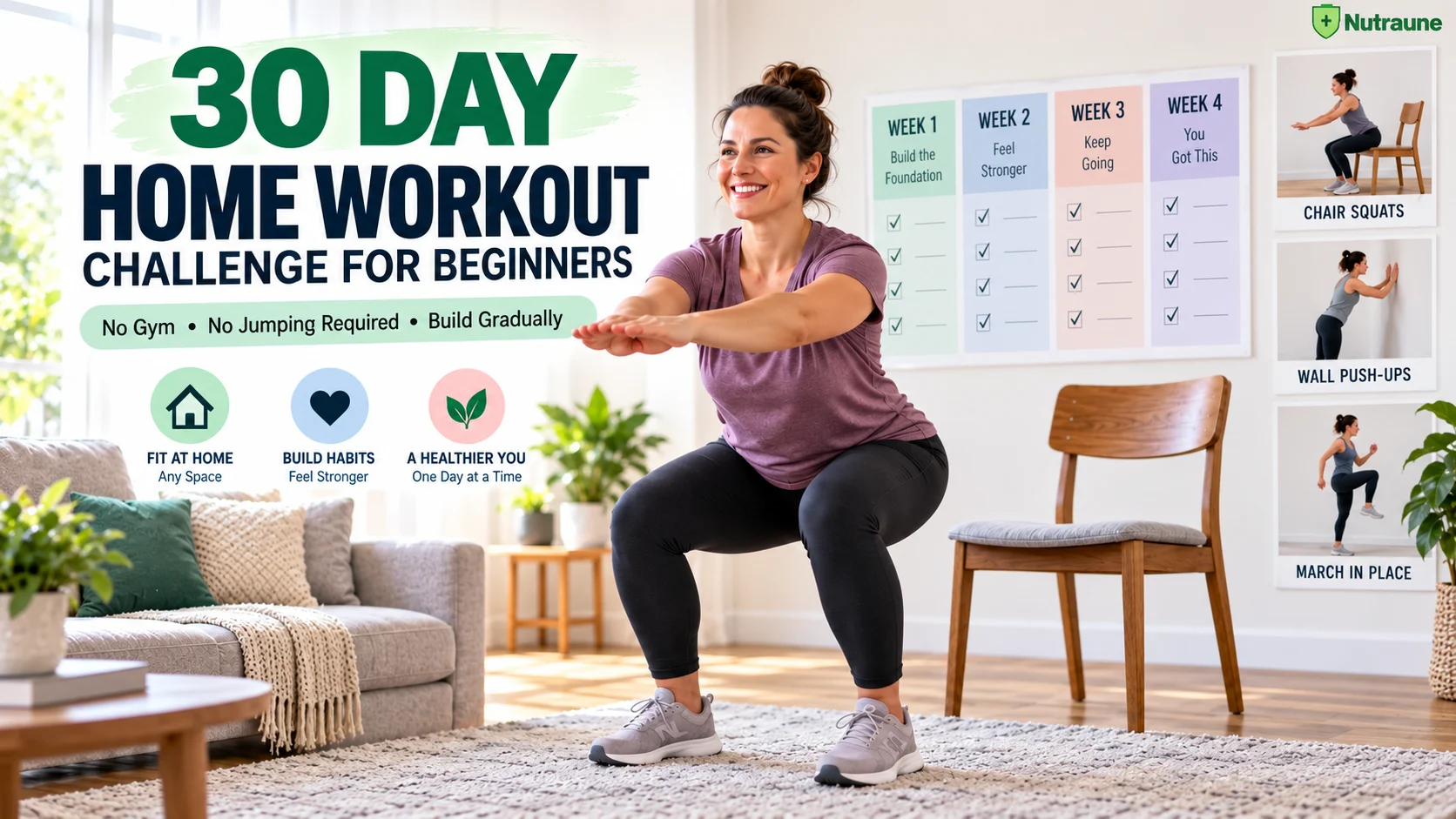
If you want a broader routine that combines different types of exercise, Nutraure’s 30-day fitness challenge for beginners can be a logical next step.
The important part is not reaching a perfect speed or step count.
It is turning walking into something you can continue doing long after the four-week calendar ends.
FAQ
How long should a beginner walk for exercise?
A complete beginner can start with 10–15 minutes if that feels manageable and increase gradually. There is no requirement to begin with 30 minutes. The American Heart Association specifically recommends short, comfortable starting durations for people who are out of shape.
How many days a week should a beginner walk?
Four walking days can be a practical starting structure, but there is no universal number. Your starting fitness, walk duration, intensity, and recovery matter. Gradually build toward the broader public-health activity recommendations rather than trying to meet them immediately.
Is 20 minutes of walking enough for a beginner?
Yes. A 20-minute walk can be a useful beginner workout and contribute to your weekly physical activity. As your fitness improves, you can increase duration or add brisk intervals.
Should beginners walk every day?
They can walk comfortably and frequently if they tolerate it well, but walking every day is not required. Rest or easier days are reasonable, particularly when you are increasing duration or intensity.
How fast should a beginner walk?
Use effort rather than chasing a fixed mph number. At moderate intensity, CDC says you can generally talk but not sing comfortably.
Do I need 10,000 steps per day?
No. Ten thousand is not a universal minimum for health or fitness. Research shows benefits across a range of daily step counts rather than a single magic threshold.
Can walking alone help me get fit?
Walking can substantially improve aerobic fitness and overall physical activity, especially when you progress from easy to brisk walking. A complete fitness program should also include muscle-strengthening activity; CDC recommends strengthening major muscle groups on at least two days per week.
Is treadmill walking as effective as outdoor walking?
Both can provide aerobic exercise when the effort is appropriate. Treadmills make speed and incline easier to control, while outdoor walking offers more natural terrain and variety. Choose the environment that you can use consistently and safely.