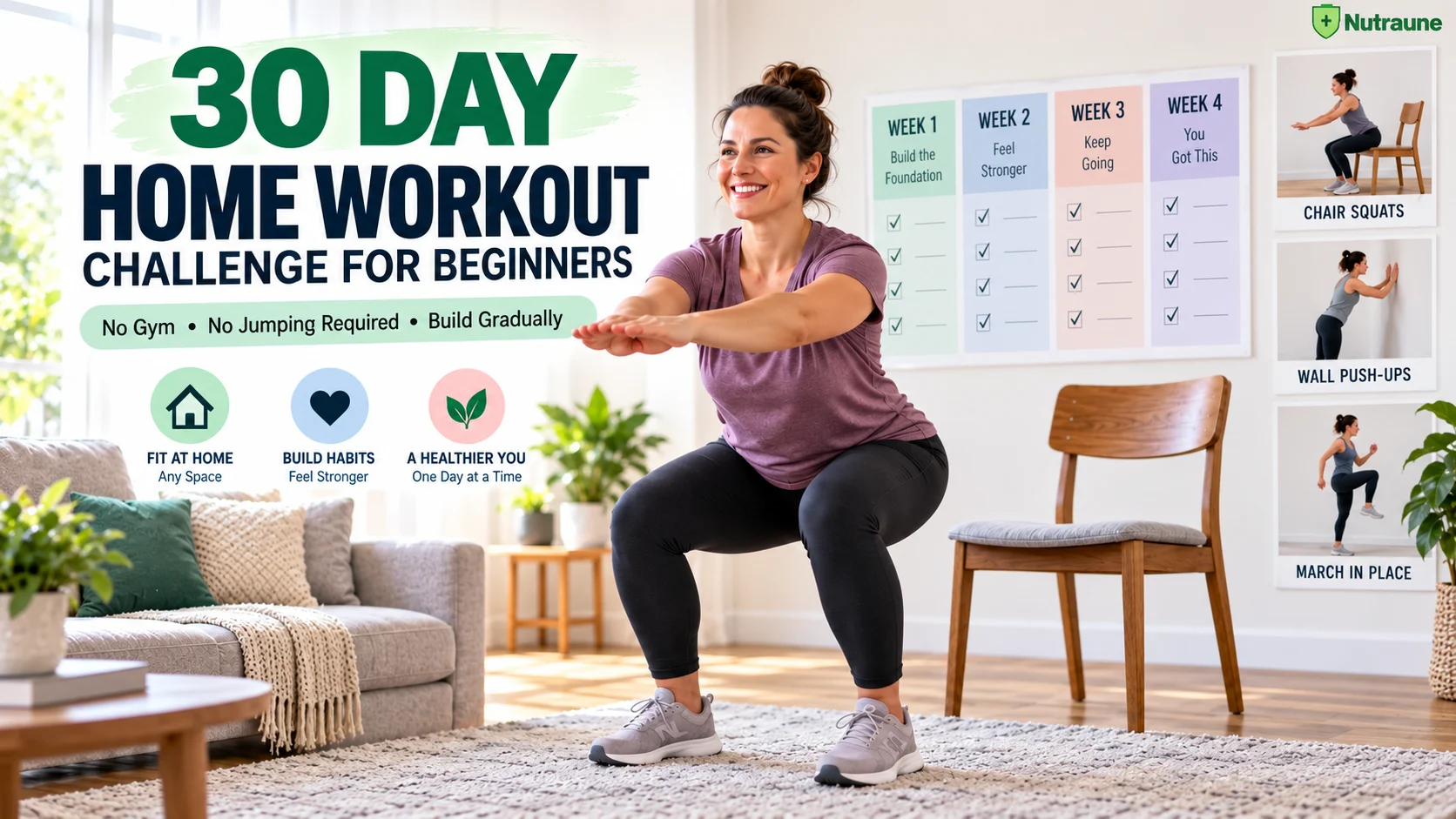
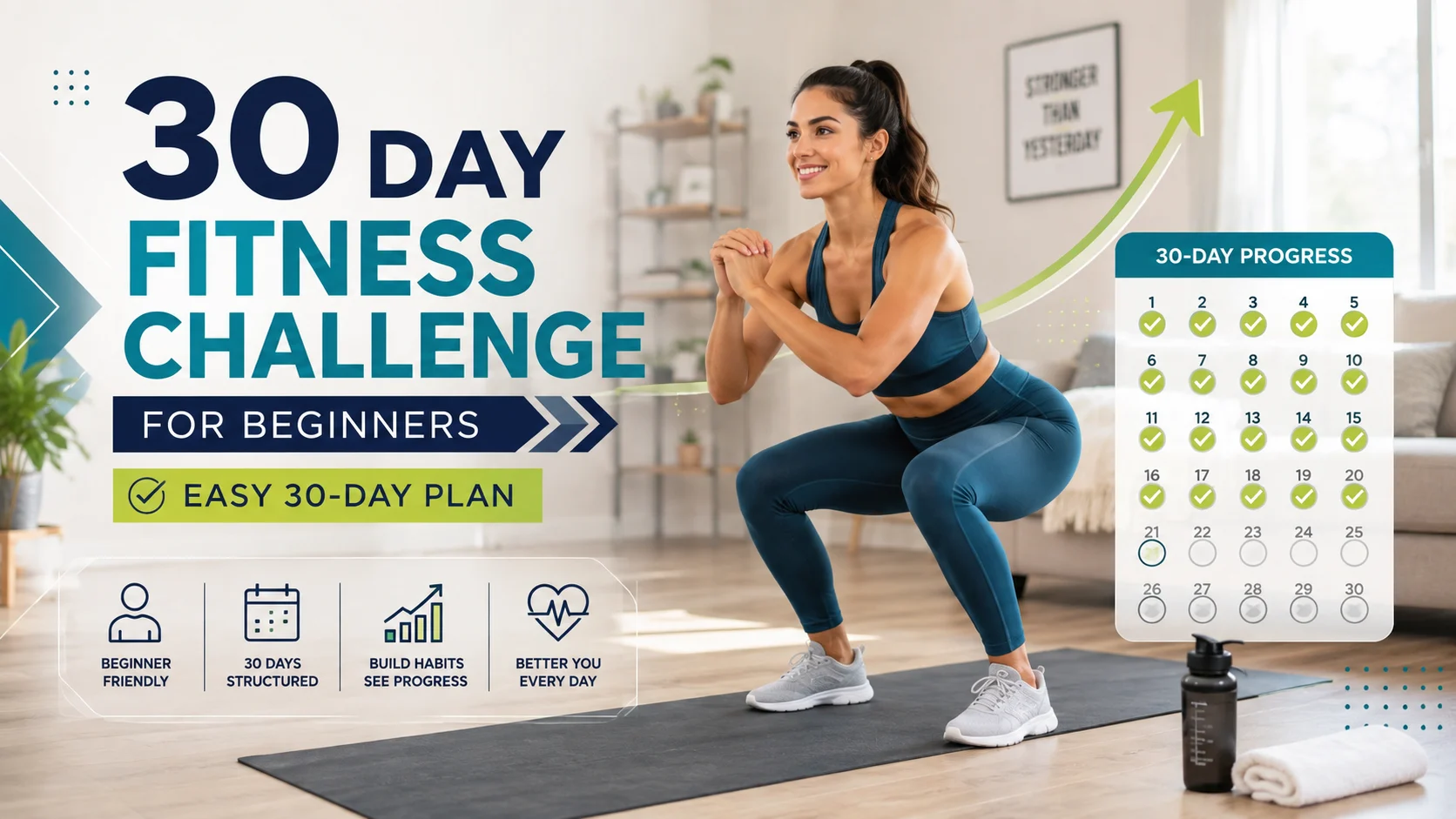
Starting a workout routine sounds simple until you actually have to decide what to do on Monday morning. Should you walk? Do squats? Try push-ups? Work out every day? And how hard should a complete beginner train?
This 30 day fitness challenge for beginners removes that guesswork.
The plan uses straightforward bodyweight exercises, low-impact cardio, mobility work, and scheduled recovery. You can complete it at home; you don’t need a gym membership, and most sessions take roughly 10–25 minutes.
More importantly, the workouts gradually become more challenging rather than throwing you into an exhausting routine on Day 1.
The goal isn’t to promise a dramatic transformation in four weeks. It’s to help you build a fitness habit, improve your strength and stamina, become more confident with basic movements, and reach Day 30 ready to keep going.
Quick answer: A 30-day beginner fitness challenge is a structured month-long exercise plan that combines simple strength, cardio, core, and mobility sessions with recovery days. Difficulty increases gradually, making it easier for someone starting from zero to develop consistency without expensive equipment or complicated workouts.
What Is a 30-Day Fitness Challenge for Beginners?
A 30-day challenge gives you one simple thing many new exercisers lack: structure.
Instead of opening a fitness app every day and wondering what workout to choose, you follow a planned schedule. Some days focus on full-body strength. Others use walking, marching, mobility, or core exercises. Recovery days give your body time to adapt.
This plan is intentionally beginner-friendly. You won’t suddenly be asked to complete dozens of burpees or advanced push-ups simply because you’ve reached Week 4.
The aim is consistent movement with gradual progression.
Who Is This Challenge For?
This beginner fitness challenge at home is designed for people who are new to structured exercise, returning after a long break, short on time, uncomfortable in a gym, or simply looking for an uncomplicated place to start.
Most movements require no specialized equipment. A sturdy chair and exercise mat are useful, but neither is essential for every workout.
If you have an injury, recently had surgery, are pregnant, have a medical condition that affects exercise, or have been advised to limit physical activity, get appropriate medical guidance before starting.

Can Beginners Really Get Fit in 30 Days?
Yes, a beginner can make meaningful fitness progress in 30 days. But it’s better to think of one month as a strong beginning rather than a complete physical transformation.
After several weeks of regular exercise, you may notice that your squats feel smoother, walking feels easier, you can perform more controlled repetitions, or you can hold a plank longer than you could on Day 1.
You may also notice something less dramatic but equally useful: working out no longer feels so unfamiliar.
Regular physical activity is associated with benefits ranging from better physical function to improved sleep and stronger muscles. Current U.S. physical activity guidance encourages inactive adults to start with manageable amounts of movement and gradually build toward broader weekly activity targets.
What Might Improve in 30 Days?
Reasonable signs of progress include:
- Better exercise consistency
- Improved movement confidence
- Increased stamina
- Better mobility
- More controlled repetitions
- Longer plank or exercise holds
- Increased strength in basic bodyweight movements
- More confidence about continuing a workout routine
What Shouldn’t You Expect?
Thirty days cannot guarantee six-pack abs, a certain amount of weight loss, huge muscle gains, or a complete body transformation.
Be especially cautious of claims that a single exercise will remove fat from a specific part of your body. Fitness and body composition don’t work that neatly.
Can This Challenge Help With Weight Loss?
It can contribute.
Exercise increases physical activity and energy expenditure, but body weight changes depend on more than just your workout calendar. Eating patterns, total activity, sleep, medications, health conditions, genetics, and your starting point can all matter.
So use this challenge to build better movement habits rather than judging its success only by the scale.

Before You Start the 30-Day Home Workout Plan
One advantage of this challenge is how little setup it requires.
Wear clothes you can move comfortably in and keep some water nearby. Supportive shoes can be useful for walking and standing movements. A phone or basic timer is enough for timed exercises.
An exercise mat, towel, and sturdy chair are optional additions.
In other words, this can work as a 30 day fitness challenge for beginners at home with no equipment beyond ordinary household items.
Record a Simple Day 1 Baseline
Before your first workout, record a comfortable—not all-out—starting point.
Write down:
- How many controlled chair squats feel comfortable
- How many wall or incline push-ups you can perform with good form
- How long you can comfortably maintain your beginner plank variation
- How a 5- or 10-minute walk or march feels
- Your general energy level from 1–10
You’ll repeat the comparison on Day 29.
Your goal isn’t to compete with anyone else’s numbers. You want a reference point for your own progress.
Follow the “Form Before Reps” Rule
Don’t sacrifice technique just to hit a number on the calendar.
If your form breaks down at eight repetitions when the plan calls for ten, eight good repetitions are more useful than two rushed ones tacked on at the end.
The calendar is a guide, not a test you can fail.
How This Easy 30-Day Workout Challenge Works
The challenge progresses in four stages.
| Week | Phase | Main Goal | Typical Session |
|---|---|---|---|
| Week 1 | Foundation | Learn the movements | 10–15 min |
| Week 2 | Build | Add a little time or volume | 15–18 min |
| Week 3 | Progress | Improve strength and endurance | 18–22 min |
| Week 4 | Confidence | Combine what you’ve learned | 20–25 min |
A typical session follows a simple flow:
Warm up for 3–5 minutes → Complete the main workout → Cool down for 3–5 minutes → Record your progress
Your warm-up might include easy marching, shoulder rolls, arm circles, hip movements, and gentle bodyweight squats.
How Hard Should a Beginner Exercise?
You should feel as though you’re working, but still in control.
During strength exercises, slow the movement enough to maintain good technique. During moderate cardio, your breathing should increase, but you shouldn’t need to turn every session into an exhausting effort.
Use an easier exercise variation when necessary. Rest longer between rounds if you need it.
That isn’t cheating. It’s how you make the plan fit your current ability.

30 Day Fitness Challenge for Beginners: Full Workout Calendar
This 30 day workout challenge for beginners alternates strength, cardiovascular movement, mobility, and recovery so that you’re not hammering the same muscles every day.
Every workout can be scaled down. Reduce repetitions, shorten an interval, use an easier variation, or complete one fewer round when necessary.
Rest days are part of the program—not missed workouts.
| Challenge Detail | Plan |
| Difficulty | Beginner |
| Location | Home |
| Equipment | None required |
| Workout time | About 10–25 minutes |
| Focus | Strength, cardio, core, mobility |
| Recovery | Built into schedule |
| Progression | Gradual |
| Jumping | Not required |
| Main goal | Build a sustainable fitness habit |
Week 1: Build the Habit
Week 1 is about learning movements rather than chasing fatigue.
Day 1 — Baseline + Full Body
Complete your baseline, then do 2 rounds: 8 chair squats, 6 wall push-ups, 10 glute bridges, a 20-second supported or elevated plank, and 60 seconds of marching.
Day 2 — Easy Cardio
Walk outside or march indoors for 10–15 minutes. Finish with gentle mobility.
Day 3 — Lower Body + Core
Complete 2 rounds: 10 chair or bodyweight squats, 8 supported reverse lunges total, 10 glute bridges, and 6 bird dogs per side.
Day 4 — Active Recovery
Take an easy 15-minute walk and spend a few minutes gently moving your hips, shoulders, and ankles.
Day 5 — Full Body
Complete 2 rounds: 10 squats, 8 wall or incline push-ups, 10 hip hinges, 10 dead bugs total, and a 60-second march.
Day 6 — Cardio + Mobility
Alternate easy marching, side steps, knee lifts, and light shadow boxing. Keep the session around 10–15 minutes.
Day 7 — Rest
Take a full rest day. Easy recreational walking is fine if you feel good.
Week 1 goal: Finish your sessions with controlled technique. Soreness is not your scorecard.
Week 2: Build Strength and Confidence
Now increase either repetitions, workout time, or rounds slightly—not everything at once.
Day 8 — Full Body
Repeat the Day 1 circuit. Add about two repetitions to an exercise only where it feels comfortable.
Day 9 — Cardio
Walk or march for 15–18 minutes at an easy-to-moderate pace.
Day 10 — Legs + Core
Complete 2–3 rounds of squats, supported reverse lunges, glute bridges, and bird dogs.
Day 11 — Active Recovery
Easy walking plus gentle stretching or mobility.
Day 12 — Full Body
Complete 2–3 rounds. If wall push-ups feel easy now, try them against a kitchen counter or another secure, elevated surface.
Day 13 — Cardio + Core
Combine low-impact cardio with a short core circuit using dead bugs, bird dogs, or your preferred beginner plank.
Day 14 — Rest
Take the day off from structured training.
Week 3: Improve Strength and Endurance
Week 3 adds a little more volume while keeping the movements familiar.
Day 15 — Full Body
Complete up to 3 controlled rounds of your main full-body circuit.
Day 16 — Low-Impact Intervals
Choose marching, side steps, low-impact knee drives, or brisk walking. Alternate approximately 40 seconds of movement with 20 seconds of easier movement or rest.
Day 17 — Lower Body + Core
Use squats, supported lunges, glute bridges, bird dogs, and a comfortable plank variation.
Day 18 — Active Recovery
Walk easily and complete a short mobility session.
Day 19 — Full Body
Use a slightly harder variation only for exercises that now feel comfortable and are performed with good technique.

Day 20 — Cardio + Core
Complete an 18–20 minute combination of low-impact cardio and basic core exercises.
Day 21 — Rest
Take a full recovery day.
Not ready to progress? Repeat the Week 2 version of an exercise. Your body doesn’t know what number is printed on the calendar.
Week 4: Put Everything Together
The final week should feel like a progression—not punishment.
Day 22 — Full-Body Circuit
Complete up to 3 rounds at a controlled pace.
Day 23 — Cardio Intervals
Complete approximately 20–22 minutes of low-impact intervals, reducing the session if needed.
Day 24 — Legs + Core
Complete up to 3 rounds of squats, supported or regular reverse lunges, bridges, bird dogs, and your plank variation.
Day 25 — Active Recovery
Walk comfortably and spend a few minutes on full-body mobility.
Day 26 — Full Body
Repeat your circuit. If you’re recovering well, you can shorten rest periods slightly instead of adding more repetitions.
Day 27 — Cardio + Mobility
Choose easy-to-moderate cardio followed by gentle mobility work.
Day 28 — Rest
Take the day off. You’ve earned it.
Day 29 — Retest
Repeat the comfortable Day 1 baseline. Compare your results without forcing a personal record.
Look for better form, easier movement, additional repetitions, a longer hold, or simply a lower feeling of effort.
Day 30 — Finish + Reset
Complete an easy full-body circuit or recovery walk. Then review the month and decide what you want to work toward next.
Beginner Exercise Guide: Form, Modifications, and Progressions
You don’t need a huge exercise library. Mastering a few basic patterns gives you a foundation you can continue using long after the challenge ends.
| Exercise | Easier Version | Main Form Cue | Next Progression |
| Squat | Chair squat | Sit hips back; keep feet planted | Bodyweight squat |
| Push-up | Wall push-up | Keep body aligned | Counter/incline push-up |
| Lunge | Supported reverse lunge | Use chair/wall for balance | Unsupported reverse lunge |
| Glute bridge | Standard bridge | Control the movement | Add a short pause |
| Plank | Elevated or knee plank | Brace without holding your breath | Lower the incline |
| Bird dog | Smaller arm/leg range | Keep hips controlled | Longer hold |
| Cardio | March in place | Stay tall and relaxed | Faster march/brisk walk |
Use This Modification Rule
If you feel pain or lose control: stop and adjust the movement.
If an exercise is very difficult but your form remains controlled: stay at that level.
If you complete every repetition comfortably: add a few repetitions, a few seconds, another round, or a slightly harder variation.
You don’t need advanced training techniques to make progress as a beginner. The important part is doing enough to challenge yourself while keeping the workout repeatable.
Recovery, Food, and Sleep During the Challenge
Training is only part of the picture.
Treat Recovery Days as Part of the Plan
Rest gives your body time to recover from training. You don’t need to “make up” a missed workout by doing two sessions the following day.
Easy walking and gentle mobility are fine on active-recovery days if you feel comfortable.
Keep Nutrition Simple
A 30-day challenge doesn’t require a detox, extreme restriction, or an expensive supplement stack.
Build meals around a variety of nutritious foods, including protein-rich options, fruits and vegetables, whole grains or other carbohydrate sources that work for you, and adequate fluids.
If weight loss is one of your goals, remember that exercise is only part of weight management. Your overall eating pattern and other individual factors matter too.
Don’t Ignore Sleep
Regular activity and adequate recovery work together. If you’re consistently exhausted, adding another hard workout isn’t automatically the solution.
Aim for a routine you can maintain beyond this month.
How to Actually Finish the 30-Day Challenge
Starting a challenge is usually easier than continuing it when work gets busy, motivation drops, or you miss a day.
Here’s the rule that makes this plan more realistic:
Use a Minimum Workout
If you genuinely don’t have time for the scheduled session, do five minutes.
March. Walk. Complete one round. Stretch.
A shorter session isn’t the same as the full workout, but keeping the habit alive may be more useful than deciding the entire day is ruined.
Don’t Restart Because You Missed One Day
Suppose you miss Day 12.
You do not need to return to Day 1.
Continue when you’re able. If the break lasts several days, repeat an easier session first and see how your body feels.
One missed workout is a scheduling problem. Turning it into a reason to quit creates a much bigger one.
Track What You Actually Do
Put a check on a calendar, use your notes app, or keep a simple workout log.
Your record doesn’t have to look perfect. Its purpose is to show you something motivation often hides: how much work you’ve already done.
What Should You Do After Day 30?
Don’t finish Day 30 and immediately start hunting for another random challenge.
Use what you’ve learned.
If the workouts still feel challenging, repeat the program with cleaner form and slightly higher repetitions where appropriate.
If you’ve outgrown them, you could add resistance bands or dumbbells, move into a structured three-day full-body strength program, increase your walking or cardio duration, or choose a specific goal such as strength, endurance, mobility, or body composition.
The real success of a 30-day plan is reaching Day 31 with a routine you want to continue.
Frequently Asked Questions
Can beginners get fit in 30 days?
Beginners can make noticeable improvements in exercise confidence, strength, stamina, mobility, and consistency over 30 days. However, one month should be treated as the beginning of a longer fitness process rather than a complete transformation.
Is a 30-day fitness challenge suitable for complete beginners?
Yes, if the challenge uses simple movements, gradual progression, exercise modifications, and scheduled recovery. A beginner plan should adapt to your ability rather than force you to match an arbitrary performance target.
How long should a beginner work out each day?
Sessions in this plan generally range from about 10 to 25 minutes. That’s a manageable starting point rather than a universal long-term exercise prescription. As fitness improves, beginners can gradually build their overall weekly activity.
Can I complete this challenge without equipment?
Yes. This is primarily a bodyweight workout for beginners. A sturdy chair can help with squats, lunges, and elevated exercises, while a mat can make floor movements more comfortable, but no specialized gym equipment is required.
Should beginners exercise all 30 days?
No. A 30-day challenge does not mean 30 hard workout days. Rest and active-recovery days are deliberately included because recovery is part of a balanced training plan.
What if I miss a workout?
Continue the plan when you’re able rather than doubling your next workout or automatically restarting from Day 1. If you’ve missed several days, returning with an easier session is a sensible way to assess how you feel.
Can a 30-day fitness challenge help with weight loss?
It can increase your physical activity and support weight-management efforts, but exercise alone cannot guarantee a particular amount of weight loss. Nutrition, overall activity, sleep, individual biology, medications, medical conditions, and your starting point can influence results.
What should I do after the 30 days?
Move into a routine you can maintain. You might repeat the challenge at a slightly harder level, begin resistance training, increase your walking, or choose another structured program based on a specific goal.
Final Takeaway
You don’t need a gym, complicated equipment, or an exhausting workout every day to begin improving your fitness.
Start at a level you can control. Use easier exercise variations when necessary. Take your recovery days. Track your progress. Increase the challenge only when your technique and recovery support it.
The best 30 day fitness challenge for beginners isn’t the hardest challenge you can survive. It’s one that helps you become consistent enough to keep moving on Day 31.