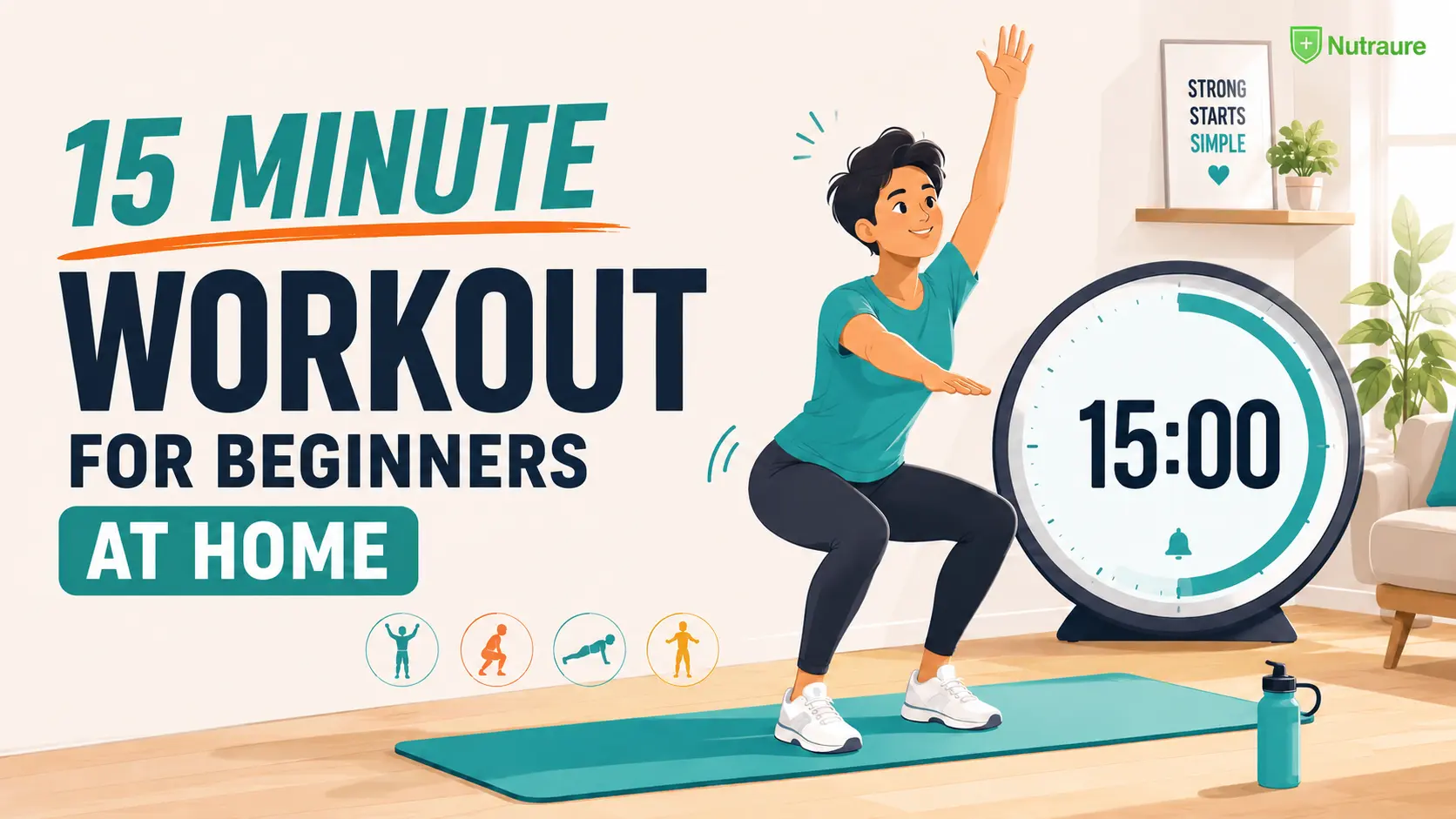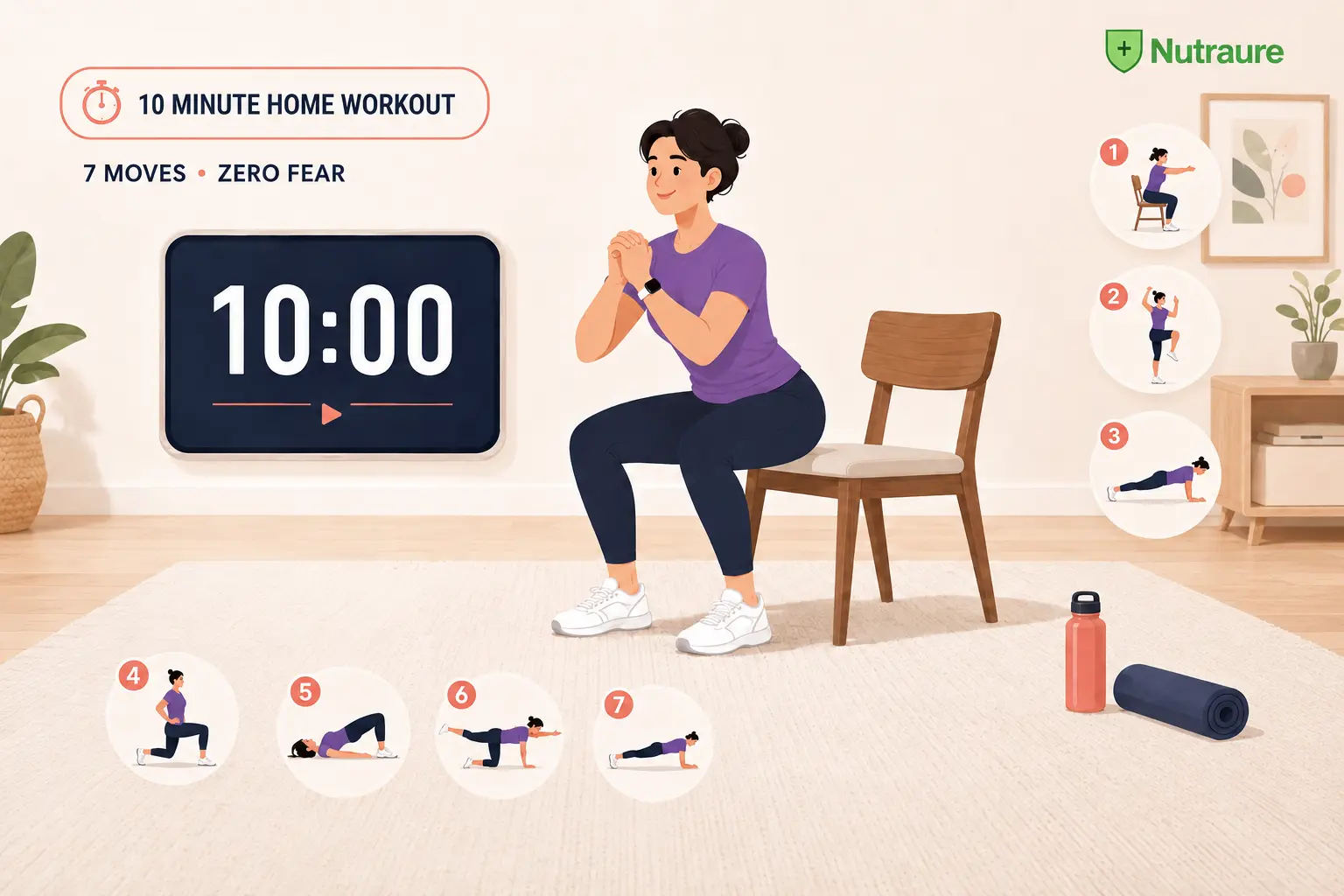
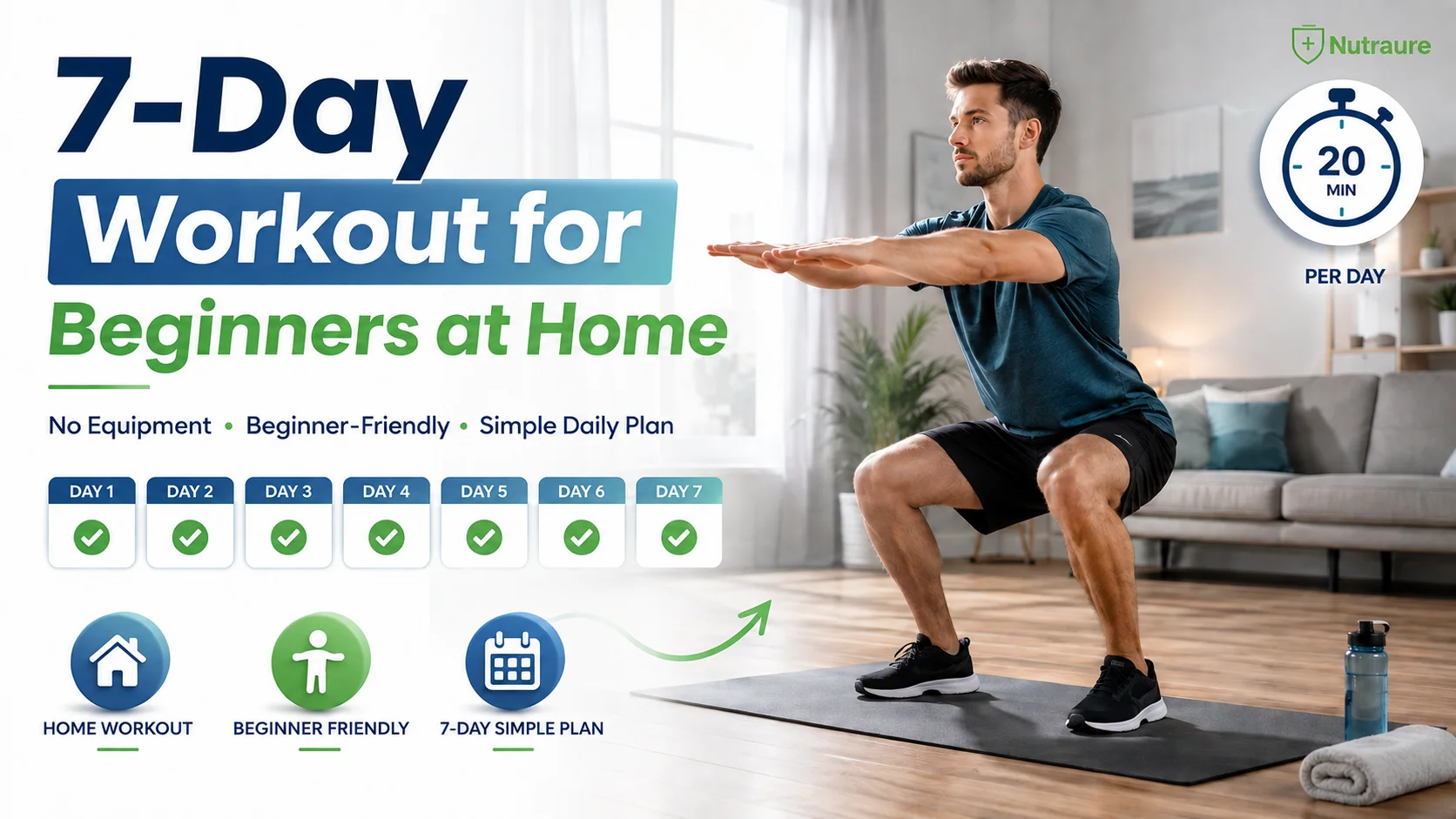
Starting a fitness routine can feel harder than the workout itself. You may not know which exercises to choose, how long to exercise, or whether you are doing each movement correctly. Add gym fees and complicated equipment, and it becomes easy to keep putting off your first session.
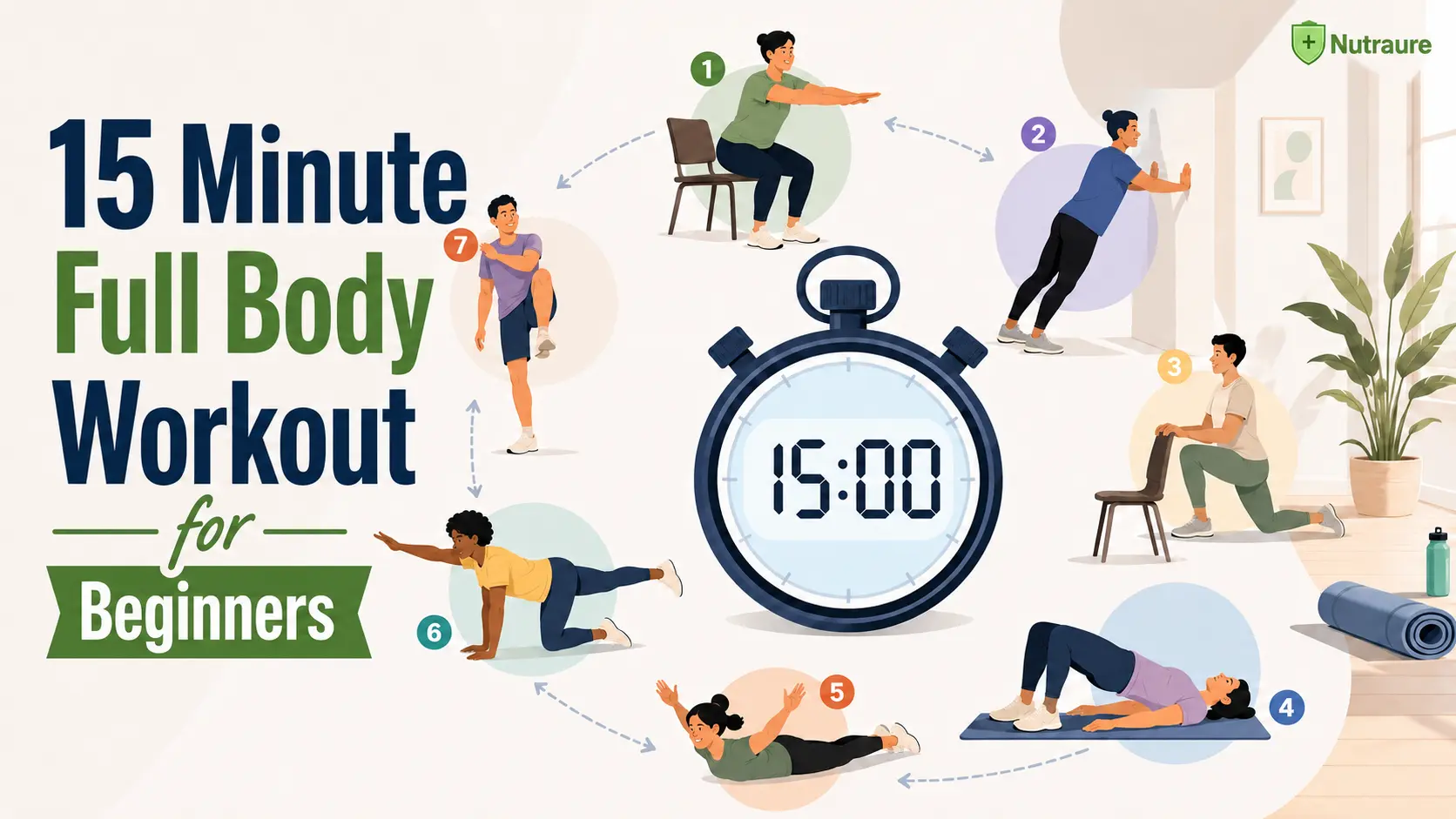
This workout for beginners at home no equipment gives you a simpler place to start. It combines basic strength movements, low-impact cardio, core work, mobility, and recovery across seven manageable days.
Most sessions take about 10–20 minutes. You can perform them in a living room, a bedroom, or any other clear space. A sturdy chair, wall, or kitchen counter may be used for support, but no fitness equipment is required.
The goal is not to transform your body in one week. It is to learn the basic movements, discover your current fitness level, and build enough confidence to continue.
Quick answer: A beginner home workout without equipment uses your body weight as resistance. This plan includes five structured workout days and two lighter recovery days. Start with the easiest exercise variations, move at a controlled pace, and take additional rest whenever you need it.
What Is a Workout for Beginners at Home With No Equipment?
A no-equipment home workout is a routine that uses bodyweight exercises instead of dumbbells, resistance machines, or other gym equipment. Squats, wall push-ups, glute bridges, planks, and marching in place are common examples.
This style of training is sometimes called bodyweight training or beginner calisthenics. Your muscles still work against resistance—the resistance simply comes from your own body rather than an external weight. The American Heart Association includes exercises that use the body’s own resistance in strength and resistance training.
This plan is designed for:
- Absolute beginners who are unsure where to start
- People returning after a long break from exercise
- Busy adults who need short, practical sessions
- People who do not have a gym membership
- Anyone exercising in a small room or apartment
- Beginners who need low-impact exercise options
You do not need to complete every movement perfectly on your first attempt. Your first week is for learning the routine and finding exercise variations that suit your ability.
Why This 7-Day Beginner Home Workout Works

This plan works as a starting routine because it removes several common barriers at once. There is no travel time, expensive equipment, complicated setup, or expectation that you already understand advanced fitness terminology.
It also gives each day a clear purpose. Instead of randomly choosing exercises, you will work on full-body strength, cardio, core stability, lower-body strength, upper-body control, mobility, and recovery.
Bodyweight movements can help you train major muscle groups, while marching, step jacks, and standing knee drives add aerobic activity. Regular physical activity is associated with better sleep, stronger bones and muscles, improved balance, and a lower risk of several chronic health conditions.
The need for an accessible starting point is significant. The World Health Organization reports that approximately 31% of adults worldwide do not meet recommended physical activity levels. WHO also emphasizes that any amount of activity is better than none and that all movement counts.
This seven-day plan will not automatically meet every long-term fitness recommendation. It is a foundation. As your stamina improves, you can gradually add walking or other aerobic activity and work toward the broader recommendation of at least 150 minutes of moderate activity per week, along with muscle-strengthening activity on two or more days.
Before You Start: Safety, Setup, and Warm-Up
This routine is written for generally healthy adults beginning a basic exercise program. It is not individualized medical or rehabilitation advice.
Speak with a qualified healthcare professional before beginning if you have an injury, a chronic health condition, unexplained pain, significant balance problems, or concerns about how exercise may affect you. The CDC also advises people with chronic conditions to discuss appropriate types and amounts of activity with a healthcare provider.
Stop exercising if you experience sharp pain, faintness, chest discomfort, or unusual shortness of breath. Normal muscular effort may feel challenging, but it should not feel like sudden or severe pain.
What You Need
You only need:
- Comfortable clothing
- A clear, non-slip floor
- Water
- A timer or phone
- A sturdy chair, wall, or counter for support
- An optional exercise mat or folded towel
Make sure the chair cannot roll or slide. Move rugs, cables, toys, and other trip hazards before starting.
Complete This 5-Minute Warm-Up
A gradual warm-up raises your heart rate and prepares your muscles for the movements ahead. The American Heart Association’s warm-up guidance recommends warming up for approximately 5–10 minutes, depending on the activity.
Perform each movement slowly:
- March in place — 60 seconds: Let your arms swing naturally.
- Arm circles — 30 seconds each direction: Keep the circles small if your shoulders feel tight.
- Hip circles — 30 seconds: Use a chair for balance if necessary.
- Bodyweight good mornings — 45 seconds: Soften your knees and push your hips back while keeping your spine neutral.
- Ankle rolls or heel raises — 45 seconds: Move through a comfortable range.
- Easy chair squats — 60 seconds: Sit down gently and stand again.
How Hard Should the Workout Feel?
Use the talk test rather than chasing a specific calorie number. During moderate activity, your breathing and heart rate increase, but you can still carry on a conversation.
For this first week, aim to finish each session feeling as though you could have completed a little more. You do not need to exercise until exhaustion.
7-Day Workout for Beginners at Home No Equipment
Complete the warm-up before Days 1, 2, 3, 5, and 6. Rest for 20–30 seconds between exercises or longer if needed. A beginner who needs 45–60 seconds of rest is still completing the workout correctly.
Day 1: Full-Body Foundation Workout
Goal: Learn five basic movement patterns without rushing.
Complete two rounds:
- Chair squat — 30 seconds
Stand in front of a chair with your feet about hip-width apart. Push your hips back, sit down lightly, and stand by pressing through your feet. - Wall push-up — 30 seconds
Place your hands against a wall at chest height. Keep your body in a straight line, bend your elbows, and bring your chest toward the wall. - Glute bridge — 30 seconds
Lie on your back with your knees bent. Press through your heels and lift your hips without excessively arching your lower back. - Bird-dog — 30 seconds
From your hands and knees, slowly extend one arm and the opposite leg. Use a smaller movement if maintaining balance is difficult. - March in place — 45 seconds
Stand tall and lift one knee at a time. Keep one hand on a chair if needed.
Beginner focus: Move slowly enough to notice which muscles are working. Good control matters more than completing a high number of repetitions.
Day 2: Low-Impact Cardio and Core
Goal: Increase your heart rate while practicing core control.
Complete two rounds. Work for 30 seconds and rest for 30 seconds:
- Step jacks: Step one foot to the side while lifting your arms, then return to the middle and switch sides.
- High-knee march: Lift each knee only as high as you can without leaning backward.
- Standing knee-to-elbow: Bring one knee toward the opposite elbow without forcing them to touch.
- Dead bug heel taps: Lie on your back with your knees bent. Brace your abdomen and slowly tap one heel to the floor.
- Incline plank: Place your hands on a wall or sturdy counter and hold your body in a straight line.
Keep both feet close to the floor during the standing movements. You do not need to jump to make the session useful.
Day 3: Lower-Body Strength and Balance
Goal: Strengthen your legs, hips, and glutes while improving stability.
Complete 10–12 controlled repetitions of each exercise. Repeat the circuit twice:
- Chair squats
- Supported reverse lunges
- Calf raises
- Glute bridges
- Standing side leg raises
For a supported reverse lunge, hold a wall or chair, step one foot back, and lower only as far as feels stable. If lunges bother your knees or balance, use a split stance and perform a small up-and-down movement instead.
During side leg raises, keep your toes pointing forward. Avoid leaning your entire body in the opposite direction.
Day 4: Active Recovery and Mobility
Goal: Reduce the intensity while keeping your daily movement habit.
Spend 10–15 minutes on the following sequence:
- Walk or march gently for two minutes.
- Perform eight slow cat-cow movements.
- Complete eight standing hip circles in each direction.
- Hold a gentle chest-opening stretch for 20–30 seconds.
- Hold a hamstring stretch for 20–30 seconds on each side.
- Finish with slow breathing for one or two minutes.
Mobility work should feel gentle. Do not force a deeper stretch simply because another person appears more flexible.
If kneeling is uncomfortable, skip cat-cow and use standing pelvic tilts instead. Day 4 is not a test. Its purpose is to give your body a break from harder training while preserving the routine you are building.
Day 5: Upper-Body and Posture Workout
Goal: Train your chest, shoulders, arms, upper back, and core.
Complete two rounds:
- Wall push-ups — 8–12 repetitions
- Wall shoulder taps — 8–10 per side
- Arm circles — 20 seconds in each direction
- Standing “W” squeeze — 10–12 repetitions
- Incline plank hold — 20–30 seconds
For the standing “W” squeeze, bend your elbows and bring them close to your sides so your arms form a W shape. Gently draw your shoulder blades together, pause, and release. Avoid shrugging your shoulders toward your ears.
To make wall push-ups slightly harder, move your feet farther from the wall. To make them easier, stand closer.
Day 6: Full-Body Conditioning Circuit
Goal: Combine strength and low-impact cardio in one continuous routine.
Complete three rounds. Work for 30 seconds, rest for 20 seconds, and take up to one minute between rounds:
- Chair or bodyweight squats
- Wall or countertop push-ups
- Glute bridges
- Wall mountain climbers
- Standing punches
- Incline plank hold
Wall mountain climbers are performed with your hands against a wall or counter. Bring one knee forward at a time while keeping your movement controlled.
This is the most demanding session of the week, but it should not become an all-out effort. Although routines like this are often described as “fat-burning workouts,” no single circuit guarantees fat loss. Its practical value is that it moves several major muscle groups and increases your total activity.
Day 7: Recovery, Stretching, and Habit Check-In
Goal: Recover and decide how to continue next week.
Walk around your home or march gently for three minutes. Then stretch your calves, thighs, hips, chest, shoulders, and back. Hold each comfortable stretch for approximately 20–30 seconds without bouncing.
Afterward, answer these questions:
- Which exercise felt most natural?
- Which movement was hardest to control?
- Did you need less rest by the end of the week?
- Did any movement cause discomfort that needs attention?
- What time of day made the workout easiest to complete?
- What is one realistic improvement for next week?
Progress can be as simple as feeling less confused by the routine. You do not need dramatic physical changes after seven days for the week to count as a success.

Best No-Equipment Exercises for Beginners
A balanced beginner home workout does not need dozens of movements. A smaller group of exercises can cover the main movement categories.
Lower-Body Exercises
Chair squats train the thighs and hips while providing a clear depth target. Glute bridges strengthen the muscles around the hips without requiring standing balance. Calf raises work the lower legs, while supported lunges introduce single-leg control.
Upper-Body Exercises
Wall push-ups are an accessible way to begin pressing movements. Moving from a wall to a counter, then to a lower surface, makes the exercise progressively harder.
Wall shoulder taps and standing W squeezes add shoulder stability and upper-back work without requiring floor-based strength.
Core Exercises
Your core does more than create visible abdominal muscles. It helps control your trunk as your arms and legs move.
Dead bugs, bird-dogs, and incline planks allow beginners to practice this control without performing fast twisting or repeated sit-ups.
Low-Impact Cardio Exercises
Marching in place, step jacks, standing knee drives, and wall mountain climbers raise your heart rate without requiring repeated jumping. You can increase the challenge by moving your arms more actively or holding the exercise longer—without sacrificing control.

Common Beginner Workout Mistakes
Doing Too Much Too Soon
An exhausting first workout can leave you so sore or discouraged that you avoid the next one. Starting below your maximum ability gives you room to improve.
The American Heart Association recommends gradually increasing the amount and intensity of physical activity.
Treating Rest as Failure
Taking an extra 30 seconds does not ruin a workout. Rest allows your breathing to settle and helps you perform the next movement with better control.
Ignoring Exercise Form
Fast repetitions can hide poor technique. Use a mirror, record a short video for your own review, or ask a qualified trainer to check your form if you are uncertain.
Skipping the Warm-Up and Cooldown
A warm-up provides a gradual transition into exercise, while a cooldown lets your heart rate come down gradually rather than stopping suddenly.
Expecting Visible Results in Seven Days
One week is enough to begin a habit, but not enough to promise a complete physical transformation. Look for early signs of progress, such as better coordination, greater confidence, increased energy, or fewer pauses during familiar movements.
Turning Every Session Into a Weight-Loss Test
Do not judge a workout only by sweat, calories, or soreness. Physical activity can support weight management, but the amount required varies between individuals. Weight loss generally depends on total activity and nutrition creating an overall calorie deficit—not on one particular exercise.
How to Progress After the First Seven Days
You do not need an entirely new routine after Day 7. Repeat the plan for another 2 to 4 weeks, changing one variable at a time.
Add Time
Increase the exercise interval from 30 seconds to 35 or 40 seconds.
Add Repetitions
If 10 chair squats feel comfortable and you have good control, try 12. Avoid adding repetitions if your form begins to break down.
Add One Round
Move from two circuits to three on one or two workout days. Do not add a round to every session at once.
Use a Harder Variation
Progress from:
- Chair squats to controlled bodyweight squats
- Wall push-ups to countertop push-ups
- Wall planks to countertop planks
- Step jacks to slightly quicker step jacks
- Supported lunges to lightly supported or unsupported lunges
Reduce Rest Gradually
A beginner resting for 45 seconds might move to 35–40 seconds after the routine becomes familiar. There is no need to eliminate rest completely.
Add Walking
This plan includes short cardio intervals, but additional walking can help you meet general weekly aerobic activity recommendations. The CDC’s adult activity guidance notes that the recommended weekly minutes can be divided into smaller sessions.
Benefits of a Beginner Workout at Home
The most obvious benefit is convenience. You can exercise without commuting, waiting for equipment, or planning around a gym’s opening hours.

A no-equipment routine can also help you:
- Practice basic movement skills privately
- Build strength using scalable bodyweight exercises
- Improve balance and coordination
- Increase daily movement
- Create a repeatable exercise habit
- Learn which movements need modification
- Make exercise more accessible when time or money is limited
Regular physical activity is associated with both immediate and long-term health benefits, including improved sleep, reduced feelings of anxiety, better bone health, and a lower risk of several chronic diseases.
The most important benefit during your first week, however, may be psychological: the routine stops feeling unknown. Once you know what Day 1 looks like, starting it again becomes easier.
Frequently Asked Questions
Can beginners get fit at home without equipment?
Yes. Bodyweight movements can provide resistance, while marching, step jacks, and similar exercises add aerobic activity. Over time, however, the routine must become more challenging through longer intervals, additional repetitions, more rounds, harder variations, or added resistance.
How long should a beginner home workout be?
Ten to 20 minutes is a practical starting range for many beginners. A shorter routine you can repeat is usually more useful than an ambitious workout you avoid.
As your fitness improves, gradually increase your total weekly activity. General adult guidance recommends at least 150 minutes of moderate aerobic activity per week and muscle-strengthening activity on two or more days.
Should beginners exercise every day?
You can move every day, but each session shouldn’t be intense. This plan alternates structured workouts with active recovery and mobility.
Take an additional rest day if you feel unusually tired or sore. A missed day does not require you to double the next workout. Continue from where you stopped.
What are the best no-equipment exercises for beginners?
Useful beginner exercises include chair squats, wall push-ups, glute bridges, bird-dogs, dead bugs, incline planks, calf raises, step jacks, and marching in place. The best choices are movements you can perform with control and without pain.
Can this workout help with weight loss?
It can increase your physical activity and support a broader weight-management plan. It cannot guarantee weight loss by itself.
The CDC explains that weight loss results from a calorie deficit and that both regular activity and eating patterns play a role. The amount of exercise needed also differs between individuals.
Can I perform the workout in a small apartment?
Yes. Most movements require little more than enough room to lie down and extend your arms and legs. Replace traveling movements with marching or stepping in place, and avoid jumping if noise or floor stability is a concern.
What if I cannot perform push-ups or lunges?
Use a simpler variation. Perform push-ups against a wall and hold a chair during split-stance movements. You can also replace lunges with chair squats or small supported step-backs.
A modification is not a failed version of an exercise. It is the version that currently allows you to train with control.
Should I repeat this seven-day workout?
Yes. Repeat it for approximately two to four weeks if the exercises remain appropriately challenging. Progress one element at a time rather than changing the entire routine.
If the plan becomes easy even after adding time, repetitions, or harder variations, you may be ready for a more structured strength program.
Start Small and Keep Going
You do not need a gym, advanced exercises, or a perfect schedule to begin moving more.
This workout for beginners at home, no equipment, gives you a clear first week: learn the basic movements, use modifications when needed, recover between harder sessions, and pay attention to how your body responds.
Start with Day 1 rather than worrying about Day 7. Once the first session is complete, the plan is no longer something you intend to do. It is something you have started.