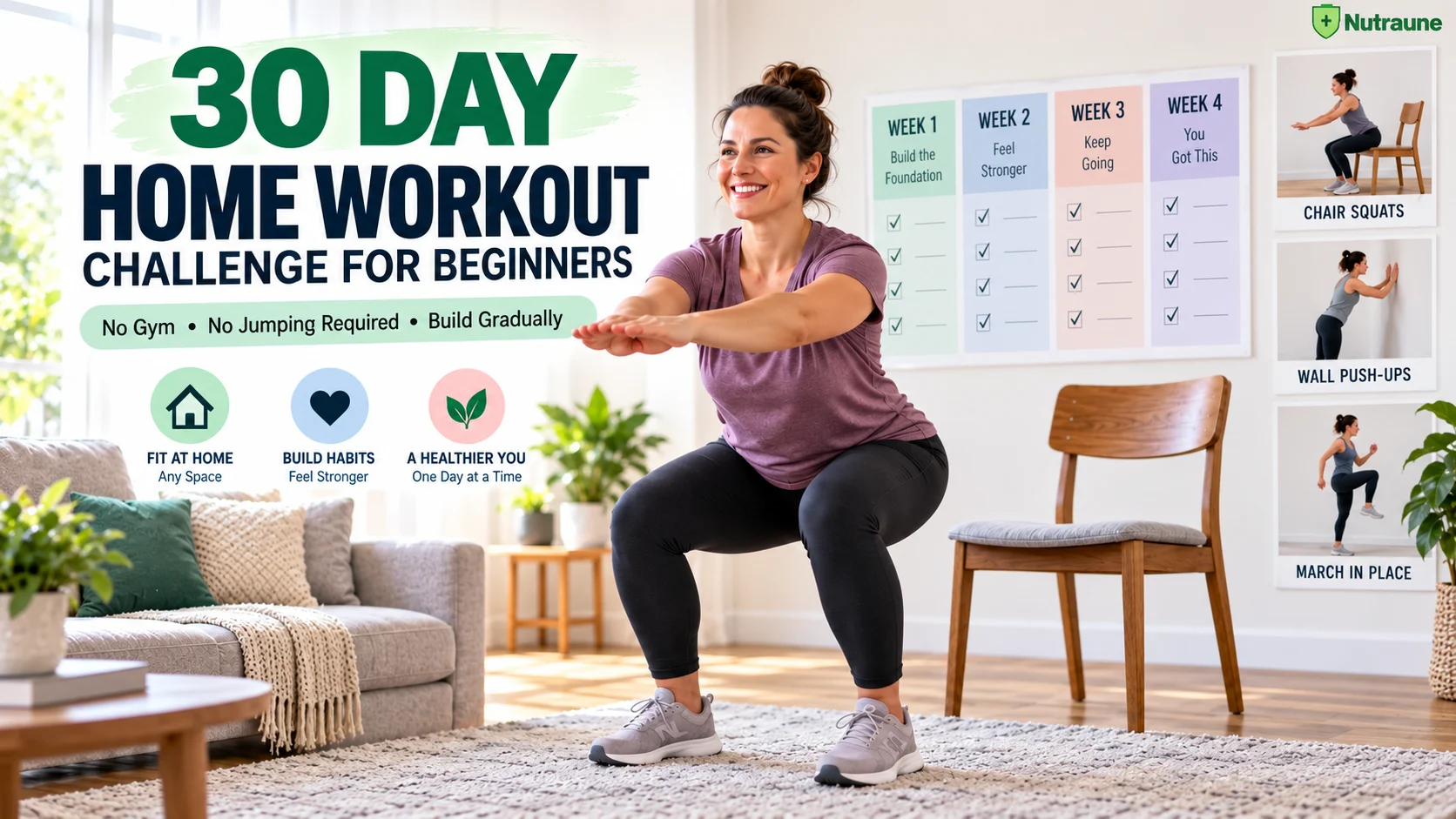
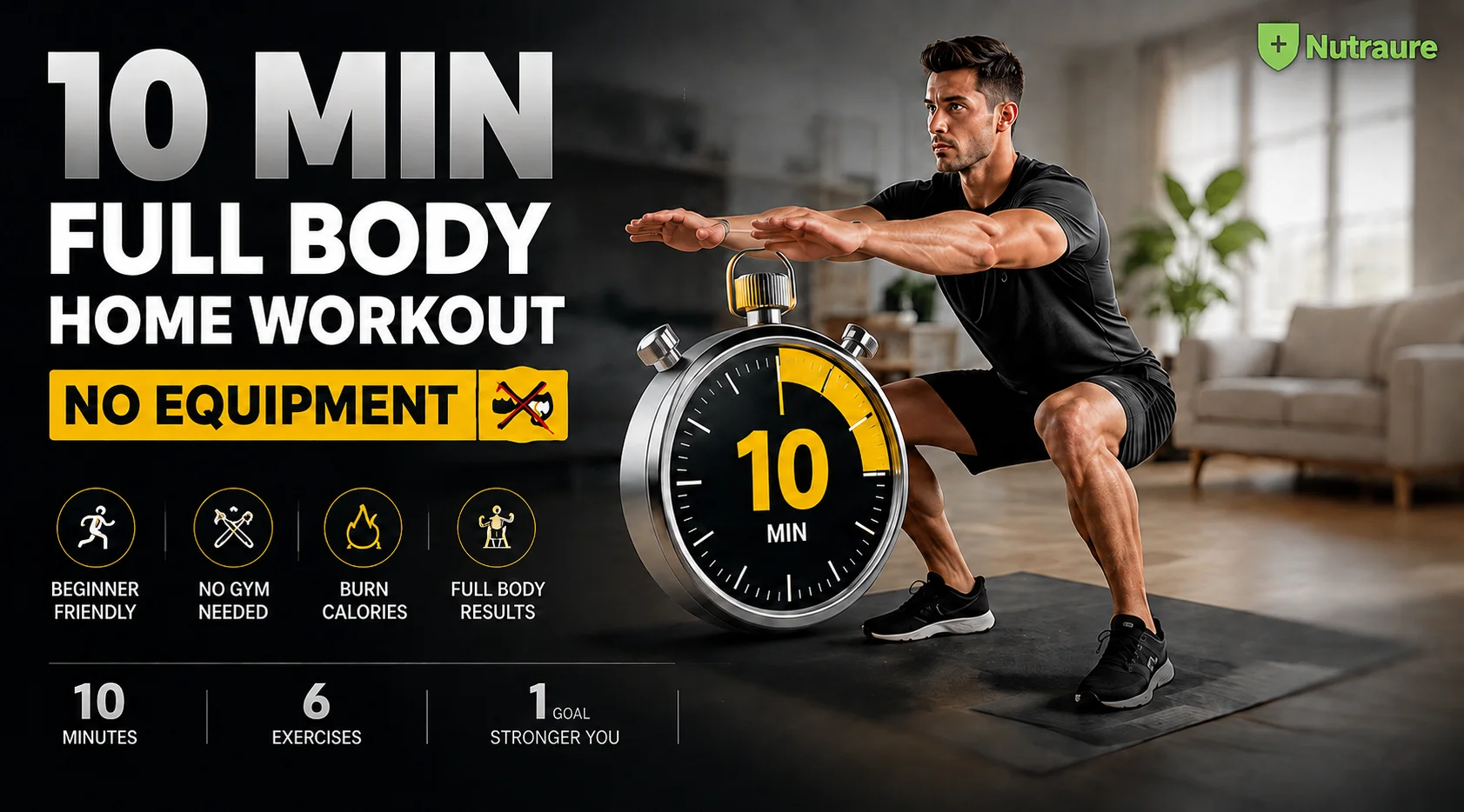
Starting a workout routine does not have to mean buying expensive equipment or spending hours at the gym. A beginner full body home workout no equipment routine can help you build strength, improve mobility, and create a consistent fitness habit using only your body weight and a small amount of space.
If you are new to exercise, busy with work, studying, or simply looking for an easy way to become more active, a 10-minute home workout can be a practical starting point. The goal is not to complete the hardest workout possible. The goal is to move consistently, learn proper exercise form, and gradually improve your fitness level.
This beginner-friendly routine combines simple bodyweight exercises that target major muscle groups, including your legs, upper body, and core, as well as your cardiovascular system. You do not need dumbbells, machines, or a gym membership — just a few minutes, comfortable clothing, and the motivation to begin.
A short workout may seem simple, but when performed regularly, it can become the foundation of a healthier lifestyle.
What Is a 10-Min Beginner Full Body Home Workout No Equipment?
A beginner full body home workout no equipment is a simple exercise routine designed to train multiple muscle groups without using weights, machines, or fitness equipment.
Instead of relying on external resistance, these workouts use bodyweight exercises where your own body provides the resistance. Movements such as squats, push-ups, lunges, and planks help beginners develop basic strength, balance, and coordination.
The main purpose of a beginner home workout is to make exercise accessible. Many people avoid fitness because they believe they need a gym, a personal trainer, or complicated equipment. A no-equipment workout removes these barriers.
A 10-minute routine usually includes three sections:
- Warm up to prepare your muscles and joints.
- Workout circuit using several full-body exercises.
- Cooldown to help your body recover.
This structure makes it easier for beginners to understand how exercise works and build confidence before moving to longer or more challenging routines.

Why This 10-Minute Workout Matters for Beginners
Many beginners struggle with consistency, not motivation. A workout plan that requires too much time, equipment, or preparation can become difficult to maintain.
A short 10-minute full body workout at home creates a lower barrier to exercise. Instead of waiting for the perfect time or environment, you can complete a quick session almost anywhere.
Builds Strength Without Weights
Bodyweight training helps beginners develop functional strength by using natural movement patterns.
Exercises like:
- Squats strengthen the legs and glutes.
- Push-ups train the chest, shoulders, and arms.
- Planks activate the core muscles.
- Lunges improve lower-body stability.
These movements teach your body how to control and support itself.
For beginners, learning proper movement patterns is often more important than lifting heavy weights. Good technique creates a strong foundation for future fitness progress.
Improves Energy and Physical Fitness
Regular movement can support better energy levels and overall physical fitness.
A consistent home exercise routine can help improve:
- Cardiovascular endurance
- Muscle coordination
- Flexibility
- Daily movement ability
Even simple exercises can challenge your muscles when performed with controlled movements and proper form.
According to health organizations such as the World Health Organization, regular physical activity plays an important role in maintaining overall health.
Helps Build a Long-Term Exercise Habit
One of the biggest advantages of a beginner workout routine at home is consistency.
A 10-minute session feels achievable. This makes it easier to create a daily or weekly habit.
Instead of thinking:
“I need one hour to exercise.”
You can start with:
“I only need 10 minutes today.”
Small actions repeated over time can create meaningful lifestyle changes.
Beginner Workout Benefits at a Glance
| Benefit | How It Helps |
|---|---|
| Strength | Builds functional muscle control |
| Mobility | Supports easier movement |
| Endurance | Improves stamina |
| Consistency | Makes exercise easier to maintain |

How the 10-Min Beginner Full Body Workout Works
This beginner workout follows a simple circuit format:
- 1-minute warm-up
- 8-minute exercise circuit
- 1 minute cooldown
Total time:
10 minutes
You can complete this workout in your living room, bedroom, office, or any area with enough space to move safely.
Step 1: Warm-Up (1 Minute)
Before exercising, spend one minute preparing your body.
A simple warm-up:
Arm Circles
Move your arms in controlled circles to loosen your shoulders.
Marching in Place
Lift your knees gently while keeping your posture upright.
Shoulder Rolls
Roll your shoulders forward and backward to reduce stiffness.
The purpose of warming up is to prepare your muscles and joints for movement.
Step 2: Main Workout Circuit (8 Minutes)
Perform each exercise:
40 seconds workout
20 seconds rest
Move through each exercise with control. Beginners should focus on quality movement rather than speed.
1. Bodyweight Squats
Targets:
- Legs
- Glutes
- Core
How to perform:
- Stand with feet about shoulder-width apart.
- Keep your chest lifted.
- Lower your hips as if you were sitting in a chair.
- Push through your feet to return upward.
Beginner modification:
Use a chair behind you for support until you feel comfortable.
Common mistake:
Avoid letting your knees collapse inward during the movement.
2. Incline or Knee Push-Ups
Targets:
- Chest
- Shoulders
- Arms
Push-ups are excellent upper-body exercises, but beginners may need an easier variation.
Options:
- Wall push-ups
- Incline push-ups using a table
- Knee push-ups
Focus on keeping your body controlled instead of rushing through repetitions.
3. Mountain Climbers
Targets:
- Core
- Cardio endurance
Mountain climbers combine core stability with cardiovascular movement.
Beginner version:
Perform them slowly by bringing one knee forward at a time.
Focus on:
- Keeping your back stable.
- Engaging your stomach muscles.
- Maintaining steady breathing.
4. Standing Lunges
Targets:
- Legs
- Glutes
- Balance
- Core stability
Standing lunges are among the best full-body exercises for beginners because they build lower-body strength while improving coordination.
How to perform:
- Stand tall with your feet hip-width apart.
- Step one foot forward.
- Lower your hips until both knees are bent comfortably.
- Push through your front foot to return to the starting position.
- Switch sides.
Beginner modification:
If balancing feels difficult, perform reverse lunges or hold onto a stable surface lightly for support.
Common mistake:
Avoid pushing your front knee too far inward. Keep your knee aligned with your toes.
5. Plank Hold
Targets:
- Core muscles
- Shoulders
- Posture support
The plank is a simple but effective bodyweight exercise that teaches beginners how to engage their core muscles.
How to perform:
- Place your hands or forearms on the floor.
- Keep your body in a straight line.
- Tighten your stomach muscles.
- Hold the position while breathing normally.
Beginner modification:
Start with a 10–20 second hold and gradually increase the duration.
Common mistake:
Do not let your hips drop too low or rise too high. Maintain a controlled position.
6. Jumping Jacks or Low-Impact Jacks
Targets:
- Full body movement
- Cardiovascular endurance
Jumping jacks increase heart rate and add a cardio element to this beginner workout routine at home.
Beginner option:
If jumping feels uncomfortable:
- Step one foot out at a time.
- Move your arms overhead.
- Maintain a steady pace.
The goal is not maximum intensity. The goal is consistent movement.
Step 3: Cool Down (1 Minute)
After completing your workout circuit, spend one minute allowing your body to recover.
Try:
Deep Breathing
Slowly inhale and exhale to lower your breathing rate.
Gentle Stretching
Stretch:
- Legs
- Shoulders
- Back
Recovery Movement
Walk slowly around your space for a few seconds.
A cooldown helps transition your body from exercise back to a relaxed state.

Beginner Full Body Home Workout Exercise Breakdown
A successful beginner workout is not only about completing exercises. It is about understanding how each movement works and how to perform it safely.
Here is a deeper look at the main exercises in this no-equipment home workout.
Bodyweight Squats: Build Lower Body Strength
Squats are often called a fundamental movement because we perform similar motions in everyday activities, such as sitting down or standing up.
Benefits:
- Strengthens thighs and glutes.
- Improves lower-body control.
- Helps develop movement confidence.
Beginner tips:
- Keep your chest upright.
- Move slowly.
- Avoid rushing repetitions.
- Focus on a comfortable range of motion.
Progression:
Once regular squats become easier, beginners can increase repetitions or slow down the movement for more control.
Push-Ups: Strengthen the Upper Body
Push-ups train multiple upper-body muscles at the same time.
They work:
- Chest muscles
- Shoulder muscles
- Triceps
- Core stabilizers
Many beginners cannot perform traditional push-ups immediately, and that is completely normal.
Start with:
Wall Push-Ups
Best for complete beginners.
Incline Push-Ups
Use a table or elevated surface.
Knee Push-Ups
A stepping stone toward standard push-ups.
Focus on building strength gradually instead of comparing your progress with others.
Mountain Climbers: Combine Core and Cardio
Mountain climbers are useful because they combine strength and movement.
They challenge:
- Core stability
- Coordination
- Cardiovascular endurance
For beginners:
Perform slow mountain climbers.
Think about:
“Control first, speed later.”
Maintaining proper form is more valuable than completing many fast repetitions.
Lunges: Improve Balance and Stability
Lunges train each side of your body separately, helping improve balance and coordination.
Benefits include:
- Stronger legs.
- Better stability.
- Improved lower-body movement.
Beginners should focus on:
- Small controlled steps.
- Stable posture.
- Smooth movement.
Planks: Strengthen Your Core
A strong core supports many daily movements.
Planks help beginners learn to brace their abdominal muscles and maintain control of their bodies.
Remember:
A shorter plank with correct form is better than a longer plank with poor posture.
Jumping Jacks: Add Simple Cardio
Jumping jacks are an easy way to increase movement intensity without equipment.
They help:
- Increase heart rate.
- Improve coordination.
- Add variety to workouts.
For beginners who prefer low impact:
Replace jumping with side steps.
Beginner Workout Schedule: How Often Should You Do This?
A common mistake beginners make is trying to exercise intensely every day from the beginning.
A better approach is to build consistency gradually.
Here is a simple beginner fitness plan:
Week 1–2
Aim for:
3 workout days per week
Example:
- Monday: Workout
- Wednesday: Workout
- Friday: Workout
Focus:
- Learning exercise form.
- Building confidence.
- Creating a routine.
Week 3–4
Progress to:
4–5 workout days per week
Add:
- Longer walks.
- Mobility exercises.
- Light stretching.
Remember that recovery is part of progress.
Your body needs time to adapt and become stronger.
Health organizations recommend regular physical activity and encourage inactive people to start with smaller amounts and gradually increase frequency and intensity over time.

Common Beginner Mistakes During Home Workouts
Even simple workouts can become ineffective if performed incorrectly.
Avoid these common mistakes.
Skipping Warm-Up
Some beginners immediately start intense movements without preparing their bodies.
Why it matters:
A warm-up helps your body transition into exercise.
Better approach:
Spend one minute moving your joints to increase your body temperature.
Moving Too Fast With Poor Form
Many beginners think faster means better.
However, poor technique can reduce the effectiveness of exercise.
Instead:
- Slow down.
- Control your movement.
- Focus on proper posture.
Quality repetitions matter more than quantity.
Doing Too Much Too Soon
A common beginner mistake is increasing workout difficulty too quickly.
Examples:
- Exercising intensely every day.
- Adding too many repetitions.
- Ignoring muscle soreness.
A sustainable approach is gradual improvement.
Ignoring Recovery
Rest days are important.
Recovery helps your body adapt to exercise.
Include:
- Sleep.
- Hydration.
- Stretching.
- Balanced nutrition.
How to Make Your No-Equipment Workout More Effective
A simple workout can become more challenging over time without adding equipment.
Try these strategies:
Improve Exercise Form
Before increasing intensity, improve your technique.
Ask yourself:
- Is my posture correct?
- Am I controlling the movement?
- Am I breathing properly?
Increase Repetitions Gradually
Example:
Week 1:
10 squats
Week 2:
15 squats
Week 3:
20 squats
Small improvements create long-term progress.
Reduce Rest Time Slowly
If your workout feels easier, reduce your rest period slightly.
Example:
Beginner:
40 seconds exercise
20 seconds rest
Later:
45 seconds exercise
15 seconds rest
Track Your Progress
Keep simple notes:
- Workout days completed.
- Exercises performed.
- How do you feel after training?
Tracking creates awareness and motivation.
Who Can Do This Beginner Full Body Home Workout?
A beginner full body home workout no equipment routine is designed to be accessible for most people who want to start moving more.
This workout can be suitable for:
- Complete beginners starting their fitness journey
- Busy professionals with limited time
- Students who want a simple exercise routine
- People who prefer exercising at home
- Anyone returning to fitness after a long break
- People with limited workout space
The biggest advantage of a no equipment home workout is flexibility. You do not need a large room, expensive equipment, or a complicated training plan.
However, every person has a different fitness level. Beginners should choose exercise variations that match their current ability.
For example:
- A beginner may start with wall push-ups instead of regular push-ups.
- Someone with limited mobility may perform slower movements.
- Someone with more experience can increase the number of repetitions or the workout intensity.
The goal is progress, not perfection.
A successful fitness routine is one that you can maintain consistently.
Key Facts About 10-Minute Home Workouts
Short workouts are becoming popular because many people struggle to find time for longer exercise sessions.
A 10-minute workout can be valuable because it removes common barriers:
- Lack of time
- Lack of equipment
- Lack of gym access
- Lack of confidence
Important points to remember:
10 Minutes Can Be a Starting Point
A short workout may feel easier to start, especially for someone new to exercise.
Starting with manageable sessions can help create a regular habit.
Bodyweight Exercises Train Multiple Muscle Groups
Many no-equipment exercises engage multiple muscle groups at once.
Examples:
- Squats work the lower body and core.
- Push-ups involve the upper body and stabilizing muscles.
- Planks challenge core control.
Consistency Matters More Than Occasional Intense Workouts
A simple workout performed regularly is often easier to maintain than an advanced routine that is difficult to follow.
Physical activity guidelines from organizations such as the Centers for Disease Control and Prevention emphasize the importance of regular movement for overall health.
Quick Workout Summary
10 Minutes
Complete beginner-friendly session
6 Exercises
Train your entire body
0 Equipment
Use only your body weight
3–5 Days Weekly
Build a consistent routine
Beginner Full Body Home Workout: Quick Routine Summary
Here is the complete 10-minute workout plan:
| Time | Activity |
|---|---|
| Minute 1 | Warm-up |
| Minutes 2–9 | Exercise circuit |
| Minute 10 | Cooldown |
Workout circuit:
- Bodyweight squats
- Incline or knee push-ups
- Mountain climbers
- Standing lunges
- Plank hold
- Jumping jacks or low-impact jacks
Repeat consistently and adjust the difficulty according to your fitness level.
How to Start Working Out at Home Without Equipment
Starting is often the hardest part.
Follow these simple steps:
1. Choose a Fixed Time
Pick a realistic time:
- Morning before work
- Evening after studying
- Lunch break
A consistent schedule makes exercise easier to remember.
2. Prepare Your Space
You only need:
- Enough room to move safely
- Comfortable clothing
- Water nearby
A simple environment reduces excuses.
3. Focus on Building the Habit
Do not worry about being perfect during your first workouts.
Your first goal should be:
“Show up and complete the session.”
Fitness improves through repeated practice.
Final Takeaway: Start Small, Stay Consistent
A 10-minute beginner full body home workout no equipment routine is a simple way to begin improving your fitness without needing a gym, weights, or complicated programs.
The most important step is starting.
By practicing basic bodyweight movements, focusing on proper form, and staying consistent, beginners can build strength, improve movement, and develop a healthier daily routine.
Remember:
A small workout today is better than waiting for the perfect time tomorrow.
Frequently Asked Questions (FAQ)
Can beginners really get results from a 10-minute home workout?
Yes. A 10-minute workout can help beginners build consistency in exercise, improve movement skills, and strengthen major muscle groups when performed regularly.
The results depend on factors such as workout frequency, exercise quality, nutrition, sleep, and overall lifestyle habits.
What is the best beginner full body home workout without equipment?
A balanced beginner workout usually includes movements that target different areas of the body.
Examples include:
- Squats for legs
- Push-ups for upper body
- Lunges for balance
- Planks for core strength
- Cardio movements for endurance
The best routine is one that matches your fitness level and that you can follow consistently.
How many days a week should beginners do home workouts?
Most beginners can start with about 3 days per week and gradually increase as comfort and recovery allow.
A beginner home workout plan should allow enough rest between sessions.
Consistency is more important than doing extremely difficult workouts.
Can I lose weight with a no equipment home workout?
A no-equipment workout can support weight management by increasing physical activity and burning calories.
However, weight changes depend on several factors, including:
- Overall calorie intake
- Nutrition habits
- Daily movement
- Sleep quality
- Workout consistency
A balanced lifestyle works better than relying only on exercise.
Do I need gym equipment for a full body workout?
No. Many effective exercises use your own body weight as resistance.
Exercises such as:
- Squats
- Push-ups
- Lunges
- Planks
Can train multiple muscle groups without equipment.
Is a 10-minute workout enough for beginners?
Yes, especially as a starting point.
For someone who is inactive, a short workout can help build confidence and create a regular exercise habit.
As fitness improves, beginners can gradually increase the duration or intensity of their workouts.
What should I do after completing this beginner workout?
After becoming comfortable with this routine, you can progress by:
- Increasing repetitions
- Adding more workout rounds
- Extending workout duration
- Trying more advanced bodyweight exercises
Progress should happen gradually.