

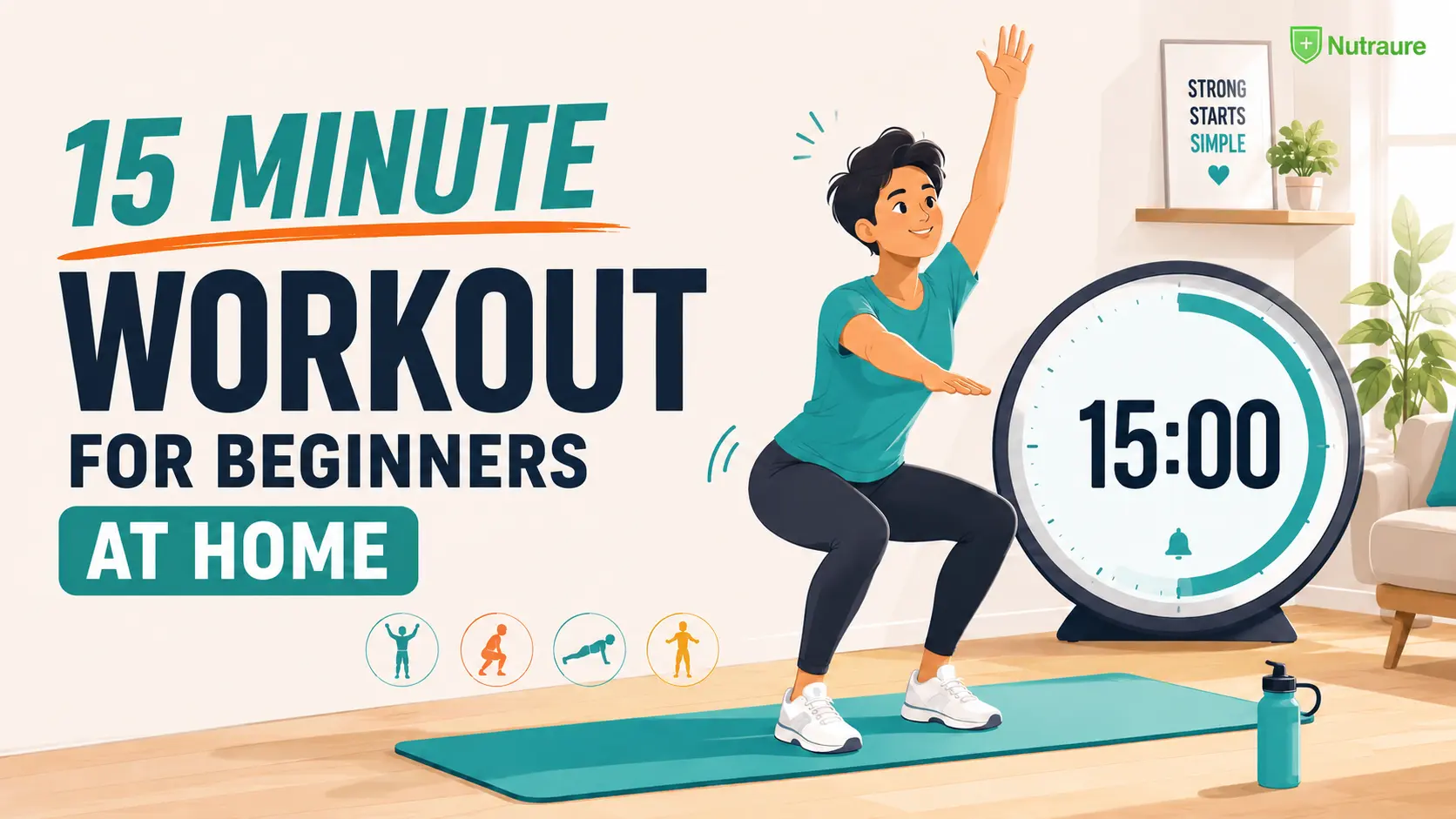
No gym, no equipment, and barely any free time? This 15-minute workout for beginners at home is designed for exactly that situation. You don’t need special gear; you can do it in a small space, and every move has an easier version. It combines simple strength movements with light cardio, and it takes exactly 15 minutes, including your warm-up and cooldown.
One honest note up front: no single 15-minute session will magically burn significant fat on its own. But as a starting point for building consistency, it works. Let’s get into it.
Your 15 Minute Workout for Beginners at Home — Quick Overview
Before I explain the details, here’s what you’re getting. A 2-minute warm-up, a 10-minute circuit, and a 3-minute cooldown. All bodyweight, all low-impact, all beginner-friendly.
What You’ll Need
- Comfortable clothing
- Supportive shoes (optional but helpful)
- Exercise mat (optional)
- A chair or wall for balance modifications
- Water nearby
- A timer or phone
The 15-Minute Workout at a Glance
| Time | Activity |
|---|---|
| 0:00–2:00 | Beginner warm-up |
| 2:00–12:00 | Full-body circuit (5 exercises × 2 rounds) |
| 12:00–15:00 | Cooldown |
The main circuit has five exercises. You do each one for 40 seconds, rest for 20 seconds, then repeat the whole circuit once. That gives you an exact 10-minute block — no guesswork.
Is a 15-Minute Workout Actually Enough?
This is probably the first question that came to mind. Let’s be realistic.
What 15 Minutes Can Do
A short session like this works well as:
- A way to build an exercise habit without overwhelming yourself
- A tool for increasing daily movement on busy days
- A method for practicing bodyweight movements with good form
- A way to break up long periods of sitting
Official physical activity guidelines from the U.S. Department of Health and Human Services recommend that adults aim for at least 15–30 minutes of moderate-intensity aerobic activity per week, plus muscle-strengthening activities on at least two days. But — and this matters — those same guidelines explicitly say inactive adults should start with smaller amounts and build gradually. That’s what this workout supports.
What 15 Minutes Cannot Promise
I want to be straightforward here. Fifteen minutes of exercise is not a magic solution for fat loss. That depends on your overall activity levels, nutrition, sleep, stress, and consistency over weeks and months, not a single session.
Before You Start This Beginner Home Workout
Clear Your Workout Space
You need enough room to take a step backward, stretch your arms overhead without hitting anything, and lie down if you’re doing glute bridges. A standard living room or bedroom corner works fine.
Use the Talk Test
You should be able to speak a short sentence during the workout — not sing, but not gasp either. Beginners don’t need to train at maximum intensity. Save that for later.
When to Stop
Stop immediately if you feel unusual chest pain, severe dizziness, faintness, or sharp joint pain. If you have a significant health condition, a recent injury, pregnancy-related concerns, or any medical restrictions, check with a healthcare professional before starting any new exercise program.
How This 15-Minute Full-Body Workout Works
This is a 15-minute full-body workout for beginners. Here’s the structure:
- 2-minute warm-up
- 10 minutes circuit (5 exercises × 40 seconds work + 20 seconds rest × 2 rounds)
- 3-minute cooldown
40 Seconds Work + 20 Seconds Rest
The 20-second rest matters. It gives you enough time to reset your posture, take a quick breath, and prepare for the next move. This rhythm helps beginners maintain good form throughout the entire circuit.
Five Beginner Bodyweight Exercises
Here are the exercises:
- Squat to Reach
- Wall or Incline Push-Up
- Alternating Reverse Lunge
- Standing Cross-Body Knee Drive
- Glute Bridge
Together, these train your lower body, upper body, core, and cardiovascular system. No single move is overly complicated, and every one has an easier option if needed.
2-Minute Beginner Warm-Up
Don’t skip this. It warms up your muscles and slightly raises your heart rate, so the circuit feels smoother.

0:00–0:30 — March in Place
Stand tall. Lift your knees to a comfortable height. Swing your arms naturally. Keep your shoulders relaxed, not hunched.
0:30–1:00 — Step Touch With Arm Swings
Step to the right, bring your left foot in, and swing both arms overhead. Repeat to the left. This gently opens up your shoulders and hips.
1:00–1:30 — Bodyweight Good Morning
Stand with feet hip-width apart. Place your hands behind your head. Hinge at your hips, pushing your glutes backward while keeping your back flat. Return to standing. Go slowly.
1:30–2:00 — Chair Squat or Sit-to-Stand
Stand in front of a chair. Sit back until you lightly touch the seat, then stand back up. This activates your legs and knees before the circuit starts.
The 10-Minute Fat-Burning Beginner Workout
This is the main event. Read through each move once, then start your timer.
Exercise 1 — Squat to Reach
40 seconds work / 20 seconds rest
Feet roughly hip-to-shoulder width. Sit your hips backward like you’re lowering into a chair. Keep your knees tracking in line with your toes — don’t let them collapse inward. Stand back up and reach your arms overhead.
Works: Quads, glutes, core
Beginner modification: Use a chair. Lower until you lightly touch the seat, then stand. That’s one rep.
Common mistake: Rushing the depth or letting your knees cave inward. Go slower than you think you need to.
Exercise 2 — Wall or Incline Push-Up
40 seconds work / 20 seconds rest
Place your hands on a wall at shoulder height. Walk your feet back until your body forms a straight line from head to heels. Bend your elbows and bring your chest toward the wall. Push back to start.
Works: Chest, shoulders, triceps, core
Make it easier: Use a higher wall angle.
Make it harder: Move to a sturdy countertop or the edge of a couch. This progression is useful because many other routines jump straight into floor push-ups, which most beginners can’t do yet.
Exercise 3 — Alternating Reverse Lunge
40 seconds work / 20 seconds rest
Stand tall. Step one foot backward, lower your back knee toward the floor — only as far as feels comfortable. Push through your front foot to return to a standing position. Alternate sides.
Works: Quads, glutes, hamstrings, balance
Beginner modification: Hold a wall or chair with one hand and reduce your range of motion.
Knee-friendly alternative: Instead of lowering fully, perform backward toe taps without deeply bending either knee.
Exercise 4 — Standing Cross-Body Knee Drive
40 seconds work / 20 seconds rest
Stand upright. Bring one knee up toward the opposite elbow while staying tall. Alternate sides smoothly. This is a core-focused movement that also raises your heart rate a bit.
Works: Core, hip flexors
Beginner modification: Slow it down to a controlled march.
Higher-intensity option: Increase tempo without jumping — keep both feet on the ground at all times.
Exercise 5 — Glute Bridge
40 seconds work / 20 seconds rest
Lie on your back with knees bent and feet flat on the floor. Brace your core lightly, lift your hips toward the ceiling, squeeze your glutes at the top, then lower with control.
Works: Glutes, hamstrings, trunk stability
No-floor alternative: Standing hip extensions while holding the back of a chair work well if lying down is uncomfortable.
Repeat the Circuit for Round 2
At the 7-minute mark, start over from Exercise 1. Maintain control rather than chase more reps. Choose the easier version if your technique starts falling apart. Extra recovery is fine if you need it.
| Round | Time |
|---|---|
| Round 1 | 2:00–7:00 |
| Round 2 | 7:00–12:00 |

3-Minute Cooldown After Your Workout
12:00–13:00 — Slow March + Breathing
Gradually slow your pace. Take a few deep breaths in through your nose, out through your mouth. Let your heart rate come down naturally.
13:00–14:00 — Standing Quad/Hip Stretch
Stand on one leg (hold a wall if needed). Gently pull your opposite foot toward your glutes. Hold for 30 seconds, then switch sides.
14:00–15:00 — Chest, Shoulder and Upper-Back Stretch
Clasp your hands behind your back, straighten your arms, and open your chest. Then cross one arm across your body and gently press it toward your chest with the other hand. Hold 15 seconds per side.
Need an Easier Version? Use These Low-Impact Modifications

| Regular Move | Easier Beginner Version |
|---|---|
| Squat to reach | Chair sit-to-stand |
| Incline push-up | Wall push-up |
| Reverse lunge | Supported backward toe tap |
| Cross-body knee drive | Slow marching in place |
| Glute bridge | Standing hip extension |
The Beginner Effort Rule
Good form comes first. Controlled repetitions matter more than trying to “burn” the maximum number of calories. If you feel your form slipping, take the easier version or rest a few extra seconds.
How Often Should Beginners Do This 15-Minute Workout?

Simple Beginner Weekly Schedule
Here’s one way to structure your first few weeks:
| Day | Activity |
|---|---|
| Monday | 15-minute workout |
| Tuesday | Easy walking or mobility |
| Wednesday | 15-minute workout |
| Thursday | Recovery or easy movement |
| Friday | 15-minute workout |
| Saturday | Optional walk or activity |
| Sunday | Full recovery |
This is an example, not a fixed prescription. Adjust based on how your body feels.
How to Progress After 2–4 Weeks
- Week 1: Focus on learning each movement with good form
- Week 2: Complete both rounds consistently without skipping exercises
- Week 3: Increase movement pace slightly while maintaining control
- Week 4: Use harder exercise versions (e.g., move from wall push-up to counter push-up)
Later progression could include adding resistance bands or light dumbbells. Official guidelines emphasize gradually increasing your total weekly activity toward the broader aerobic and strengthening recommendations.
Will This 15-Minute Workout Burn Fat?
Let’s answer this directly because the title promises fat-burning, and I don’t want to overpromise.
Exercise Burns Energy — but Fat Loss Is Bigger Than One Workout
A short workout contributes to your total daily energy expenditure. That’s a good thing. But I’m not going to give you a universal calorie-burn number because individual variation is massive. Your body size, exercise intensity, fitness level, movement selection, and rest time all affect how much energy you burn.
For Better Long-Term Results
Fat loss that lasts usually involves:
- Consistent physical activity over weeks and months
- Gradual progression in difficulty or duration
- Adequate sleep and recovery
- Appropriate nutrition (not extreme restriction)
- Daily movement outside formal workouts
No single 15-minute routine replaces those bigger factors. But as a consistent starting point that gets you moving, it has value.
5 Beginner Workout Mistakes to Avoid
Going Too Fast
Speed kills form. Move at a pace that lets you control every repetition.
Skipping the Easier Modification
Taking an easier version isn’t a step backward. It’s a step that lets you build strength safely.
Holding Your Breath
People do this unconsciously. Breathe normally throughout each movement.
Trying to Make Every Workout Maximum Intensity
Beginners need recovery and gradual progression, not constant max effort.
Expecting Instant Weight-Loss Results
One workout won’t change your body composition. Consistency across weeks matters far more than any single session.
Frequently Asked Questions
Is a 15-minute workout enough for beginners?
It’s a practical starting point, and it’s better than doing nothing. Official physical activity guidelines support starting with small amounts when you’re inactive. As your fitness improves, aim to gradually increase your total weekly activity.
Can a 15-minute workout help you lose weight?
It contributes to your overall energy expenditure, but no single routine guarantees weight loss. Long-term results depend on your total activity level, nutrition, sleep, and consistency.
Can I do this beginner workout every day?
That depends on your intensity level and recovery. Most beginners benefit from alternating workout days with walking or easier activity. Listen to your body.
Do I need equipment for this 15-minute home workout?
No. A chair or wall can help with modifications, but you don’t need any special equipment.
Is this workout suitable if I can’t jump?
Yes. Every exercise in the core routine can be done without jumping.
How many calories does a 15-minute beginner workout burn?
There’s no universal number. Calorie burn varies significantly based on your body size, effort level, and exercise selection.
Should I eat before a 15-minute workout?
It depends on your comfort. Some people prefer to go on an empty stomach for short sessions. Others do better with a light snack 30–60 minutes beforehand. Experiment and see what works for you.
What should I do when the workout becomes easy?
Increase difficulty gradually by improving your movement quality, using a fuller range of motion, increasing repetitions or tempo, or trying harder exercise versions.
Your Next 15 Minutes Can Be Your Starting Point
This 1515-minuteorkout for beginners at home is designed to meet you where you are. Start at your current level, use the modifications freely, focus on good form, repeat it consistently, and progress when you’re ready.
Save or bookmark this page and try the workout three times this week. The hardest part is starting — and you just did.


1 thought on “Fat-Burning! 15 Minute Workout for Beginners at Home”