
Starting a walking workout sounds simple until you try to decide how far, how fast, and how often you should actually walk.
Should your first session be 10 or 3 minutes? Do you need 10,000 steps? Is an easy stroll enough, or does every walk need to leave you breathing hard?
For a beginner, the best answer is usually simpler: start with an amount you can repeat, learn what moderate effort feels like, then build gradually.
This walking workout for beginners gives you a first session you can use today, a four-week plan, an easy way to judge your pace, and clear rules for deciding when to progress.
You don’t need a gym, a smartwatch, or a complicated training program.
What Should a Beginner Walking Workout Look Like?
If you’re currently inactive, start with about 10–20 minutes at a comfortable effort three or four days this week. Build the habit before trying to walk faster or farther.
Public-health recommendations are a destination, not an entrance exam. WHO recommends that adults aim for 150–300 minutes of moderate-intensity aerobic activity per week and emphasizes that some activity is better than none.
Source: WHO physical activity guidance
Your First 20-Minute Walking Workout
If 20 minutes feels manageable:
| Time | What to do |
|---|---|
| Minutes 0–5 | Walk easily and let your body warm up |
| Minutes 5–15 | Increase to a purposeful pace |
| Minutes 15–20 | Slow gradually to an easy pace |
During the middle section, you should feel that you’re exercising, but you shouldn’t have to race.
If 20 minutes sounds like too much, use the same structure for 10 minutes:
3 minutes easy → 4 minutes purposeful → 3 minutes easy.
That’s still a workout.

How Hard Should a Beginner Walk?
For most beginners, moderate effort is a better target than a specific speed.
The CDC gives a practical test: during moderate-intensity activity, you can generally talk but not sing.
That is more useful than assuming everyone must walk at the same speed, in miles or kilometers per hour.
| Effort | How it feels | Talk test | Use |
|---|---|---|---|
| Easy | Relaxed | Conversation and singing are easy | Warm-up/recovery |
| Moderate | Purposeful | Can talk, but singing becomes difficult | Main beginner pace |
| Hard | Heavy breathing | Only short phrases are comfortable | Not necessary for most first-week walks |
On a 0–10 effort scale, an easy walk may feel like 2–3, and a moderate walk like 5–6. You don’t need to hit those numbers perfectly. They’re simply another way to notice effort.
Source: CDC guide to measuring physical-activity intensity

Before You Start: Keep the Setup Simple
You don’t need specialist equipment.
Start with:
- shoes that feel comfortable and don’t rub;
- clothing suitable for the temperature;
- a reasonably flat, predictable route;
- water when weather, duration or your needs make it appropriate;
- a phone or timer if you want to track minutes.
A fitness tracker is optional. If numbers motivate you, Nutraure’s guide on whether fitness trackers are worth it explains why trends are generally more useful than obsessing over a single reading.
When should you be more cautious?
If you have a health condition, major balance limitation, significant joint problem, or have been advised to restrict exercise, ask an appropriate healthcare professional what level of activity is suitable for you.
During exercise, don’t dismiss symptoms such as chest pressure or discomfort, unusual or extreme shortness of breath, dizziness, confusion, or a fast or irregular heartbeat. The American Heart Association advises stopping and seeking appropriate medical guidance when warning symptoms occur.
Source: American Heart Association exercise warning signs
4-Week Walking Workout Plan for Beginners
This plan deliberately starts below the full weekly activity guideline.
Why?
Because the first goal is not to prove how much exercise you can tolerate. It is to establish a level you can repeat consistently.
Week 1: Learn the routine
Goal: Four 15-minute walks
Example:
- Monday: 15 minutes
- Wednesday: 15 minutes
- Friday: 15 minutes
- Sunday: 15 minutes
Keep most sessions easy to moderate.
Your goal this week is to finish feeling as though you could have continued for a little longer.
Week 2: Add time
Goal: Four 20-minute walks
Use:
5 minutes easy → 10 minutes moderate → 5 minutes easy
If Week 1 still felt challenging, there is no reason you must progress. Repeat it.
Week 3: Build duration before chasing speed
Goal: Four 25-minute walks
Three walks can remain easy-to-moderate.
On one walk, try simple intervals:
- Walk easily for 5 minutes.
- Walk briskly for 1 minute.
- Return to an easier pace for 2 minutes.
- Repeat the brisk/easy pattern three or four times.
- Finish easily.
“Brisk” still does not mean sprinting. You should remain in control.
Week 4: Add one more walking day
Goal: Five walks of approximately 25 minutes
That gives you around 125 minutes of planned walking for the week.
You might structure it like this:
| Day | Workout |
|---|---|
| Monday | 25-minute steady walk |
| Tuesday | Rest/easy movement |
| Wednesday | 25-minute walk with short brisk intervals |
| Thursday | 25-minute easy walk |
| Friday | Rest |
| Saturday | 25-minute steady walk |
| Sunday | 25-minute easy/moderate walk |
You’re now close to the widely recommended 150-minute moderate-activity target without having forced yourself to reach it in Week 1.
After Week 4, gradually extend selected walks toward 30 minutes if you’re recovering comfortably.

What if a week feels too difficult?
Repeat it.
Your cardiovascular system doesn’t know what number is printed on your calendar.
A repeated week that becomes easier is useful progress.
How to Walk With Better Form
Walking doesn’t need complicated technique coaching, but a few cues can make your stride feel more natural:
- keep your head comfortably upright;
- look ahead rather than continually toward your feet;
- relax your shoulders;
- let your arms swing naturally;
- use comfortable steps instead of reaching far forward;
- keep your breathing steady rather than holding it deliberately.
Avoid imitating race walking or deliberately lengthening every stride.
A walking workout should still look and feel like natural walking.
How Should You Progress After the First Month?
Change one main difficulty variable at a time.
A useful order is:
1. Add time
Turn a 20-minute session into 25 minutes.
2. Add frequency
Once your existing sessions feel manageable, add another walking day.
3. Add short brisk intervals
For example:
1 minute brisk + 2 minutes easy
4. Add terrain or incline
A modest hill or treadmill incline can increase the effort without requiring you to move dramatically faster.
Avoid increasing duration, frequency, pace, and incline all during the same week.
Use the Progress–Repeat–Reduce rule
Progress: You finish your walks comfortably, recover normally,y and feel ready for the next session.
Repeat: The workout remains challenging but manageable.
Reduce: You’re struggling to recover, your technique changes significantly, or discomfort is worsening rather than settling.
Pain isn’t an achievement marker.

Outdoor Walking vs Treadmill vs Indoor Walking
All three can be useful. Choose the setting you’re most likely to use consistently.
| Option | Biggest advantage | Main limitation |
|---|---|---|
| Outdoor walking | Variety, fresh air, natural terrain | Weather, traffic, uneven surfaces |
| Treadmill | Precise time/speed/incline control | Requires access to equipment |
| Indoor walking | Weather-proof and convenient | Less space and natural variety |
You can also march in place, use side steps,s and move around your home when weather or safety makes outdoor walking impractical.
For a structured indoor alternative, Nutraure also has a 10-minute beginner home workout with easier exercise variations.
How Many Steps Should a Beginner Walk?
You do not need to reach 10,000 steps before your walking “counts.”
Ten thousand is easy to remember, but there is no universal rule saying every beginner needs that amount.
A large 2025 systematic review and dose-response meta-analysis found that higher daily step counts were associated with better outcomes across several health measures, with important changes often appearing around roughly 5,000–7,000 steps depending on the outcome studied. These are observational associations, not a rule that everyone must hit one particular number.
Source: 2025 systematic review of daily steps and health outcomes
For a beginner, a more practical approach is:
Measure where you are → add a manageable amount of walking → reassess.
A consistent extra 10-minute walk can be more useful than setting a 10,000-step target that makes the first week feel impossible.
Can a Beginner Walking Workout Help With Weight Loss?
Walking can support weight management by increasing physical activity and energy expenditure, but it does not guarantee a specific amount of weight loss.
Results vary with:
- total activity;
- food intake;
- body size;
- workout duration and intensity;
- sleep and recovery;
- consistency over time.
If weight management is your goal, don’t immediately turn every walk into a hard interval workout.
First build consistency. Then gradually increase the duration of one or two weekly walks, add hills or brisk sections where appropriate, and consider complementary strength training.
Should Beginners Strength Train Too?
Yes, if you’re able to.
Walking is an excellent aerobic activity, but it does not replace every type of exercise.
WHO recommends muscle-strengthening activity involving the major muscle groups on at least two days per week for adults.
That doesn’t mean you need a gym.
A few basic movements, such as chair squats, wall push-ups, hip hinges, calf raises, and simple core exercises, can complement walking.
Nutraure’s 7-day no-equipment beginner workout provides examples you can adapt.
Common Beginner Walking Mistakes
1. Starting with someone else’s step target
Your first useful target is based on your current activity, not somebody else’s smartwatch.
2. Making every walk hard
Easy walking has a place. You don’t need intervals every day.
3. Increasing everything simultaneously
Longer + faster + more days + hills is a large jump.
Change one major variable first.
4. Treating soreness or pain as proof the workout worked
Normal exertion and persistent pain are not the same thing. Adjust or seek appropriate professional advice when pain persists or worsens.
5. Giving up because you missed a day
Missing Thursday does not ruin Monday, Tuesday, and Wednesday.
Resume the plan rather than trying to “repay” missed exercise with an oversized session.
6. Assuming you must progress every week
Sometimes repeating Week 2 is exactly what makes Week 3 possible.

Start With the Next Walk, Not the Perfect Plan
A useful beginner walking workout doesn’t need to leave you exhausted.
Start with 10–20 minutes. Keep most of the effort comfortable. Learn the talk test. Repeat the routine until it feels familiar, then increase one thing at a time.
Your long-term goal can be more activity.
Your goal today is simpler:
Choose a manageable walk you can finish and realistically do again.
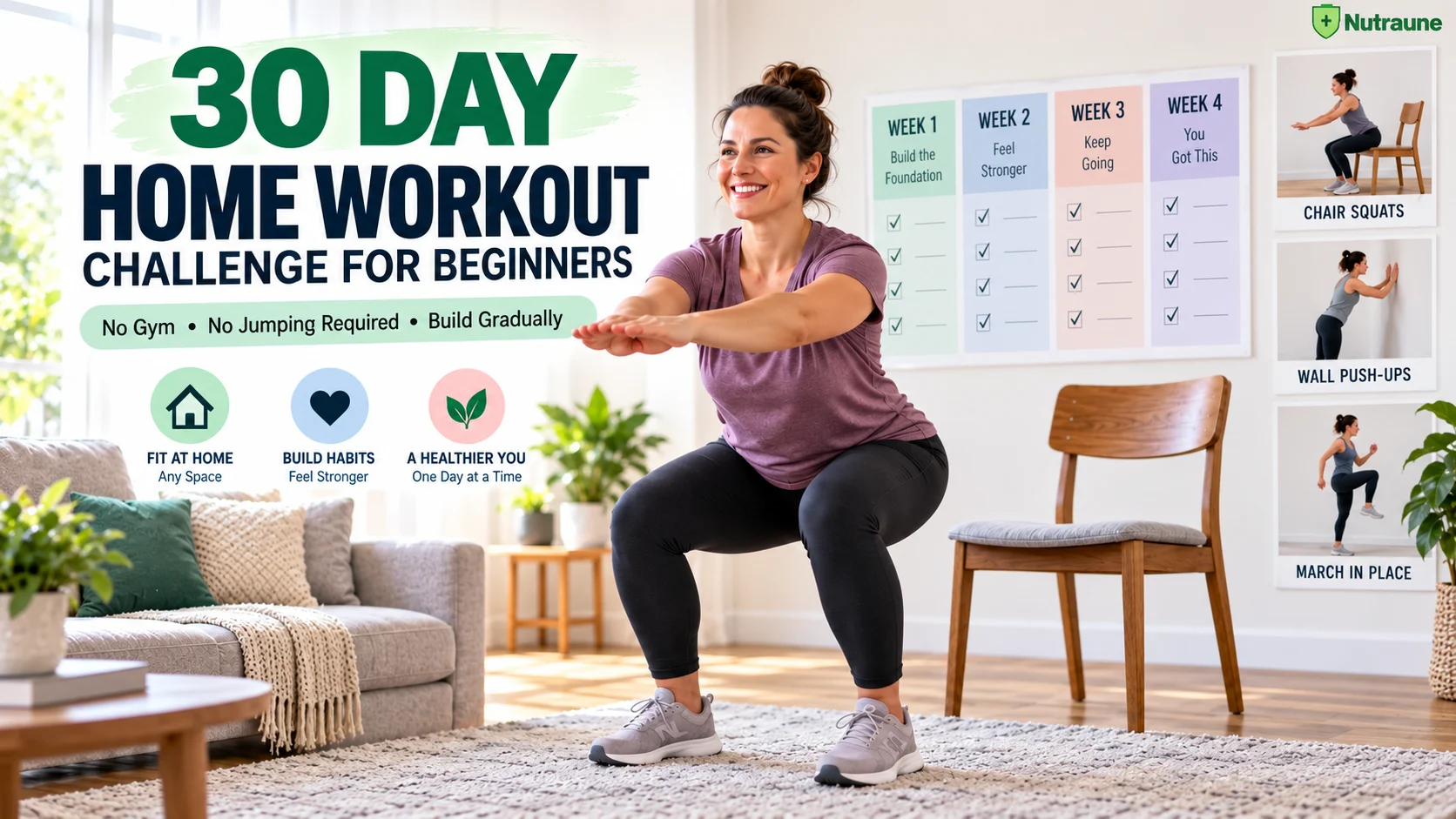
For a broader month-long progression after you establish your walking routine, continue with Nutraure’s 30-day fitness challenge for beginners.
FAQ
How long should a beginner walk for exercise?
A complete beginner can start with 10–20 minutes per session and increase gradually. There is no need to start at 30 or 60 minutes if that makes the routine difficult to repeat.
How many days a week should a beginner walk?
Three to four planned walks per week is a reasonable starting structure for many beginners. As your body adapts, you can add time or an additional walking day.
Is 20 minutes of walking enough for a beginner?
Yes. Twenty minutes can be a useful beginner workout, particularly when you’re transitioning from very little structured activity. Over time, gradually build toward the broader weekly physical-activity recommendations.
What is a good walking pace for beginners?
Use effort rather than forcing a speed. At moderate intensity, you should generally be able to talk but not sing, according to the CDC.
Do I need to walk 10,000 steps every day?
No. Ten thousand steps is not a universal minimum. Recent research indicates that health associations appear at substantially lower step counts and continue to vary by outcome and population studied.
Can I do a walking workout every day?
Some people can comfortably walk every day, but a beginner doesn’t have to. Mixing structured walks with easier days or rest days can make progression more manageable.
Is treadmill walking good for beginners?
Yes. A treadmill can be especially useful when weather, traffic, lighting, or uneven surfaces make outdoor walking inconvenient. Begin at a comfortable speed and with little or no incline before increasing the difficulty.