Starting a workout routine can feel harder than the workout itself. You may think you need a gym membership, expensive equipment, or an hour of free time before exercise is worth doing. You don’t.
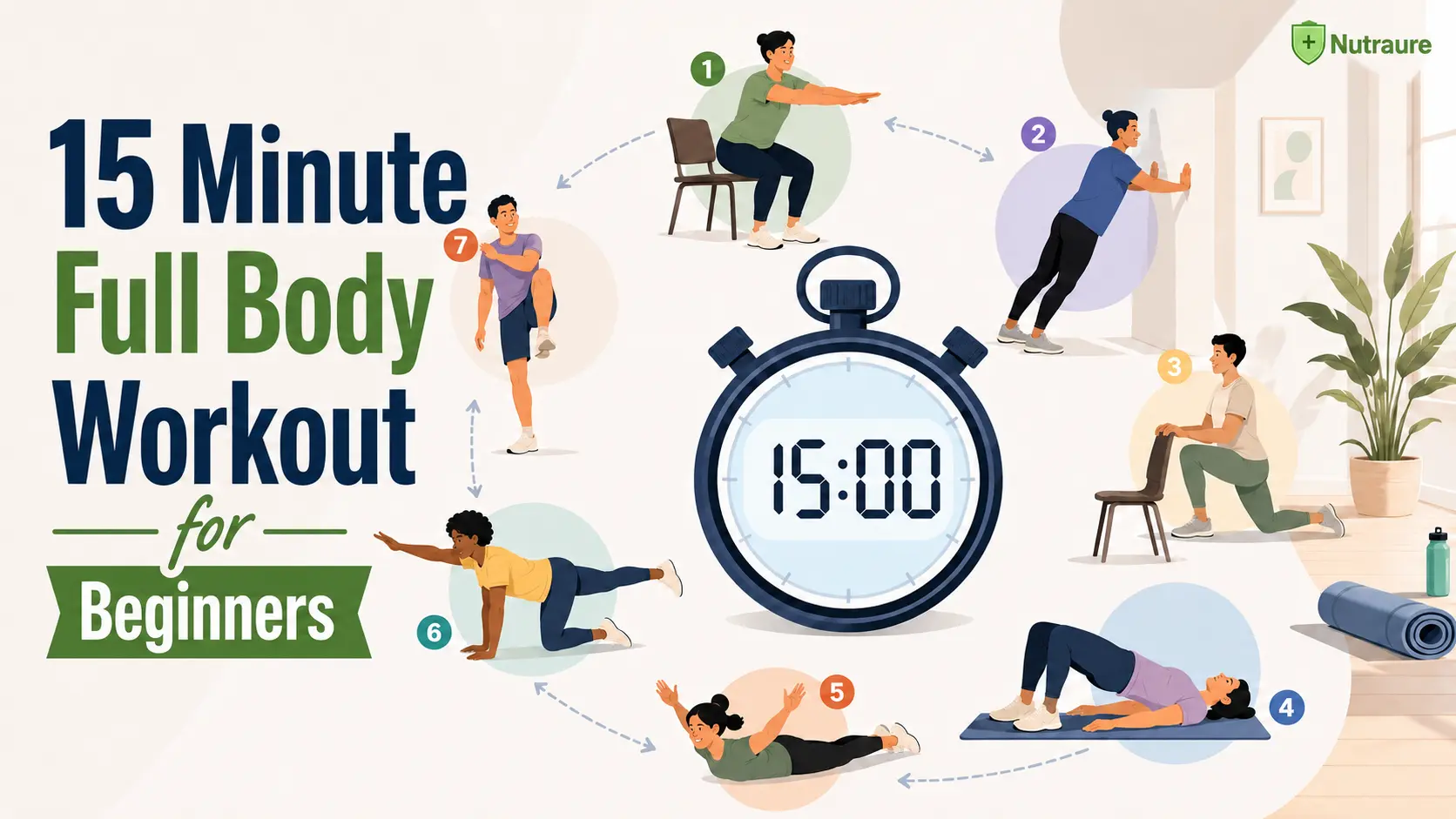
This 15 minute full body workout for beginners gives you a practical place to start. It uses seven simple bodyweight exercises to work your legs, glutes, chest, shoulders, upper back, and core—all from home.
There is no jumping, no complicated equipment, and no pressure to keep up with an advanced pace. You’ll work for 40 seconds, take 10 seconds to transition, and use easier variations whenever you need them.
The goal isn’t to finish exhausted. It’s to finish feeling like you can come back and do it again.
Your 15-Minute Beginner Workout at a Glance
This is a full body workout at home, so you don’t need to spend time setting up a home gym.
What You’ll Need
Keep it simple:
- Comfortable clothes
- A little open floor space
- A stable chair, wall, or countertop
- An exercise mat if you prefer one
- Water nearby
- A phone or interval timer
You won’t need dumbbells, resistance bands, or gym machines. A chair or wall is only there to make some movements more beginner-friendly.
The Exact 15-Minute Timer
Here’s how the entire routine fits into 15 minutes:
| Workout Phase | Time |
|---|---|
| Warm-up | 2:00 |
| 7 exercises × 2 rounds | 11:40 |
| Cooldown | 1:20 |
| Total | 15:00 |
For the main circuit, complete each movement for 40 seconds, then rest for 10 seconds before changing positions.
After all seven exercises, start at Exercise #1 and complete the circuit one more time.

Why This 15-Minute Full Body Workout Works for Beginners
A short workout doesn’t have to be one you can easily ignore.
The biggest advantage of starting with 15 minutes is that it lowers the barrier to getting moving. Instead of waiting for the perfect day when you have an uninterrupted hour, you have a routine that can fit into a busy morning, lunch break, or evening.
Short Workouts Still Count
Fifteen minutes shouldn’t be viewed as a magic number or as all the exercise you’ll ever need. It’s better viewed as a manageable starting point.
The CDC physical activity guidelines recommend that adults aim for at least 150 minutes of moderate-intensity aerobic activity per week, along with muscle-strengthening activities on at least two days. The CDC also notes that activity can be spread throughout the week and broken into smaller chunks.
So, if you’re currently doing very little structured exercise, a short workout for beginners can help you begin building a repeatable habit rather than trying to change everything on day one.
Full-Body Exercises Make Good Use of Limited Time
Rather than spending 15 minutes on one small muscle group, this beginner routine includes movements for your:
- Quadriceps and hamstrings
- Glutes
- Chest
- Shoulders
- Upper back
- Arms
- Core
That makes it a practical beginner strength workout when time and equipment are limited.
Simple Is a Feature, Not a Flaw
You don’t need a new routine every day.
The American College of Sports Medicine’s updated resistance-training guidance emphasises regular participation, individualisation, and consistent training of major muscle groups rather than chasing unnecessarily complicated programs.
For a beginner, repeating a few basic movements also gives you time to learn them.
Before You Start: 3 Beginner Rules
Before starting the timer, keep three things in mind.
1. Start With the Easiest Version
You don’t earn extra points for choosing the hardest variation.
If a wall push-up gives you better control than a floor push-up, use the wall. If a full reverse lunge feels unstable, hold a chair and shorten the movement.
Modifications aren’t a sign that the workout isn’t working. They’re how you match the exercise to your current ability.
2. Move Slowly Enough to Control Each Rep
For this workout, form matters more than speed.
You don’t need to squeeze as many repetitions as possible into each 40-second interval. Move at a pace that lets you stay balanced, breathe steadily, and maintain control.
When that becomes easy, you have room to progress.
3. Don’t Push Through Sharp or Unusual Pain
Working muscles can feel challenged, and your breathing may become faster. Sharp, sudden, worsening, or unusual pain is different.
Stop the exercise if something feels wrong rather than trying to push through it.
If you have a chronic health condition, an existing injury, a significant mobility limitation, or have been advised to restrict exercise, getting individualised advice from a qualified healthcare professional may be appropriate before starting a new routine. The CDC gives similar guidance for people managing chronic conditions.
15 Minute Full Body Workout for Beginners: 7 Easy Moves
Here is the complete routine.
Work: 40 seconds
Transition: 10 seconds
Rounds: 2
Equipment: No specialist exercise equipment
Jumping: None required
Don’t worry about counting repetitions. Concentrate on moving well for the full interval.

2-Minute Warm-Up
Start by preparing your body to move.
The Mayo Clinic’s warm-up guidance recommends beginning an activity at a slower, easier pace so your body can gradually transition into exercise.
First 60 seconds: March in place
Stand tall and begin marching gently. Let your arms swing naturally and gradually increase your pace without turning it into a sprint.
Next 30 seconds: Arm circles
Extend your arms comfortably and make small controlled circles. Change direction halfway through.
Final 30 seconds: Hip hinges
Stand with your feet comfortably apart. Soften your knees, push your hips backwards, keep your torso controlled, then return to standing.
Now you’re ready for the circuit.
Easy Win #1 — Chair Squat
Targets: Quads, glutes, and core
Stand directly in front of a stable chair with your feet roughly hip- to shoulder-width apart.
Push your hips back as if you’re about to sit down. Bend your knees comfortably and lower yourself until you lightly touch or sit on the chair. Press through your feet and return to standing.
Keep the movement controlled rather than dropping onto the seat.
Make it easier: Use a higher chair or reduce how far you lower.
Make it harder later: Perform a bodyweight squat without touching the chair.
Watch for: Knees collapsing noticeably inward or losing control on the way down.
Easy Win #2 — Wall or Incline Push-Up
Targets: Chest, shoulders, triceps, and core
A wall or incline push-up lets you practice the same basic pushing movement without immediately asking your body to handle a floor push-up.
Place your hands against a wall or stable countertop, slightly wider than shoulder-width.
Step back until your body forms a comfortable straight line. Bend your elbows and bring your chest toward the surface. Then press away until your arms straighten.
Make it easier: Use a wall and stand more upright.
Progress gradually: Wall → countertop → lower stable surface → floor.
Watch for: Hips sagging or your head reaching forward before the rest of your body.
Easy Win #3 — Supported Reverse Lunge
Targets: Quads, glutes, hamstrings, and balance
Stand beside a stable chair or countertop so you can use it for support.
Step one foot backwards and lower only as far as feels controlled. Push through the front foot to return to standing, then repeat on the other side.
You don’t need to make the lunge deep.
Make it easier: Step one foot backwards, tap your toes to the floor, then return without lowering into a full lunge.
Watch for: Placing one foot directly behind the other like you’re balancing on a tightrope. A little width between the feet generally makes balancing easier.
Easy Win #4 — Glute Bridge
Targets: Glutes, hamstrings, and core
Lie on your back with your knees bent and feet planted comfortably on the floor.
Gently brace your midsection. Press your feet into the floor and lift your hips until you reach a comfortable position. Pause briefly, squeeze your glutes, and lower yourself with control.
The goal isn’t to lift your hips as high as possible.
Make it easier: Use a smaller range of motion.
Progress gradually: Take two or three seconds to lower your hips.
Watch for: Forcing the movement by excessively arching your lower back.
Easy Win #5 — Prone W Raise
Targets: Upper back and rear shoulders
Lie face down with your arms bent so your upper body forms a loose “W.”
Keep your neck neutral instead of lifting your chin. Gently raise your hands and elbows a small distance while drawing your shoulder blades toward each other. Lower slowly.
This movement doesn’t require a large range of motion.
Make it easier: Keep the lift very small.
Floor-free alternative: Perform standing wall slides instead.
Watch for: Shrugging your shoulders toward your ears or aggressively lifting your chest.
Easy Win #6 — Bird Dog
Targets: Core, glutes, back stabilisers, and coordination
Start on your hands and knees, with hands beneath your shoulders and knees beneath your hips.
Slowly extend one arm forward while extending the opposite leg behind you. Keep your torso as steady as possible.
Return to your starting position and switch sides.
Think about creating length rather than trying to lift your arm and leg as high as possible.
Make it easier: Move only one arm or one leg at a time.
Progress gradually: Hold the extended position for two seconds.
Watch for: Rotating your hips or arching your lower back to create extra range.
Easy Win #7 — Standing Cross-Body Knee Drive
Targets: Core, hips, legs, and shoulders
Finish the circuit standing.
Reach your arms overhead or comfortably upward. Raise one knee while bringing your hands toward the opposite side of your body. Return to standing and alternate sides.
Keep the movement smooth and controlled.
This adds a gentle cardiovascular element without turning the workout into a jumping routine.
Make it easier: Perform a slow standing march.
Make it harder later: Gradually increase your pace while maintaining control.
Repeat the Circuit Once
You’ve finished Round 1. Now return to the chair squat and repeat all seven exercises.
There’s no need to beat your first-round repetition count.
Instead, ask yourself:
- Can I make the movement smoother?
- Can I keep a better balance?
- Can I breathe more consistently?
- Can I maintain control for the full 40 seconds?
Those are worthwhile forms of progress too.
Finish With an 80-Second Cooldown
For the first 40 seconds, walk or march slowly and let your breathing settle.
For the final 40 seconds, continue moving gently while relaxing your shoulders and taking slower breaths.
Cooling down by gradually reducing exercise intensity gives your cardiovascular system time to transition out of the workout.
Make Any Move Easier: Beginner Exercise Modifications
Some exercises will naturally feel easier than others. That’s normal.
You don’t have to abandon the whole low-impact full-body workout because one movement doesn’t work for you.

If Squats or Lunges Feel Too Difficult
Try one change at a time:
- Use a higher chair for squats.
- Reduce your squat depth.
- Hold a stable support.
- Replace reverse lunges with step-back toe taps.
- Move more slowly.
If Push-Ups Feel Too Difficult
Change the angle rather than forcing repetitions.
Start with:
Wall → countertop → lower stable surface
Move to a more challenging level only when the current version feels controlled.
If Floor Exercises Aren’t Comfortable
You also have options:
- Bird dog: Standing opposite arm-and-leg reach
- Prone W raise: Standing wall slide
- Glute bridge: Controlled standing hip hinge
These substitutions also make the routine easier to adapt for people who prefer a beginner workout without jumping or getting repeatedly on and off the floor.
Your Simple 4-Week Beginner Progression
One good workout doesn’t have to become ten different workouts.
For your first month, consider keeping the same basic routine and changing only what your body is ready to handle.

Week 1 — Learn
Aim for two sessions.
Your only priorities are learning the exercise order, practising the movements, and finding the variations that feel manageable.
Week 2 — Repeat
Complete two or three sessions, depending on how you feel and recover.
Try to make transitions less rushed and your repetitions more consistent.
Week 3 — Progress One Thing
Complete two or three sessions.
Instead of making every exercise harder, choose one small progression:
- Squat slightly lower if comfortable.
- Use a lower surface for push-ups.
- Pause longer during bird dogs.
- Slow the lowering portion of your glute bridge.
Week 4 — Build the Habit
If you’re recovering well, aim for three sessions.
You can also add walking or another form of activity you enjoy on other days.
This approach fits the broader principle in ACSM’s current guidance: a sustainable resistance-training routine that you can consistently perform is more useful than an unnecessarily complex plan you don’t maintain.
5 Mistakes Beginners Should Avoid
1. Starting Too Fast
Your first workout doesn’t need to prove anything. Choose a pace that leaves you able to control the final repetition as well as the first.
2. Copying the Hardest Variation
Use the exercise version that matches your current ability—not the version that looks most impressive.
3. Sacrificing Form for More Reps
The timer tells you how long to move. It doesn’t tell you to race.
4. Ignoring Recovery
Doing more isn’t automatically better. Your body needs time between challenging strength sessions.
5. Changing the Routine Constantly
Repeating basic movements gives you an opportunity to notice whether your balance, control, range of motion, or confidence is improving.
Frequently Asked Questions
Is a 15 minute full body workout enough for beginners?
A 15-minute workout can be a useful starting point, particularly if you’re moving from little structured exercise toward a more active routine.
However, it shouldn’t be interpreted as the total amount of weekly activity every adult needs. Current CDC guidelines recommend at least 150 minutes of moderate-intensity aerobic activity per week and muscle-strengthening activity on at least two days.
How many times a week should beginners do this workout?
For many beginners, two to three non-consecutive sessions per week can be a practical starting structure, with the exact frequency adjusted for ability, recovery, and other activity.
ACSM’s current resistance-training guidance places particular emphasis on training major muscle groups at least twice per week and choosing a program you can maintain.
Do I need equipment for this workout?
No specialist workout equipment is required.
A wall, stable countertop, or sturdy chair is useful for modifications, and an exercise mat is optional.
That makes this a practical 15 minute full body workout for beginners with no equipment beyond ordinary household support.
Can I do this workout without jumping?
Yes. None of the seven exercises requires jumping.
If the standing cross-body knee drive feels too fast, replace it with a comfortable march in place.
Can a 15-minute workout help with weight loss?
Exercise can contribute to the energy your body uses and is one part of weight management, but no 15-minute routine can guarantee weight loss.
The amount of physical activity needed for weight management differs from person to person, and nutrition, total activity, sleep, health, and other factors can also matter. The CDC notes that some people may need more than the general minimum activity recommendations for weight management.
Avoid judging this routine only by calories burned. Improvements in consistency, movement quality, strength, and confidence matter too.
What if I can’t do push-ups or lunges?
Use the easier versions.
Try a wall push-up instead of a lower incline push-up and a supported step-back toe tap instead of a full reverse lunge.
Progress only when you can perform the current version with good control.
Start With 15 Minutes and Keep Going
Starting doesn’t have to mean completely overhauling your life.
This 15 minute full body workout for beginners gives you seven manageable movements, an exact timer, no-jumping options, and clear ways to make exercises easier or harder as your ability changes.
Your first goal isn’t perfection. It’s consistency.
Learn the movements. Repeat them. Notice what gets easier. Then progress gradually rather than making the routine unnecessarily complicated.
If 15 minutes feels manageable today, that’s a useful first step.
Save the workout, schedule your first two sessions, and focus on making your next round a little more controlled than your last one.