
Starting exercise becomes much easier when you do not have to decide what to do every morning.
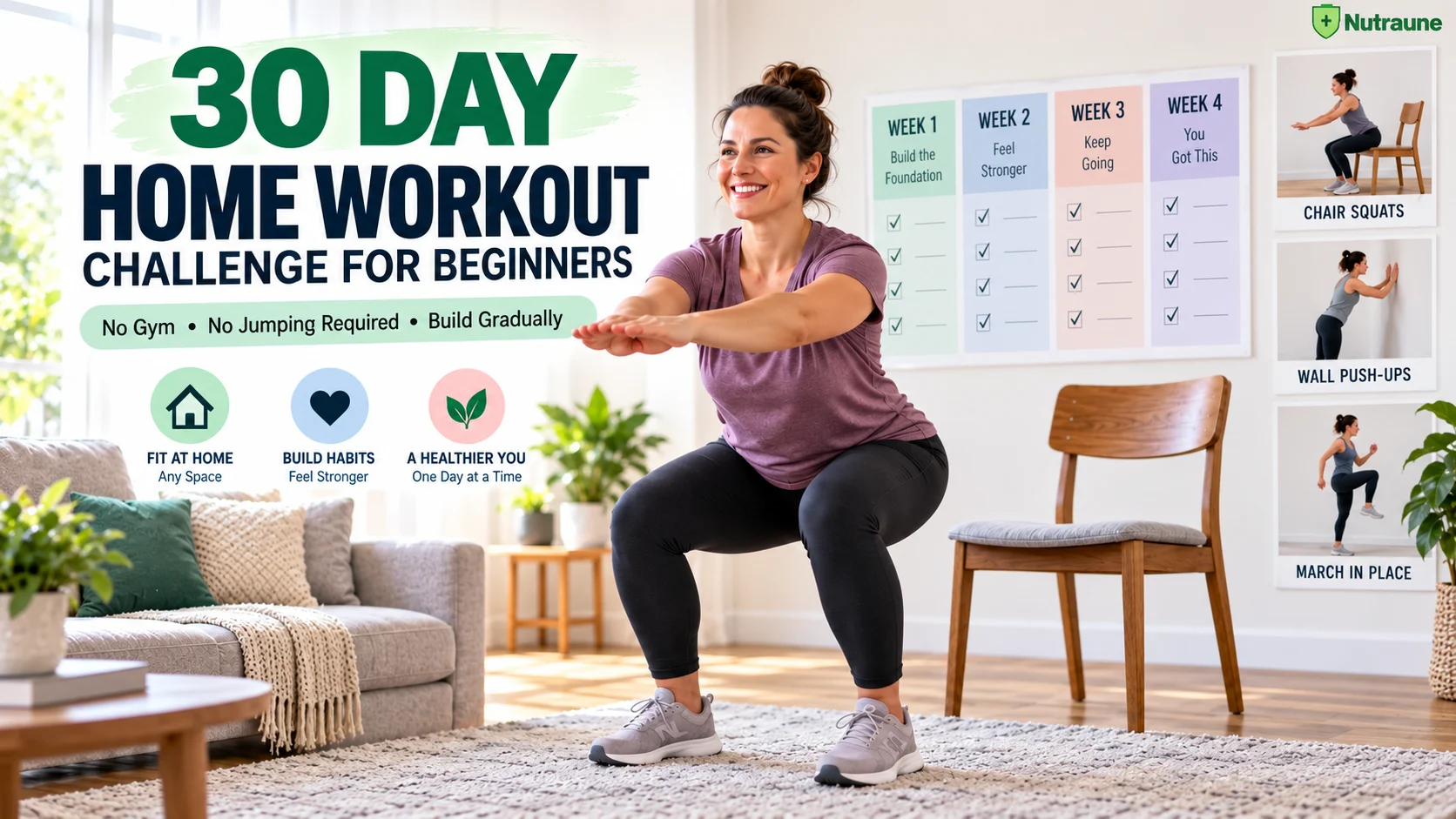
This 30 day home workout challenge for beginners gives you a simple plan for the next month using bodyweight movements, walking or marching, mobility work, and planned recovery. You do not need a gym, and jumping is not required.
The challenge starts deliberately easy. Over four weeks, you will gradually increase repetitions, time, rounds, or move to slightly harder exercise variations. You will not increase everything at once.
The goal is also more realistic than a 30-day “body transformation.” Use this month to learn basic movement patterns, improve your exercise tolerance, become stronger,r and establish a routine you can continue on Day 31.
The plan at a glance
| Detail | Plan |
|---|---|
| Fitness level | Complete beginner |
| Duration | 30 days |
| Main workout | About 10–22 minutes |
| Warm-up | About 5 minutes |
| Equipment | None required |
| Optional | Sturdy chair, wall/counter, mat |
| Jumping | Not required |
| Training | Strength + low-impact cardio + mobility |
| Recovery | Built into the calendar |
| Main goal | Build a repeatable fitness routine |

Before You Start the 30-Day Challenge
You need surprisingly little preparation. Ensure clear floor space to move without hitting furniture, wear clothes that allow comfortable movement, and keep a stable chair or wall nearby for support.
A mat is useful for floor exercises but not essential.
This plan is written for generally healthy adults who are new to exercise or restarting after a long break. If you have an injury, have recently had surgery, are pregnant or postpartum, have a chronic health condition that affects exercise, or have been told to restrict physical activity, use professional guidance appropriate to your circumstances instead of treating a generic internet plan as individualized medical advice.
Global physical-activity guidance encourages adults to be regularly active and to include both aerobic and muscle-strengthening activities. Inactive people do not need to reach every long-term target immediately; the first objective is to begin at an achievable level.
WHO physical activity recommendations
Record a simple Day 1 baseline
Do not perform an all-out fitness test. Instead, record a comfortable starting point:
- Controlled chair squats you can perform before technique deteriorates.
- Wall or counter push-ups that feel manageable.
- How long an elevated plank feels comfortable.
- How a five-minute walk or march feels.
- Your overall exercise effort from 0–10.
Repeat the same observations on Day 29. Better control or lower perceived effort can be progress even if your numbers barely change.
If 10 or 15 minutes already feels intimidating, Nutraure’s shorter 10-minute home workout for beginners can be your starting point.
How Hard Should a Beginner Exercise?
Most sessions should feel manageable rather than maximal.
A useful way to judge cardio effort is perceived exertion. CDC guidance describes moderate activity as roughly 5–6 on a 0–10 effort scale. The talk test provides an even simpler check: during moderate activity you should generally be able to talk, although singing would be difficult.
CDC guide to measuring physical activity intensity
For this challenge, there is no prize for reaching 8, 9, or 10 out of 10.
On strength movements, finish the set while your repetitions are still controlled. You do not need to train to complete muscular failure. ACSM’s 2026 resistance-training review emphasizes regular participation and individualized programs; it also notes that bodyweight and home-based resistance training can yield meaningful benefits and that advanced methods, such as training to failure, are often unnecessary for the average healthy adult.
ACSM 2026 resistance-training guidelines

How the 30-Day Home Workout Challenge Works
The month uses four phases.
| Week | Main objective | What changes |
|---|---|---|
| Week 1 | Learn | Find comfortable exercise variations |
| Week 2 | Build | Add a little volume or time |
| Week 3 | Progress | Add another round or modest progression |
| Week 4 | Consolidate | Perform the movements with better control and confidence |
The most important rule is:
Progress one thing at a time
You can increase:
repetitions OR duration OR rounds OR exercise difficulty.
Do not increase all four simultaneously.
For example, suppose you performed two rounds of eight wall push-ups on Friday, and they felt controlled. In your next session, you might perform 10 repetitions or move your hands to a slightly lower, stable surface.
You do not need to do both.
This creates a much more useful form of progressive overload for a beginner than turning every week into a punishment.

The Three Core Workouts
Instead of learning 30 different routines, you will repeat three simple workout types. Repetition helps you learn the movements and makes it easier to notice progress
Workout A: Full-Body Foundation
Complete one to three rounds depending on the week.
| Exercise | Starting target |
|---|---|
| Chair or bodyweight squat | 8–12 reps |
| Wall/counter push-up | 6–10 reps |
| Bodyweight hip hinge | 8–12 reps |
| Glute bridge | 8–12 reps |
| Bird dog | 5–8 each side |
| March in place | 45–60 sec |
Rest approximately 30–90 seconds when necessary.
Workout B: Legs + Core
| Exercise | Starting target |
|---|---|
| Supported reverse lunge | 4–8 each side |
| Chair squat | 8–12 |
| Calf raise | 8–15 |
| Glute bridge | 8–12 |
| Dead bug | 5–8 each side |
| Elevated plank | 10–30 sec |
If lunges are uncomfortable or balance is difficult, replace them with another set of controlled chair squats.
Workout C: Low-Impact Cardio
Cycle through:
- Easy marching.
- Side steps.
- Gentle knee lifts.
- Light shadow boxing.
- Easy walking.
Perform roughly 30–45 seconds of movement followed by 15–30 seconds at an easier pace. Keep the effort controlled rather than turning it into high-intensity interval training.
Use the talk test as your guide.
Spend roughly five minutes moving easily before the main workout. Marching, shoulder rolls, arm movements, shallow sit-to-stands, and easy hip movements work well.
30 Day Home Workout Challenge for Beginners: Full Calendar
Week 1 — Learn the Movements
Day 1 — Baseline + Workout A
Record your comfortable baseline, then complete one round of Workout A. Stop each exercise before your form becomes sloppy.
Day 2 — Easy Movement
Walk or march for 10–15 minutes. Keep the pace comfortable.
Day 3 — Workout B
Complete one round. Take generous rest between exercises.
Day 4 — Active Recovery
Walk easily for 10 minutes or spend a few minutes on gentle mobility.
Day 5 — Workout A
Complete one or two rounds depending on how you recovered from Day 1.
Day 6 — Workout C
Complete approximately 10 minutes of low-impact cardio.
Day 7 — Rest
No structured workout is required.
Week 2 — Build Consistency
Day 8 — Workout A
Complete two rounds. Only add repetitions if Week 1 felt controlled.
Day 9 — Cardio
Walk or march for approximately 15–20 minutes at an easy-to-moderate effort.
Day 10 — Workout B
Complete up to two rounds.
Day 11 — Active Recovery
Easy walking and gentle mobility.
Day 12 — Workout A
Two rounds. If wall push-ups have become easy, consider trying them against a secure counter instead.
Day 13 — Workout C
Complete in approximately 12–15 minutes.
Day 14 — Rest
Take a full recovery day.
If the first two weeks still feel difficult, there is no reason to rush ahead. Nutraure’s 7-day no-equipment workout for beginners can also be repeated as a simpler foundation.
Week 3 — Progress Gradually
Day 15 — Workout A
Complete two rounds; add a third only if the second remains controlled.
Day 16 — Workout C
Aim for roughly 15 minutes of low-impact cardio.
Day 17 — Workout B
Complete two rounds, or up to three if appropriate.
Day 18 — Active Recovery
Easy walking or mobility.
Day 19 — Workout A
Choose one small progression: a few additional repetitions, an extra round, or one harder exercise variation.
Day 20 — Cardio + Core
Complete 10–15 minutes of Workout C followed by one short round of dead bugs and bird dogs.
Day 21 — Rest
Take a full rest day.
Week 4 — Put It Together
Day 22 — Workout A
Complete up to three controlled rounds.
Day 23 — Workout C
Aim for approximately 18–20 minutes.
Day 24 — Workout B
Complete up to three rounds.
Day 25 — Active Recovery
Walk comfortably and spend several minutes moving your hips, shoulders, and ankles.
Day 26 — Workout A
Progress one movement only if your technique and recovery support it.
Day 27 — Workout C + Mobility
Complete about 20 minutes at a sustainable effort, followed by easy mobility.
Day 28 — Rest
No hard training.
Day 29 — Retest
Repeat your Day 1 baseline without turning it into an all-out competition.
Look for differences such as:
- More controlled repetitions.
- A lower feeling of effort.
- Better balance.
- Longer comfortable holds.
- Improved confidence with the movements.
Day 30 — Finish and Plan Day 31
Choose your favorite Workout A, B, or C, and complete a comfortable version of it.
Then decide what comes next.
Make Every Exercise Fit Your Current Level
The calendar is not a pass/fail test. Modify the exercise before abandoning the program.
| Movement | Scale down | Standard | Progress |
|---|---|---|---|
| Squat | Sit fully to chair | Chair-touch squat | Free bodyweight squat |
| Push-up | Wall | Counter/high incline | Lower incline |
| Lunge | Supported shallow step-back | Supported reverse lunge | Unsupported reverse lunge |
| Glute bridge | Shorter range | Standard bridge | Pause at top |
| Bird dog | One limb at a time | Opposite arm + leg | Longer controlled hold |
| Plank | Wall/elevated | Higher incline plank | Lower incline |
| Cardio | Slow march | Purposeful march | Brisker walk/march |
Do not rush toward the right-hand column simply because a new week begins.
Your body cannot read the calendar.

Should You Progress, Repeat or Scale Down?
Use this practical decision rule after a session.
Progress slightly when the workout feels comfortable, your technique remains controlled and recovery is normal.
Repeat the same level when the workout is challenging but controlled. Repeating a week is still progress.
Scale down when your form repeatedly breaks down, you cannot complete the intended work without rushing, or fatigue is significantly greater than expected.
Stop the workout if you experience concerning symptoms such as chest discomfort, dizziness/lightheadedness, or unusually severe shortness of breath. American Heart Association guidance identifies symptoms such as chest discomfort, dizziness, and unusual or extreme breathlessness as warning signs that require stopping exercise and seeking appropriate medical attention.
American Heart Association exercise warning signs

What Results Can You Expect After 30 Days?
A month is enough time to learn a great deal about your starting fitness level, but it is not a deadline for dramatically changing your body.
Useful signs of progress can include:
- Squats feeling smoother.
- More controlled push-ups.
- Walking at the same pace with less perceived effort.
- Better balance during lunges.
- Longer comfortable plank holds.
- Less confusion about what to do when exercising.
- Greater consistency.
Weight or appearance changes are much less predictable. Exercise can support weight management, but body weight is influenced by total activity, food intake, health, medications, sleep, and individual biology.
Do not judge the success of the challenge by whether a scale displays a particular number on Day 30.
There is another limitation worth understanding. A completely equipment-free routine can train squatting, pushing, hips, legs and core very effectively, but it becomes harder to progressively train pulling movements for the back without a suitable resistance band, dumbbell, cable or other safe setup.
That is one reason this program is best viewed as a starting block rather than your forever program.
What If You Miss a Workout?
Do not perform two hard sessions tomorrow to “make up” for one missed workout.
If you miss one day, continue when you can. If you miss several days, restart with a slightly easier session and see how your body responds.
Likewise, a recovery day is not a failed challenge day.
The challenge lasts 30 calendar days, but finishing it in 32 or 35 days because life interrupted the schedule does not erase the training you completed.
What should you do after Day 30?
You have several sensible options.
You can repeat the plan using slightly more repetitions or more challenging variations. You can gradually increase your walking or other aerobic activity. Or, if you enjoyed the strength sessions, move to a simple resistance program.
Nutraure’s 20-minute dumbbell workout for beginners is a logical next step because dumbbells make progressive resistance—and especially pulling exercises—much easier to program.
The most important result of the challenge is not being able to say you survived 30 workouts.
It is reaching Day 31 knowing what kind of exercise you can realistically continue.
Final Takeaway
A useful 30-day home workout challenge for beginners should make exercise clearer, not more intimidating.
Begin at the easiest variation you can control. Keep most sessions manageable. Take your recovery days. Progress only one variable at a time and repeat a level whenever you are not ready to advance.
Day 1 does not need to be impressive.
It needs to be repeatable.
FAQ
Can a beginner do this 30-day home workout challenge without equipment?
Yes. The plan primarily uses bodyweight exercises, walking, or marching. A wall, a stable counter, or a sturdy chair can make several exercises easier, but specialized fitness equipment is not required.
Should a beginner work out hard for all 30 days?
No. A 30-day challenge should not mean 30 consecutive hard workouts. This plan deliberately includes rest and active-recovery days.
How long should a beginner home workout last?
There is no universal minimum session length. In this plan, the main sessions start at around 10–15 minutes and gradually increase to approximately 20 minutes, plus preparation and recovery time. A shorter session is appropriate if that is what you can perform comfortably.
What if I cannot do a normal push-up?
Start against a wall. Once wall push-ups become comfortably controlled, move to a sturdy counter or another secure elevated surface. Lower the incline gradually rather than forcing floor push-ups.
Can this 30-day challenge help me lose weight?
It can increase your physical activity and support weight-management efforts, but it cannot guarantee a specific amount of weight loss. Total diet, daily activity, sleep, medications, health, and individual biology also affect body weight.
What if I miss three days?
Resume with an easier version of the next suitable workout rather than doubling up. You do not have to restart from Day 1 unless doing so would help you rebuild confidence.
Is muscle soreness normal for beginners?
Some unfamiliar muscle soreness can occur after beginning exercise, but soreness is not the goal of the program. Sharp pain, significant joint pain,n or concerning symptoms should not be treated as evidence that the workout is “working.”
What should I do after completing the 30 days?
Repeat the program with small progressions, gradually increase your aerobic activity, or introduce suitable resistance, such as dumbbells or bands. The best next program is one you can continue consistently.