Yes, fitness trackers can be worth it if the information they collect helps you move more, train smarter, or build healthier habits. But they aren’t equally accurate across all metrics, and wearing one doesn’t automatically improve your health. The real value depends on what you track, how you use the data, and whether the benefits justify the cost.
Fitness trackers have come a long way from simple step counters. Today’s wearable devices can monitor heart rate, workouts, sleep, GPS activity, recovery signals, estimated calories burned, and more.
That sounds useful. But it also raises a reasonable question: are fitness trackers worth it, or are they just another piece of technology that collects numbers you’ll eventually stop checking?
Research suggests the answer sits somewhere between the hype and the skepticism. Wearable activity trackers can help people increase physical activity, but their usefulness varies depending on the person, the goal, and the metric being measured. A 2022 systematic review of reviews found evidence that activity trackers can increase physical activity across different populations.
Here are seven things worth knowing before you spend your money.
Are Fitness Trackers Worth It? The Short Answer
For many people, yes—but only when the tracker solves an actual problem.
A fitness tracker is more likely to be worth buying if you:
- Need accountability to stay active
- Enjoy working toward measurable fitness goals
- Want to understand your activity or workout patterns
- Exercise regularly and want a record of your training
- Want to monitor longer-term trends such as steps or resting heart rate
- Are willing to change your behavior based on what the data shows.
It may be less useful if you already own a smartwatch that provides the same information, dislike wearing or charging devices, rarely review your health data, or expect every number on the screen to be perfectly accurate.
The simplest test is this:
Will the information change something you do?
If the answer is yes, a tracker can be valuable. If the answer is no, you’re mostly paying to collect data.
Worth It vs. Skip It
| A Tracker May Be Worth It If… | You May Want to Skip It If… |
|---|---|
| You want more daily accountability | You rarely look at fitness data |
| Goals motivate you | Tracking makes exercise feel stressful |
| You want to see activity trends | You expect medical-grade precision |
| You regularly log workouts | Your current smartwatch already does enough |
| You will act on the information | You mainly want an exact calorie-burn number |

1. Fitness Trackers Can Help You Move More
One of the strongest arguments for fitness trackers is also one of the simplest: seeing how much—or how little—you move can influence what you do next.
The 2022 umbrella review mentioned above evaluated systematic reviews and meta-analyses covering wearable activity trackers. It concluded that trackers can increase physical activity across various clinical and non-clinical populations.
That doesn’t mean putting a band on your wrist magically makes you fit.
The useful part is the feedback loop:
Measure → Notice → Set a goal → Act → Review
Imagine checking your tracker at 7 p.m. and realizing you’ve spent most of the day sitting. You might decide to take a 20-minute walk. Without that feedback, you may never have noticed.
That’s where many fitness tracker benefits begin. The device makes an invisible behavior—your everyday movement—visible.
The tracker doesn’t do the exercise for you
It’s easy to confuse measurement with progress.
Recording 6,000 steps doesn’t improve your fitness on its own. Neither does logging a workout, earning a badge, or closing an activity ring.
The tracker is a feedback tool. You still have to turn that feedback into action.
Truth #1: A fitness tracker becomes useful when its feedback gets you moving.
2. Fitness Tracker Accuracy Depends on What You Measure
When people ask, “Are fitness trackers accurate?”, there isn’t one honest yes-or-no answer.
Accuracy depends on the metric, device, activity, sensor placement, and conditions under which the measurement is taken.
A systematic review of commercially available wearables found that devices performed reasonably well for step counts and heart rate in many laboratory settings, while energy-expenditure estimates were much less reliable and performance varied by brand and activity.
A newer living umbrella review of wearable accuracy also found that accuracy differs substantially across biometric outcomes and devices.
Step counting: useful for activity trends
Step counts can be useful for answering practical questions:
- Am I moving more this month than last month?
- Which days am I most sedentary?
- Does working from home reduce my activity?
- Am I gradually increasing my daily movement?
The exact number matters less than many people think. Consistently tracking the same metric over time may be more useful than obsessing over whether you took exactly 8,742 steps.
Heart rate: useful, but context matters
Optical heart-rate sensors can provide useful information, particularly when you’re looking at patterns rather than treating every reading as a clinical measurement.
Research reviews have found relatively good performance of heart-rate measurement across many settings, but accuracy can vary with movement, exercise type, device, skin contact, and other factors.
That makes heart-rate data useful for fitness context while still leaving room for measurement error.
Calories burned: treat the number as an estimate
This is where expectations often get too high.
Fitness trackers estimate energy expenditure using sensor data and algorithms. They do not directly measure exactly how many calories your body burned.
Reviews of consumer wearables have repeatedly found energy-expenditure measurements less accurate than step and heart-rate measurements.
So instead of thinking:
“I burned exactly 713 calories.”
Think:
“This gives me a rough indication of how active that session was.”
That small change in mindset can prevent an estimated number of people from influencing eating or training decisions more than they deserve.
Sleep tracking: look for patterns, not a diagnosis
Sleep tracking can be interesting, particularly for noticing bedtime consistency, total sleep patterns, or changes over several nights.
But consumer wearables are not interchangeable with a sleep laboratory.
A 2024 study comparing three commercial devices with polysomnography found high sensitivity for detecting sleep but substantially greater variability in distinguishing individual sleep stages. A broader review similarly found continuing limitations in wearable sleep measurements.
Use your tracker to notice patterns—not to diagnose a sleep disorder.
| Metric | Most Useful For | How to Treat It |
| Steps | Daily and weekly activity trends | Useful trend |
| Heart rate | Exercise and resting trends | Useful with context |
| Sleep | Duration and routine patterns | Directional |
| Calories burned | Comparing activity levels | Rough estimate |
| Recovery/readiness | Guiding reflection | Device-dependent |

3. Trends Matter More Than Perfect Numbers
A fitness tracker doesn’t need to produce a flawless number every minute to tell you something useful.
This distinction matters because there are two different ways to think about wearable data:
Absolute accuracy: Is this individual measurement exactly correct?
Trend usefulness: Is the pattern consistent enough to help me notice a meaningful change?
Suppose your normal seven-day step average is around 5,000, and after changing your routine, the same tracker regularly shows 7,000.
Even if individual days aren’t measured with laboratory precision, that upward pattern may still tell you something useful about your behavior.
The same idea can apply to:
- seven-day step averages;
- resting heart-rate trends;
- workout frequency;
- sleep schedules;
- training volume; and
- recovery patterns.
Don’t let one score control your day
Wearable data can become less helpful when one poor result starts dictating how you feel.
If your tracker gives you a low sleep or recovery score but you feel energetic, consider the broader context rather than letting a single algorithmic score make the decision for you.
Your tracker has sensor data. You have context.
Both matter.
Truth #3: A consistent pattern is often more actionable than one isolated number.
4. A Fitness Tracker Can Motivate You—Until the Novelty Fades
Fitness trackers are designed around feedback.
Daily goals, streaks, progress bars, reminders, and activity summaries can make an otherwise vague goal such as “move more” feel measurable.
That can be motivating.
But there is an important difference between temporary motivation and a habit that survives after the excitement of buying a new device disappears.
Instead of depending on badges alone, turn your tracker into a simple behavior system:
Track → Notice → Choose → Act → Review
For example:
- Track: Your seven-day step average is 5,200.
- Notice: Most low-activity days happen when you work from home.
- Choose: Add a walk after lunch on home-office days.
- Act: Follow the plan for two weeks.
- Review: Check whether your average movement has increased.
Now the tracker isn’t merely showing numbers. It is helping you run a small experiment on your own routine.

Add your experience here: If you personally use a Fitbit, Garmin, ***** Watch, WHOOP, Oura Ring, pedometer or another tracker, add 2–4 sentences explaining one habit the data genuinely changed for you. If you don’t use one, leave personal experience out rather than inventing it.
Truth #4: Data becomes valuable when it leads to a useful decision.
5. Fitness Trackers Don’t Guarantee Weight Loss
A common reason people buy an activity tracker is weight management.
Can a fitness tracker help? Potentially.
Can it guarantee weight loss? No.
Research in this area is mixed. Some reviews have found that wearable-supported interventions can contribute to weight and physical-activity improvements in certain populations, while a major randomized clinical trial found that adding wearable technology to a behavioral weight-loss program did not produce greater weight loss than the standard intervention.
That distinction is important.
What a tracker can help you do
A wearable may help you:
- Notice low-activity days;
- Log exercise consistently;
- Set movement targets;
- Monitor training frequency;
- See progress over time; and
- Stay accountable to a routine.
What it can’t do for you
A fitness tracker cannot:
- automatically create sustainable eating habits;
- guarantee a calorie deficit;
- measure calorie expenditure with perfect accuracy;
- replace exercise programming or nutrition decisions; or
- Guarantee a particular body-weight outcome.
If weight loss is your goal, view the tracker as one behavior-support tool, not the solution itself.
Truth #5: Tracking can support weight-management behaviors, but wearing a tracker doesn’t cause weight loss.
6. The Real Cost Includes More Than the Device
When asking whether fitness trackers are worth the money, don’t look only at the price on the box.
Think about the total cost of owning and using the device.
That can include:
- the original purchase price;
- optional or required subscriptions;
- replacement straps or accessories;
- charging and battery-life inconvenience;
- dependence on a companion phone app;
- premium features behind a paywall; and
- eventually replacing or upgrading the device.
A $100 tracker that does everything you need may provide more value than a $500 wearable filled with metrics you’ll never use.
The opposite can also be true. If an expensive device gives a serious runner or cyclist the training information they review every day, the higher price may be easier to justify.
Privacy is part of the decision too
Wearables can collect personal information related to activity, sleep, heart rate, workouts, location, and other wellness signals.
That doesn’t automatically make fitness trackers unsafe, but it does mean privacy policies and app permissions deserve attention.
The Federal Trade Commission has updated rules covering certain health apps and connected technologies that handle health information, including technologies outside traditional HIPAA-covered healthcare settings. You can read the FTC’s health-app privacy guidance for more context.
Before buying a device, ask:
- What information does the app collect?
- Is GPS tracking optional?
- Can I delete my account and data?
- Which features require a subscription?
- Can I disable metrics I don’t want to track?
Truth #6: Compare the total value of the tracker—not just its purchase price.
7. Whether a Fitness Tracker Is Worth It Depends on You
There isn’t one ideal wearable for everyone because people buy trackers for different reasons.
Are fitness trackers worth it for beginners?
They can be.
A beginner who wants to walk more may get plenty of value from step counts, activity reminders, and a weekly progress summary.
In that situation, dozens of advanced recovery metrics may add complexity rather than value.
Are they worth it for regular gym users?
Possibly, especially if you want a consistent record of:
- workout frequency;
- exercise duration;
- heart-rate trends;
- cardio sessions; or
- General activity outside the gym.
Again, the question is whether you’re going to use the information.
What about serious athletes?
More advanced wearables can be useful for people who deliberately use GPS, pace, heart rate, training load, or recovery data as part of their training.
But advanced data doesn’t eliminate measurement limitations. The more important a number is to your training, the more important it is to understand how that metric is measured.
What if you already own a smartwatch?
You may not need a separate fitness tracker.
If your current watch already covers the steps, workouts, heart rate, and activity information you care about, buying another device could duplicate your data.
A dedicated tracker makes more sense when it offers something your current setup lacks—perhaps longer battery life, simpler tracking, comfort, sport-specific features, or a less distracting interface.
Truth #7: The best fitness tracker is not the one with the most data. It’s the one that gives you information you’ll actually use.
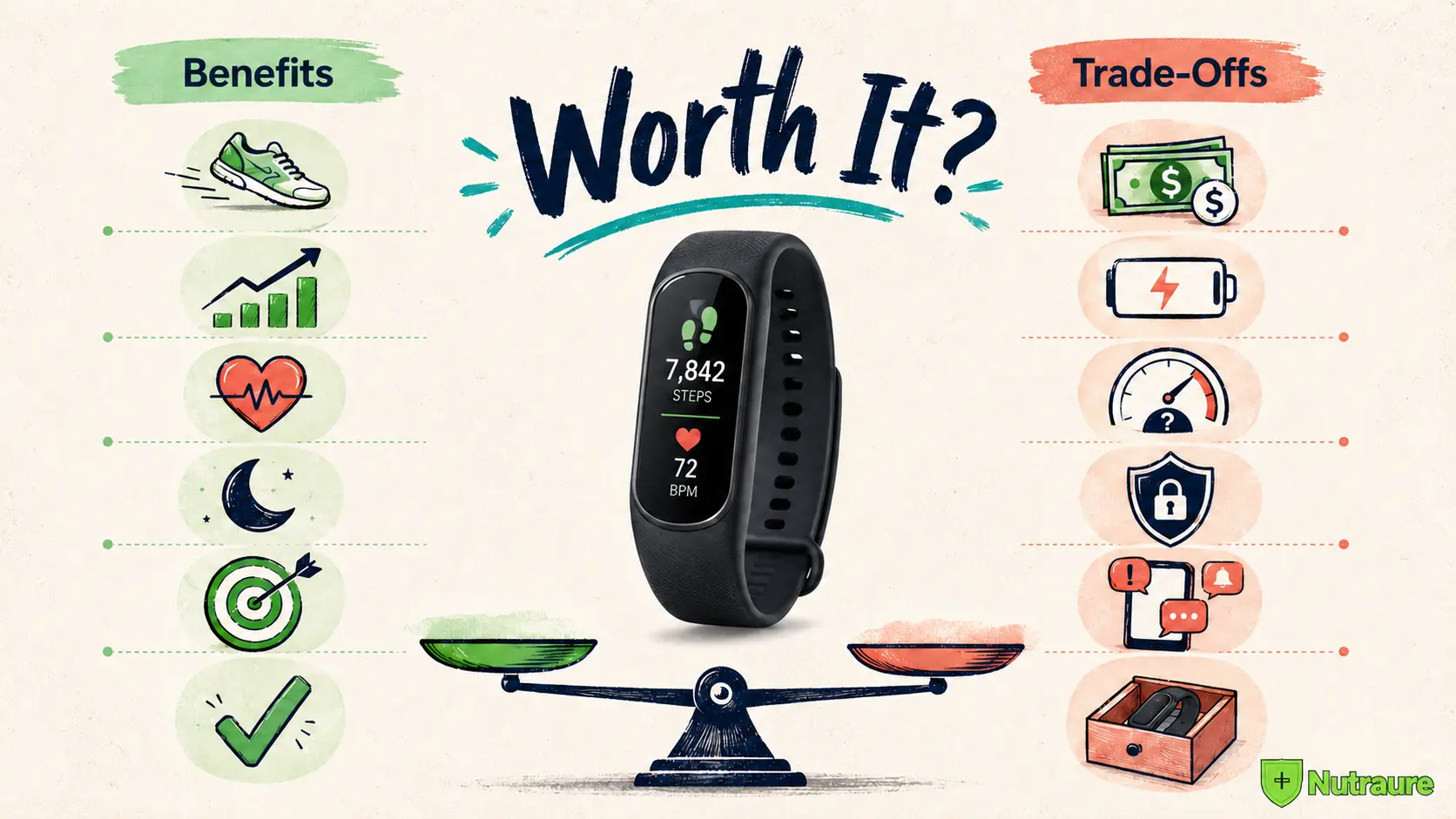
Fitness Tracker Pros and Cons at a Glance
| Potential Benefits | Potential Drawbacks |
| Makes daily activity visible | Measurements aren’t equally accurate |
| Provides measurable goals | Adds another device to charge |
| Can increase accountability | Some features may require subscriptions |
| Stores workout history | Too much data can become distracting |
| Helps reveal longer-term patterns | Privacy needs consideration |
| Makes progress easier to review | May duplicate smartwatch features |
| Can encourage more movement | Doesn’t create healthy habits by itself |
How to Make a Fitness Tracker Worth the Money
If you decide to buy one, resist the temptation to track everything from day one.
Try this instead:
- Choose one main goal. Decide whether you’re trying to move more, improve workout consistency, monitor running, or understand sleep patterns.
- Pick the metrics connected to that goal. More data is not automatically better.
- Establish a baseline. Watch your normal pattern before trying to change it.
- Review trends weekly. Don’t react emotionally to every single reading.
- Turn one number into one action. Low weekday steps? Schedule a walk.
- Disable unnecessary alerts. Your tracker should support your day, not constantly interrupt it.
- Review privacy settings. Share only the information you’re comfortable sharing.
- Reassess after a month or two. If the data isn’t changing anything you do, ask whether you still need to track it.

Frequently Asked Questions
Are fitness trackers actually worth it?
Fitness trackers can be worth it if tracking activity, workouts, or health trends helps you make better decisions or stay consistent. They provide less value when the data is rarely checked, when they duplicate another device, or when they create stress without changing behavior.
Are fitness trackers accurate?
Fitness tracker accuracy varies by metric and device. Research generally supports better performance for steps and heart rate than for estimating energy expenditure, while sleep-stage accuracy remains imperfect. Use most consumer metrics as practical guidance rather than assuming every reading is exact.
Do fitness trackers help you lose weight?
They can support weight-management behaviors, such as increasing activity awareness and monitoring exercise. However, research does not show that simply adding a wearable guarantees additional weight loss.
Are cheap fitness trackers worth it?
They can be if your needs are simple. Someone mainly interested in steps, basic activity tracking, and reminders may not need an expensive device. Compare the specific features, accuracy evidence, app experience, battery life,e and subscription requirements rather than assuming a higher price always means better value.
Is a fitness tracker better than a smartwatch?
Neither is automatically better. A dedicated fitness tracker may suit someone who prioritizes activity tracking, simplicity,y and battery life. A smartwatch may make more sense if you also want apps, communication, notifications, and broader phone-like features.
Can fitness trackers cause anxiety?
For some people, constant goals, scores, or health measurements can become distracting or stressful. Research has also identified associations between certain forms of fitness/calorie tracking and eating-disorder symptomatology, although association does not prove that trackers caused those symptoms. If tracking starts controlling your mood or behavior, reducing notifications or stopping certain metrics may be more helpful than collecting more data.
Final Verdict: So, Are Fitness Trackers Worth It?
For the right person, fitness trackers are worth it.
They can make your activity visible, help you notice patterns, provide accountability, and give you useful feedback about your routine. Research also supports their ability to increase physical activity in many settings.
But a fitness tracker is not a shortcut to better health, and not every metric deserves the same level of trust.
Buy one if you have a clear reason to use the data. Skip it if you’re mainly buying because you feel you should be tracking more.
A fitness tracker isn’t valuable because it collects more information.
It’s valuable when the right information helps you make a better decision.